Industrial Hose Reels for Port and Terminal Equipment Maintenance
September 21, 2026 | Industrial Hose Reels
Ports and terminals operate a wide range of heavy equipment, including container cranes, reach stackers, forklifts, terminal tractors, conveyors, and other material-handling machinery. These machines require regular cleaning, lubrication, hydraulic servicing, and general maintenance to remain operational in demanding working environments.
Many of these maintenance tasks depend on flexible hoses for water, compressed air, hydraulic fluid, oil, or grease. When hoses are frequently deployed across maintenance areas, leaving them loosely coiled or on the ground can make handling more difficult and expose them to unnecessary abrasion, bending, and contamination. Industrial hose reels provide a controlled way to store, deploy, and retrieve these hoses at fixed service points, workshops, and equipment maintenance areas.
The appropriate hose reel for a port application depends on the service medium, hose dimensions, working pressure, required length, installation location, and environmental conditions.
Where Are Hose Reels Used in Ports and Terminals?
Hose reels can support several different maintenance operations throughout a port or terminal. The reel configuration should be matched to the specific equipment and service being performed.
Equipment Cleaning and Washdown
Water is widely used to clean port equipment and surrounding work areas. Cranes, forklifts, terminal vehicles, conveyors, and other machinery can accumulate dust, mud, cargo residue, and other contaminants during operation.
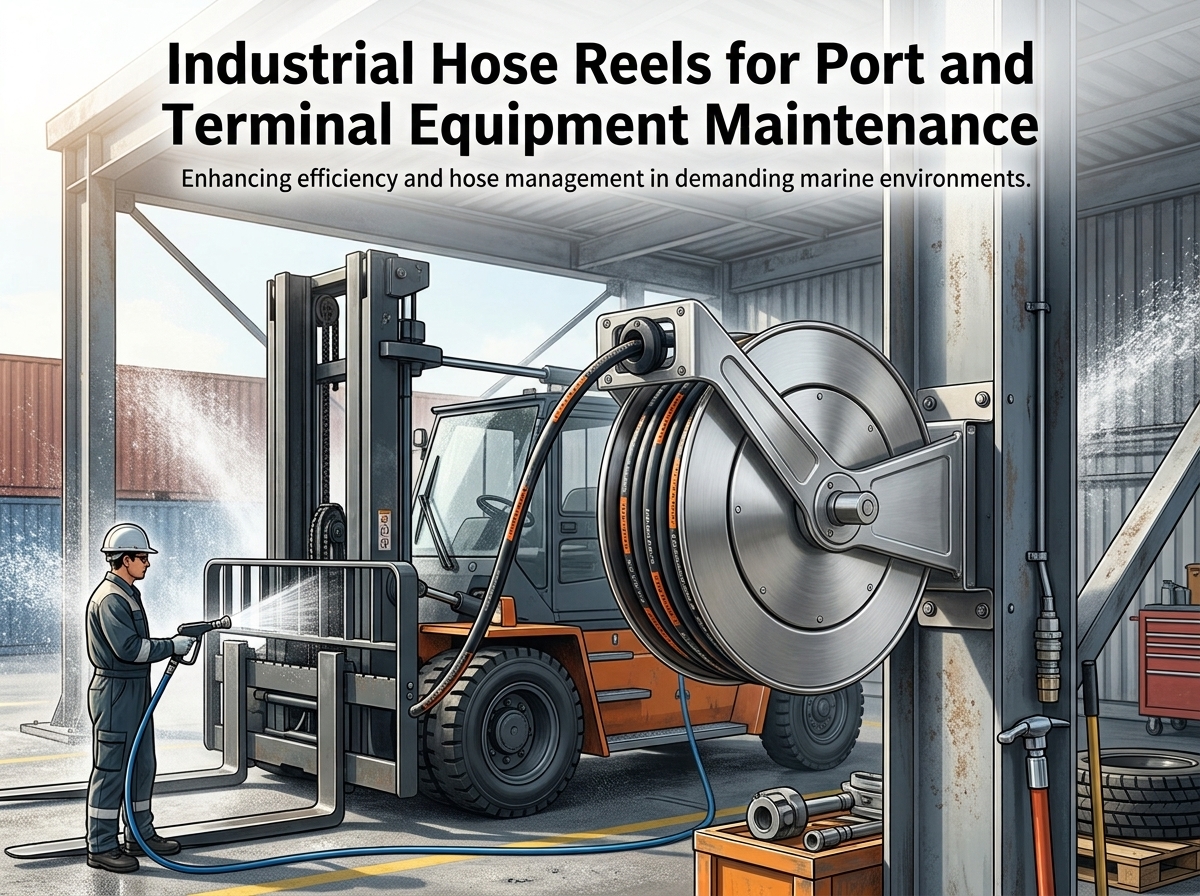
Water hose reels can be installed at designated washdown stations, allowing operators to extend the hose to the equipment being serviced and return it to the reel afterward. The required hose length should be based on the distance between the reel and the furthest cleaning point. A hose that is significantly longer than necessary can add unnecessary weight and capacity requirements, while insufficient length can restrict access.
For higher-pressure cleaning applications, the hose, reel, swivel, and fittings should be selected according to the required working pressure and water service conditions.
Hydraulic Equipment Maintenance
Hydraulic systems are common in port machinery, particularly in cranes, reach stackers, forklifts, and other material-handling equipment. Maintenance work may require hydraulic hoses to connect service equipment or provide hydraulic fluid at designated maintenance locations.
Hydraulic hose reels can help organize these hoses while allowing them to be extended when required. However, hydraulic applications require careful attention to technical specifications. Working pressure, hose inside diameter, outside diameter, temperature range, fittings, swivel specifications, and reel capacity should be considered together.
The reel must also have sufficient mechanical strength to support the selected hydraulic hose. A reel suitable for a lightweight air hose should not automatically be assumed to be suitable for a heavier high-pressure hydraulic hose.
Lubrication and Fluid Dispensing
Regular lubrication is essential for many types of port equipment. Bearings, moving components, and mechanical assemblies may require scheduled application of oil or grease.
Oil and grease hose reels can be positioned near maintenance bays or lubrication stations to provide a defined hose storage point. In these applications, compatibility between the fluid and the hose assembly is particularly important. Hose materials, seals, swivels, fittings, and other wetted components should be suitable for the oil or grease being handled.
The reel capacity should also be matched to the hose diameter and required working length so that the hose can be stored without excessive bending or overfilling the drum.
Compressed Air for Maintenance
Compressed air is commonly available in port maintenance workshops and can be used with pneumatic tools, cleaning equipment, and other service equipment.
Air hose reels provide a practical connection point where hoses are repeatedly deployed and returned. Spring-driven reels can automatically retract the hose after use, making them suitable for maintenance stations with frequent hose movement. Manual reels may be preferable where the hose is used less frequently or where a simple hand-operated mechanism is sufficient.
The hose and reel should be rated for the compressed-air system’s operating pressure and compatible with the intended application.
Environmental Requirements in Port Applications
Port environments can impose additional requirements on hose reel construction. Equipment may be exposed to salt spray, high humidity, rain, dust, sand, and changing outdoor temperatures.
Corrosion Resistance
Salt and moisture can accelerate corrosion of exposed metal components. For installations close to the sea or in areas with persistent humidity, corrosion resistance should be considered when selecting reel materials and surface treatments.
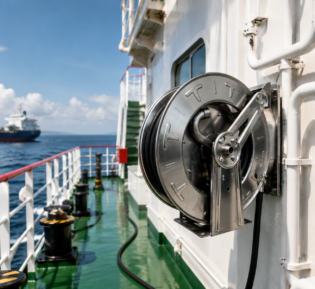
Stainless steel hose reels can be suitable for applications where corrosion resistance is an important consideration. Depending on the environment and project requirements, stainless steel construction can be used for the reel structure and other exposed components.
Material selection should be based on the actual exposure conditions rather than simply assuming that all port applications require the same level of corrosion resistance.
Dust and Contaminants
Bulk terminals and cargo-handling areas may generate considerable amounts of dust and other airborne contaminants. These materials can accumulate on mechanical components and affect maintenance requirements over time.
Where appropriate, enclosed or partially protected reel constructions can help limit exposure of internal components. The reel should also be positioned so that it is not directly exposed to unnecessary sources of contamination or mechanical impact.
Outdoor Installation
Hose reels installed outdoors need to account for rain, humidity, temperature fluctuations, and direct environmental exposure. The hose itself must also be suitable for the expected operating temperature and service medium.
The mounting structure is another consideration. A reel installed on a building or equipment structure must be securely supported, and the installation should allow the hose to move without excessive bending or contact with sharp edges.
How to Choose a Hose Reel for Port Applications
Choosing a hose reel should start with the service requirements rather than the reel mechanism.
Hose type and medium: Identify whether the application uses water, compressed air, hydraulic fluid, oil, or grease. The hose and reel assembly should be compatible with the intended medium.
Hose length and diameter: These determine the required reel capacity. The drum must accommodate the complete hose while maintaining an appropriate bending radius.
Working pressure: The pressure rating of the hose, swivel, fittings, and other pressure-bearing components should be suitable for the system. This is particularly important for hydraulic and high-pressure water applications.
Temperature: Consider both the ambient temperature and the temperature of the fluid being handled. The selected hose and reel components should be suitable for the expected operating range.
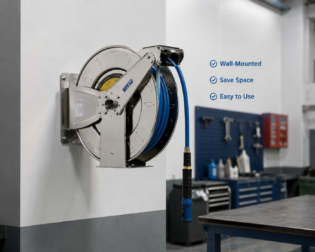
Installation method: Wall-mounted, ceiling-mounted, equipment-mounted, and mobile reels have different structural requirements. The direction of hose travel and available clearance should be considered before installation.
Frequency of use: Frequent deployment may justify a spring-driven or motor-driven reel, while occasional use may be adequately served by a manual reel.
Practical Hose Reel Configurations
Different maintenance points within the same terminal may require completely different reel configurations.
A water hose reel can be installed at an equipment washdown station for routine cleaning. A hydraulic hose reel may be positioned in a maintenance workshop serving hydraulic equipment. An air hose reel can provide compressed air for pneumatic tools, while an oil or grease hose reel can be integrated into a lubrication station.
For installations in marine environments, a stainless steel hose reel may be considered where corrosion resistance is an important requirement.
The objective is not to use one reel type throughout the entire facility. Instead, each reel should be matched to the hose, service medium, working conditions, and maintenance task at its installation point.
Installation and Routine Inspection
A correctly selected reel still requires proper installation. The mounting structure should be capable of supporting the reel and the forces generated when the hose is extended. The reel should be positioned so that the hose can move naturally toward the work area without excessive side loading, sharp bends, or abrasion.
Operators should also inspect hose reels regularly. Visible cuts, abrasion, leakage, deformation, damaged fittings, loose mounting hardware, and abnormal retraction should be addressed before they affect normal operation.
Swivels and other moving components should be checked according to the equipment’s maintenance requirements. In outdoor or corrosive environments, inspection intervals may need to reflect the actual exposure conditions.
Conclusion
Ports and terminals require different hose services across equipment maintenance, cleaning, lubrication, hydraulic servicing, and workshop operations. Industrial hose reels provide a structured way to manage these hoses at fixed service points and maintenance areas.
The right configuration depends on several factors, including the service medium, hose length and diameter, working pressure, temperature, reel capacity, installation method, drive mechanism, and environmental exposure. Water, air, hydraulic, oil, and grease applications each have different requirements, while marine environments may place greater emphasis on corrosion-resistant construction.
By matching the hose reel to the actual maintenance task and operating environment, ports and terminals can establish more controlled hose handling arrangements across workshops, equipment areas, and washdown stations.
Related Posts

Spring-Driven Hose Reels for Construction Sites
July 2, 2026
How to Choose the Right Sewer Jetter Reel for Your…
July 14, 2026