How Forklift Attachments Alter Hydraulic Hose Requirements
September 15, 2026 | Hydraulic hose reels
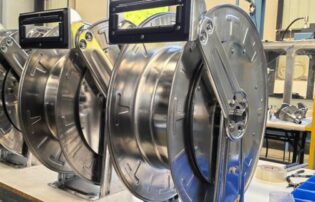
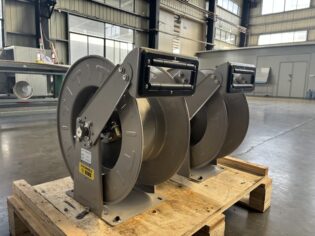
Forklifts are often equipped with various hydraulic attachments to handle loads that standard forks cannot manage efficiently. Attachments such as sideshifters, fork positioners, clamps, rotators, and paper roll clamps rely on hydraulic systems for power, yet they operate with distinct movement patterns. Consequently, the hydraulic hoses connected to these attachments face varying requirements regarding length, routing, range of motion, and protection. Hose routing suitable for standard lifting operations is not necessarily appropriate for forklifts equipped with hydraulic attachments. When attachments introduce lateral, repetitive, or rotational movements, the operational dynamics of the hydraulic hoses change. Therefore, configuring a forklift hydraulic hose reels requires consideration of the actual movement patterns of both the forklift and the attachment, rather than simply providing a storage space for excess hose.
Why Different Attachments Alter Hydraulic Hose Reel Requirements
Standard forklifts inherently possess multiple hydraulic functions. The mast moves vertically, and the forks can tilt forward or backward. Installing hydraulic attachments introduces additional movements into the system. For instance, a sideshifter allows the load to move laterally; a fork positioner adjusts the spacing between the forks; a hydraulic clamp repeatedly opens and closes; and a rotator adds rotational movement. Each type of movement alters how the hydraulic hose behaves between the fixed hydraulic connection point and the moving attachment.
Thus, hydraulic hose requirements cannot be determined solely based on the forklift itself; the specific attachment installed must also be taken into account. Three factors require particular attention:
- Direction of movement: Vertical, horizontal, or rotational
- Range of motion: The distance the connection point must travel
- Frequency of movement: Whether the hose moves occasionally or repeatedly with every work cycle
These factors determine whether the hose requires extra working length, controlled retraction, or a more optimized routing configuration.
How a Forklift Hydraulic Hose Reel Accommodates Mast Movement
The mast is a critical component to consider, as its movement significantly alters the distance between hydraulic connection points. When the mast rises, the hose connected to the moving assembly may need to extend; conversely, when the mast lowers, the hose must return to its original position without becoming excessively slack or interfering with surrounding components.
While simply increasing the hose length might temporarily solve the issue of insufficient reach, excessive slack creates new problems. The hose could form loops, rub against the mast, get trapped between moving parts, or even hinder the attachment’s proper operation. For applications requiring repeated hose movement, a forklift hydraulic hose reel offers a controlled method for extending and retracting the hose. When the attachment or mast returns to its original position, the reel retracts the unused hose rather than letting the excess hang loose.
Overall, the reel’s mounting location, retraction direction, hose capacity, and operating range must all align with the forklift’s actual movement patterns.
How Attachment Movement Affects Hose Reel Requirements
Different attachments generate distinct hose movement patterns, which is why hydraulic hose reel configurations must be tailored to specific operating conditions. Sideshifters primarily generate lateral movement; consequently, the hose must accommodate side-to-side travel without becoming over-tensioned at any point in the range of motion. Fork positioners present different requirements. Since hydraulic cylinders alter the distance between the forks, the hose layout must allow for these adjustments while maintaining sufficient slack for movement.
Hydraulic clamps undergo repeated opening and closing cycles. As this action may occur frequently during daily operations, the hose is subjected to significant, repetitive bending. Rotators present a more complex scenario, as the attachment rotates around its mounting point. In this case, the hose must be carefully routed to prevent excessive twisting or tangling during rotation. Consequently, a single reel configuration is not necessarily suitable for all forklift attachments; the specific movement generated by the attachment is the true determinant of hose requirements.
Determining the Required Hose Length for the Reel
Hose length should be determined based on the attachment’s actual operating range, rather than simply selecting the maximum length the reel can accommodate. The required length can be broken down into three components: the fixed connection length, the working length, and the necessary allowance for movement. “Fixed connection length” refers to the hose length required between the two connection points when the equipment is in its normal position. “Working length” refers to the actual hose length required when the attachment moves to its furthest operating position. “Movement allowance” accounts for equipment movement, preventing the hose from being overstretched during operation.
For example, if the attachment moves laterally, the distance from its normal position to its furthest position must be measured. If the attachment also moves vertically with the mast, that range of vertical movement must be factored in as well. Calculations differ for rotating attachments, as hose movement is also influenced by the rotation angle and the layout configuration.
Therefore, the goal is not simply to have the longest possible hose, but to achieve sufficient working length while maintaining controlled movement. Both excessive and insufficient hose lengths can cause problems.
How Hose Layout Affects Forklift Hydraulic Hose Reels
Even with a correctly sized forklift hydraulic hose reel, performance can still be compromised if the hose layout does not match the equipment’s movement patterns. The hose should maintain a clear path of movement between the reel, the hydraulic connection points, and the attachment. During operation, the hose should not be forced against sharp edges or dragged repeatedly across abrasive metal surfaces. It is also essential to adhere to the hose’s specified minimum bend radius. Repeatedly bending the hose beyond its limits can accelerate wear and shorten its service life.
Key aspects to check during installation include:
- Connection points— Identify which components remain stationary and which ones move.
- Full range of motion— Check the hose position when the mast and attachment are at their extreme limits.
- Bend radius— Ensure the hose is not subjected to excessive bending.
- Clearance— Ensure there is adequate space between the hose and moving mechanical parts.
- Friction points— Check for repeated contact between the hose and metal surfaces.
- Reel positioning— Align the reel’s retraction direction as closely as possible with the hose’s natural direction of movement.
Running a complete work cycle makes it easier to identify issues with hose routing compared to inspecting the forklift only while it is stationary.
When Are Forklift Hydraulic Hose Reels Useful?
Forklift hydraulic hose reels are particularly useful when hydraulic hoses must move repeatedly with an attachment, and using loose hoses would result in excessive slack or length. For example, if a forklift uses a hydraulic clamp all day, the hoses may undergo significant extension and retraction as the clamp opens and closes. A controlled retraction system helps minimize the slack and loose hanging of excess hose around the attachment.
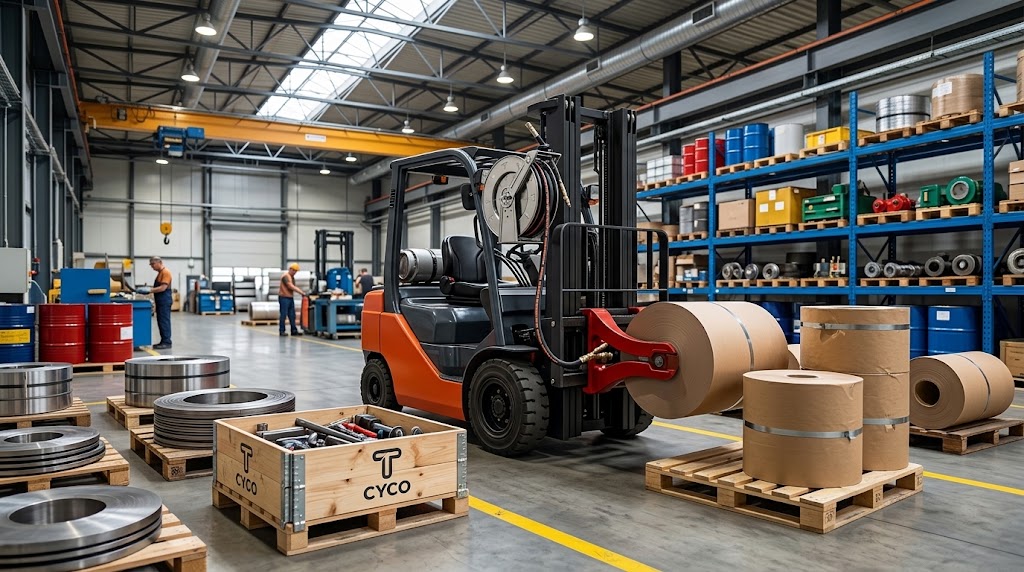
This logic also applies to attachments involving multiple types of movement. Take a paper roll clamp as an example: the forklift may need to move the roll up and down via the mast while the clamp simultaneously opens and closes. Some configurations also include a rotation function. In such cases, hose movement is far more complex than with a standard fixed connection. Forklift hydraulic hose reels help control the extension and retraction length of the hoses, keeping the unused portion relatively organized during attachment movement.
However, a reel is not a substitute for proper hose routing. If the reel is poorly positioned or the hose length is incorrect, issues such as excessive bending, twisting, or interference with other components can still occur.
Matching a Forklift Hydraulic Hose Reel to the Attachment’s Movement
When selecting a forklift hydraulic hose reel, the first step is to determine exactly what movement the hose needs to accommodate.
| Forklift Attachment | Primary Movement | Factors to Consider for Hoses |
|---|---|---|
| Standard Fork Carriage | Vertical movement | Working length during mast movement |
| Sideshifter | Horizontal movement | Lateral hose range of motion |
| Fork Positioner | Fork spacing changes | Changes in hose position around the attachment |
| Hydraulic Clamp | Repeated opening/closing | High-frequency bending cycles |
| Rotator | Rotational movement | Twisting and routing clearance |
| Paper Roll Clamp | Combined movement | Vertical, clamping, and potential rotational movements |
Hose diameter, pressure rating, and capacity remain crucial; however, these parameters primarily describe the hose and reel themselves rather than the actual movement dynamics of the entire system. Ultimately, the hose reel must be matched to the hose’s working pressure, length, and outer diameter, as well as the attachment’s range of motion, mounting location, and actual operating environment.
Practical Application: Paper Roll Clamps and Forklift Hydraulic Hose Reels
The paper roll clamp is a prime example of why analyzing an attachment’s movement patterns is essential before selecting a hose configuration. In paper processing or roll warehousing environments, a forklift may need to clamp a roll, lift it via the mast, and transport it to a designated location. Throughout this process, the clamp must repeatedly open and close, and certain configurations may also require rotating the roll. Consequently, the hydraulic hoses must accommodate multiple simultaneous movements.
If a fixed-length hose with excessive slack is used, the hose may hang loosely around the attachment; conversely, if the hose is too short, it risks being overstretched when the attachment reaches its travel limits. In such scenarios, a forklift hydraulic hose reel helps manage the hose’s active length and keeps any excess hose organized during movement.
Specific configurations must be determined based on the structural design of the forklift and the paper roll clamp. The reel should be mounted so that the hose follows a stable, predictable path throughout the entire operating cycle.
Conducting a Practical Check of Forklift Hydraulic Hose Layouts
Before installing the reel, it is best to run the forklift through a complete, actual operating cycle rather than inspecting it only while stationary. First, identify all hydraulic connection points and distinguish which ones move along with the mast, fork carriage, or attachment. Next, measure the maximum travel distances in all directions and determine whether the attachment involves rotation or repetitive bending.
Then, check for potential interference points, paying particular attention to the areas around the mast, fork carriage, attachment frame, and hydraulic connections. Finally, inspect the hose condition when the equipment is at its various travel limits. The hose must remain within its permissible bend radius and maintain sufficient working length while keeping a safe clearance from moving parts.
This comprehensive inspection method reveals many issues that are not easily detected when the forklift is stationary.
Conclusion
Requirements for forklift hydraulic hoses depend on more than just hydraulic pressure and hose dimensions. The movement patterns of the mast and various hydraulic attachments can significantly alter how hoses need to extend, bend, rotate, and retract.
Side shifters, fork positioners, hydraulic clamps, rotators, and paper roll clamps all generate distinct movement patterns, thereby influencing hose length, routing, clearance, and stowage.
For applications involving repetitive hose movement, forklift hydraulic hose reels provide controlled extension and retraction; however, the appropriate reel configuration must be determined based on the specific movement patterns of the attachment.
The most reliable approach is to evaluate the entire system as a cohesive whole:
Forklift structure + Mast movement + Attachment movement + Hose routing + Reel configuration
This ensures the hose system is truly compatible with the forklift’s operational dynamics, rather than imposing additional constraints during work.
Related Posts
Hose Reels for Paper Mills: Applications in Paper Production
September 17, 2026
Common Hydraulic Hose Reel Failures and Troubleshooting
August 12, 2026