How to Choose the Right Hose Reel Cart with Wheels
June 29, 2026 | Industrial Hose Reels
1. Introduction
A Hose Reel Cart with Wheels is a portable hose management solution designed to make transporting, storing, and using hoses easier across a wide range of working environments. Compared with traditional Industrial Hose Reels, hose reel carts provide greater mobility for applications that require frequent movement between work areas.
As gardens become larger, job sites grow in scale, and industrial workspaces become more dynamic, Hose Reel Carts with Wheels have become increasingly popular among homeowners, landscapers, farmers, maintenance teams, and industrial users. Their mobility not only simplifies hose handling but also improves productivity by reducing the time and effort required to move long, heavy hoses between work areas.
However, not every Hose Reel Cart with Wheels is suitable for every application. Factors such as hose capacity, wheel type, frame material, reel design, and the working environment all play an important role in determining overall performance and long-term durability.
This guide will walk you through the key considerations when choosing the right Hose Reel Cart with Wheels, helping you find a solution that matches your operational needs while delivering reliable performance for years to come.
2. Why Choose a Hose Reel Cart with Wheels?
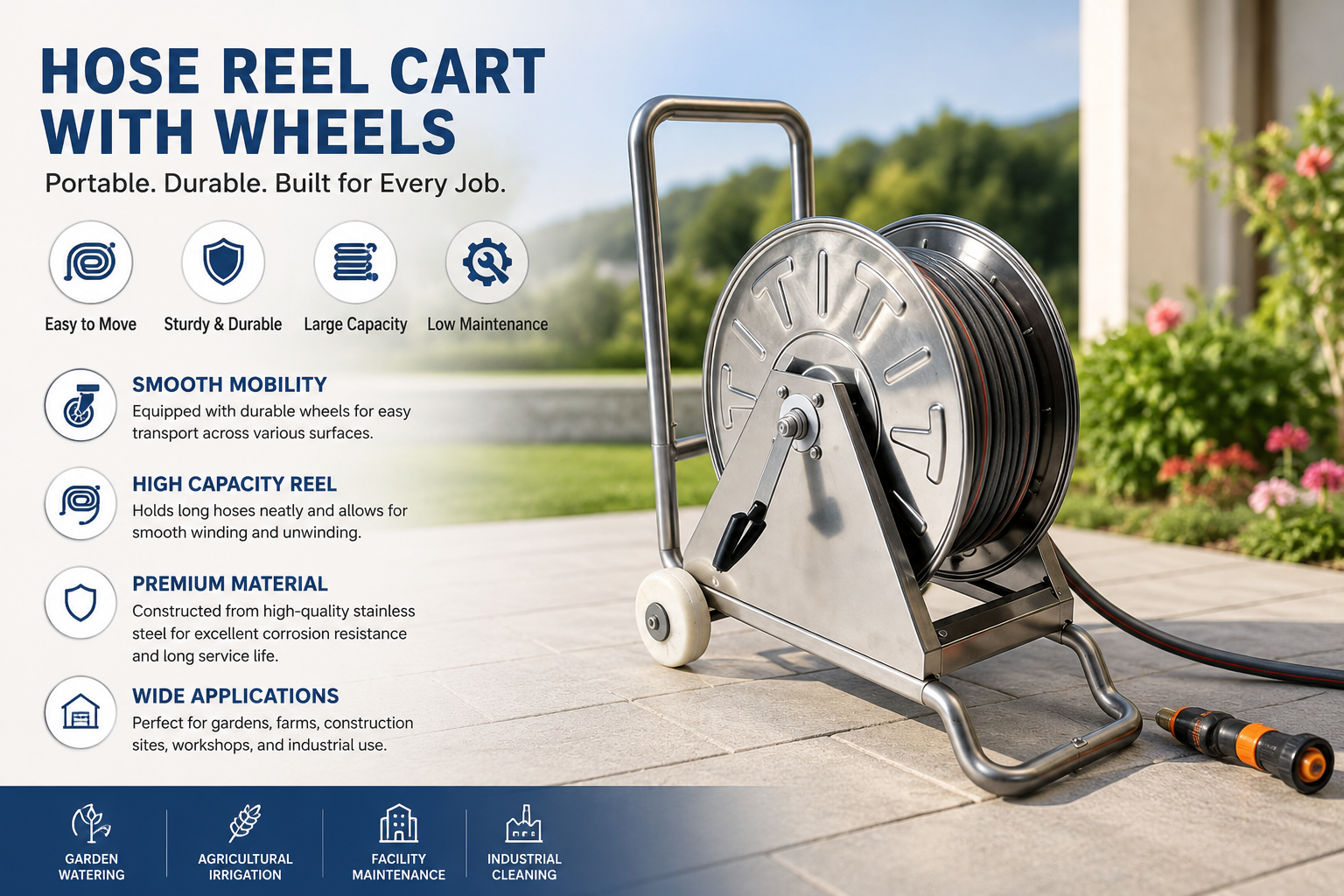
Compared to wall-mounted or fixed hose reels, a Hose Reel Cart with Wheels offers superior mobility, allowing you to easily move it to different work areas as needed. This makes it ideal for scenarios that frequently require changing locations, such as garden watering, agricultural irrigation, facility maintenance, and industrial cleaning. In addition to its excellent portability, the Hose Reel Cart with Wheels helps keep hoses neatly organized and significantly reduces the physical effort required to carry long or heavy hoses.
The cart design allows users to effortlessly push the reel to various indoor or outdoor work sites, eliminating the strain of manual handling while making it easier to cover larger areas. By positioning the Hose Reel Cart with Wheels close to the workspace, users can quickly extend and retract hoses, greatly reducing the time and effort spent on dragging. This translates into improved efficiency in daily tasks like watering, cleaning, and maintenance, ensuring a smoother and more productive workflow.
3. Key Factors to Consider When Choosing a Hose Reel Cart with Wheels
3.1Choose the Right Hose Capacity
Hose capacity is one of the most critical technical parameters when selecting a Hose Reel Cart with Wheels, as it directly determines whether the cart can meet actual job requirements. Capacity selection primarily involves three dimensions: hose length, hose diameter, and the maximum capacity of the reel itself.
Hose length should be determined based on the coverage area of the work site. If the workspace is large, or if there is a significant distance between the water source and the point of use, a longer hose is needed to avoid frequent repositioning of the cart. As a general rule, it is advisable to choose a length that satisfies current needs while leaving extra margin for unexpected expansion requirements.
Hose diameter affects the flow rate of water or other liquids. A larger diameter delivers a higher volume per unit of time, making it suitable for tasks that require high-output cleaning or irrigation. However, larger-diameter hoses are also heavier and take up more space. Therefore, once the diameter is selected, it is essential to verify that the reel’s capacity can accommodate the full length of the chosen hose at that specific diameter.
Reel capacity is typically specified by manufacturers as the maximum hose length at a given diameter. When making a selection with your Hose Reel Cart with Wheels, always ensure that the rated capacity exceeds your actual required length. It is recommended to leave at least 10 to 15 percent of spare capacity. This not only ensures smoother winding and unwinding during daily operation but also provides flexibility for future upgrades to longer or slightly larger-diameter hoses, avoiding the need to purchase an entirely new unit due to insufficient capacity.
3.2Select the Appropriate Wheel Type
The wheel type directly affects the maneuverability, stability, and service life of your Hose Reel Cart with Wheels across different ground conditions. Based on the operating environment, wheels are mainly divided into solid wheels and pneumatic wheels, each with its own application scenarios and performance advantages.
Solid Wheels
Solid wheels are made of high-density rubber or polyurethane materials, featuring a simple and rugged structure. They are best suited for smooth, hard surfaces. Typical applications include:
Workshops: Floors are usually hardened concrete or epoxy-coated, where solid wheels roll smoothly without damaging the surface coating.
Warehouses: Frequent movement between shelving aisles requires solid wheels that offer agile steering and high load-bearing capacity.
Concrete or asphalt surfaces: Whether indoors or outdoors on hard ground, solid wheels provide reliable rolling performance.
The key advantages of solid wheels are excellent wear resistance and durability. They are not prone to puncture or damage from sharp debris, ensuring a long service life for your Hose Reel Cart with Wheels. Additionally, they are virtually maintenance-free, requiring no regular pressure checks or inflation. Daily upkeep is as simple as keeping the wheel surfaces clean, which significantly reduces maintenance time and costs.
Pneumatic Wheels
Pneumatic wheels are similar to bicycle or cart tires, filled with compressed air and offering noticeable cushioning and shock-absorbing properties. They are best suited for uneven, soft, or rough terrain. Typical applications include:
Gardens: Lawns and flowerbed edges often have uneven surfaces, where pneumatic wheels effectively absorb shocks, preventing the Hose Reel Cart with Wheels from tipping over or hoses from tangling.
Farms: On dirt paths, muddy fields, or sandy soils, pneumatic wheels provide better traction and flotation, reducing the risk of sinking.
Construction sites: Ground conditions often include gravel, rubble, or temporary decking. The shock absorption of pneumatic wheels protects the reel and internal hoses from damage caused by severe jolts.
The main features of pneumatic wheels are superior shock absorption, which significantly reduces impact stress on the reel structure and hose connections during transport, thereby extending overall equipment life. At the same time, they roll more easily on rough ground, with lower rolling resistance. Even when fully loaded with heavy hoses, operators can move the Hose Reel Cart with Wheels with minimal effort, effectively reducing physical strain. However, it is worth noting that pneumatic wheels require regular pressure checks to maintain optimal inflation levels for best performance.
Selection Summary
If your primary work environment consists of smooth, hard surfaces, solid wheels are a cost-effective, durable, and low-maintenance choice for your Hose Reel Cart with Wheels. If your work is mostly outdoors on grass, uneven terrain, or soft ground, pneumatic wheels offer a more comfortable and effortless moving experience. In practice, you may also weigh the pros and cons based on mixed-use scenarios, or consider models that offer interchangeable wheel sets for greater versatility.
3.3 Choose the Right Frame Material
The frame material determines the durability, weight, and suitability of your Hose Reel Cart with Wheels for different working environments.
Powder-Coated Steel
This is the most common and cost-effective choice for a Hose Reel Cart with Wheels. It offers high strength and good durability for general-purpose applications such as gardens, workshops, and warehouses. The powder coating provides basic corrosion resistance, making it suitable for most ordinary working conditions.
Stainless Steel
Stainless steel delivers excellent corrosion resistance, making it the preferred option for harsh or wet environments. It is widely used in marine applications, food processing, and chemical industries where exposure to moisture, salt, or corrosive substances is a concern. Although more expensive, it offers superior longevity and hygiene for your Hose Reel Cart with Wheels.
Aluminum
Aluminum is the lightest option among the three, which makes your Hose Reel Cart with Wheels easier to push, pull, and maneuver. It naturally resists rust without the need for additional coating. While not as strong as steel, it is ideal for applications where portability is a priority and heavy loads are not expected.
Selection Summary
For general use, powder-coated steel provides the best balance of strength and cost for a Hose Reel Cart with Wheels. For corrosive or sanitary environments, stainless steel is the clear choice. For lightweight portability and rust resistance with moderate load demands, aluminum is an excellent option.
3.4 Manual vs. Retractable Hose Reel Cart
When selecting a Hose Reel Cart with Wheels, the retraction method is an important consideration. There are two main types available on the market: manual and retractable. Each has its own application scenarios and advantages, and users should make a reasonable choice based on actual frequency of use, work intensity, and budget.
Manual Hose Reel Cart
Manual Hose Reel Carts with Wheels rely on the operator to manually turn a crank handle to retract the hose. These products feature a simple structure with fewer mechanical components, resulting in a lower failure rate and reduced maintenance costs. They are primarily suited for low-frequency applications, such as home gardening, occasional yard cleaning, or light maintenance tasks.
For users with limited budgets, a manual Hose Reel Cart with Wheels is a cost-effective choice that meets basic hose storage needs while keeping procurement costs under control. Additionally, manual operation gives users greater control, allowing them to retract the hose slowly and evenly as needed, avoiding twisting or damage caused by excessively fast retraction.
Retractable Hose Reel Cart
Retractable Hose Reel Carts with Wheels use a spring rewind mechanism similar to many Spring Driven Hose Reels, allowing the hose to retract smoothly after use. Users simply pull the hose to trigger the retraction device, and the hose is automatically and smoothly wound back onto the reel. This design significantly improves retraction efficiency, making it particularly suitable for high-frequency use in fast-paced commercial and industrial environments, such as professional cleaning services, farm irrigation, construction site maintenance, and factory workshop cleaning.
The main advantages of retractable models are threefold: first, faster retraction speed, which substantially reduces preparation and wrap-up time before and after each job; second, reduced manual effort, as operators do not need to bend over or laboriously turn a crank, effectively lowering physical strain; and third, the hose is evenly and orderly wound onto the reel, minimizing wear, kinking, or tripping hazards caused by improper storage, thereby enhancing overall safety. It should be noted that retractable mechanisms are relatively more complex and typically come at a higher price than manual models. However, for users who prioritize efficiency and convenience, this investment is well worth it.
Selection Summary: If your usage frequency is low and budget is limited, a manual Hose Reel Cart with Wheels is sufficient for everyday needs. If you work frequently, demand efficient retraction, and have higher safety requirements, a retractable Hose Reel Cart with Wheels is the more ideal choice.
Summary
We hope this article has helped you gain a more comprehensive understanding of the key features of a Hose Reel Cart with Wheels. Whether it is hose capacity, wheel type, frame material, or retraction method, each factor directly affects daily usability and the service life of the equipment. We recommend that you consider your own working environment, frequency of use, and hose specifications, and weigh all the configurations carefully to make the most suitable choice. With the right Hose Reel Cart with Wheels, you can significantly improve your workflow efficiency and enjoy a more convenient hose handling experience for years to come.
Related Posts
Why Spring Fatigue Happens in Retractable Hose Reels
June 10, 2026