Irrigation Hose Reel Selection Guide
November 3, 2026 | Garden Hose Reels
Introduction
Different irrigation systems will have great differences due to different irrigation areas, plant types, water supply conditions and operation frequency. Greenhouse may need flexible use of hoses between planting rows, while large farms may need to transport water to different areas through longer hoses. Lawn and landscape maintenance also have different watering methods and coverage requirements.
Irrigation hose reel provides a practical hose management method for these operations by controlling the deployment, retraction and storage of hoses. However, choosing a suitable reel not only needs to consider the hose length or storage capacity. Hose diameter, water pressure, flow rate, installation position and operation mode will all affect whether the reel is suitable for a specific irrigation system.
This paper will introduce the requirements of different irrigation systems for hose reels, and explain the key factors to be considered when selecting irrigation hose reels for agriculture, greenhouse, lawn and mobile watering operations.
Different Irrigation Systems and Their Hose Reel Requirements
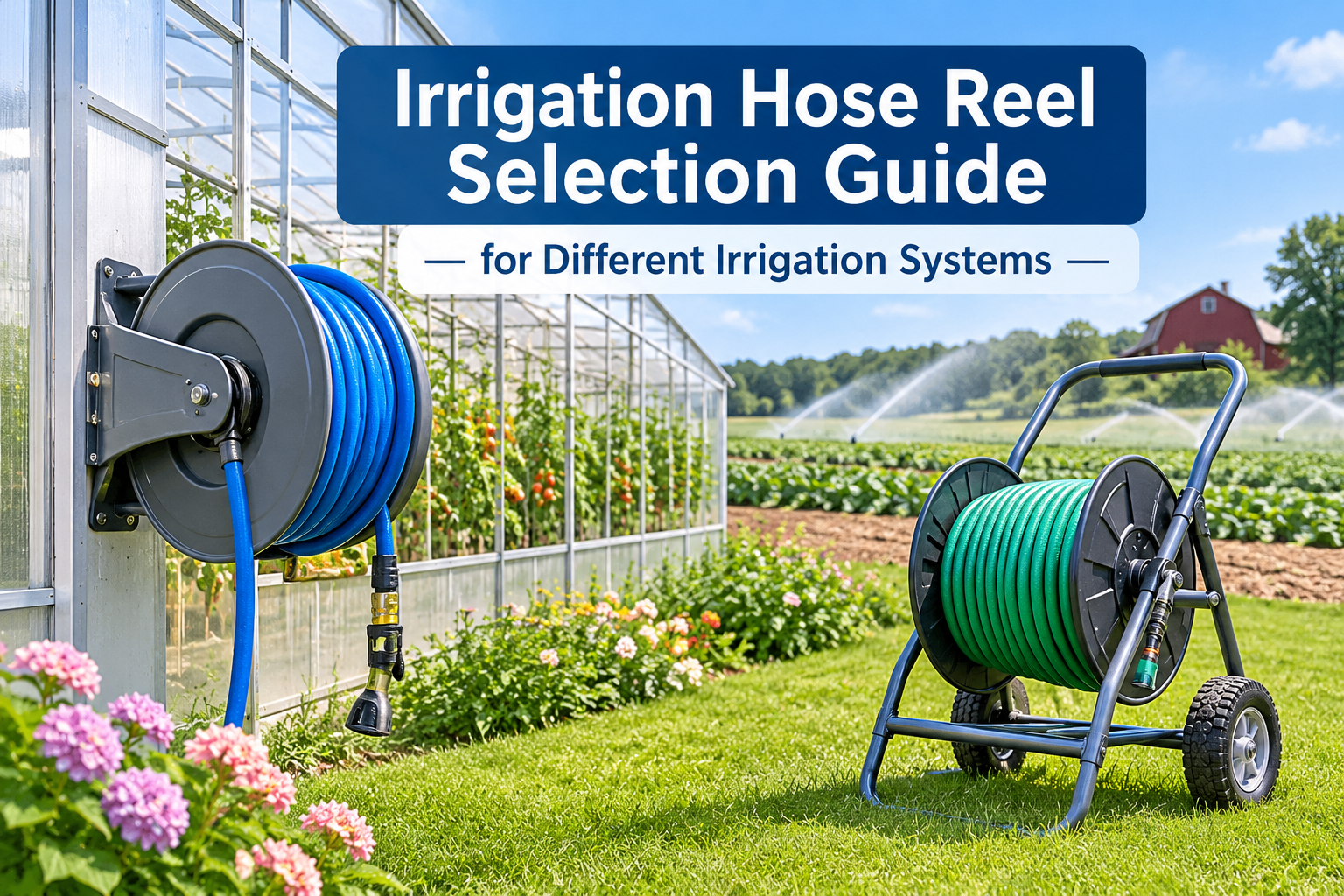
Different irrigation environments have different requirements for hose reels. Understanding the actual use of hose is helpful to determine the appropriate reel structure, capacity and installation method.
Greenhouse Irrigation
Greenhouse is usually equipped with rows of planting areas, cultivation beds and narrow passages. Watering operation may need to be carried out in different locations in the facility, so the flexibility of hose movement and storage management are particularly important.
Suitable irrigation hose reel should be able to extend the hose to the required planting area, while avoiding unnecessary obstacles in the channel. If the greenhouse structure allows, a wall-mounted reel can be used to store the hose above the ground; Portable reels may be more practical if the watering position changes frequently.
The greenhouse environment also needs to consider wet conditions and cleaning requirements. The material and surface treatment of reels that are often in contact with water should be suitable for the surrounding environment. If fertilizers or cleaning chemicals are used nearby, the possible impact of these substances on reel materials should also be evaluated.
Lawn and Landscape Irrigation
Lawn and landscape maintenance usually involves relatively open areas, including lawns, gardens, planting areas and landscape green spaces. Hoses may need to cover different areas, so working length and mobility are important selection factors.
For smaller gardens, manual garden hose reel or garden hose reel cart can usually meet the use requirements. The reel cart can move between different watering positions, and when the water supply point and the working area are relatively fixed, the fixed reel is more suitable.
For a large landscape area, the length and diameter of the hose should match the required coverage and water supply conditions. Too long hose may not only increase unnecessary water flow resistance, but also make operation more difficult. The reel should also have enough capacity to accommodate the hose and avoid the hose from being excessively squeezed during winding.
Farms and Farmland Irrigation
Farm and farmland irrigation may involve long hoses, large irrigation areas, and frequent movement between different job sites. Depending on irrigation methods, hoses may be used to transport water to planting areas, support manual irrigation, or connect mobile water supply equipment.
In these applications, reel capacity and structural strength are particularly important. The reel must be able to accommodate the hose with the required length and diameter, while bearing the weight of the hose itself. If the hose needs to move frequently on uneven ground, the stability of the reel, frame structure and moving mode should also be considered.
For agricultural operations that need to take up and take down hoses frequently, the electric hose reel can reduce the physical strength required for manual winding. For short hoses or scenes with low frequency of use, manual hose reels are still practical according to hose weight and operating frequency.
Mobile Watering Application
Mobile watering applications include irrigation between different areas of the farm, landscape maintenance in multiple locations, and watering tasks with changing water supply points or working locations.
In these cases, the portability of equipment is closely related to hose management. The portable hose reel or hose reel cart can move the hose storage position closer to the working area, thus reducing the distance that the hose needs to be dragged and making the hose deployment more convenient.
Before selecting a movable reel, the total weight of the reel, the hose and the residual water in the hose should be considered. Wheel size, frame stability, handle structure and ground conditions will all affect the mobility of the equipment. For scenes that often need to move on rugged ground, light garden carts may not meet the stability requirements of heavy industrial or agricultural hoses.
During the operation, it should also ensure that the reel is placed firmly to avoid the reel moving when the hose is extended or retracted.
How Does Hose Length and Diameter Affect Reel Selection?
The length and diameter of hose is one of the most important factors in selecting irrigation hose reel. They not only determine how many hoses the reel can store, but also affect the physical load borne by the reel and the water supply performance of the whole system.
The length of the hose determines the watering coverage. Longer hoses can be extended to farther planting rows or watering locations, but it will also increase the weight and storage space requirements. At the same time, the longer the water flows through the hose, the greater the resistance it usually receives, which may lead to the decrease of water pressure at the end of the hose. This pressure loss may be more obvious if the diameter of the hose used is small or the amount of water to be transported is large. Therefore, when selecting hoses, the actual watering distance, hose diameter and water supply demand should be considered at the same time.
The hose diameter will affect the water flow and reel capacity. A larger diameter hose can transport more water at the same flow rate, but it usually takes up more space and weighs more than a smaller diameter hose with the same length. Therefore, a reel that can store long small-diameter hoses may not have enough capacity to store short large-diameter hoses.
When checking the reel capacity, confirm whether the marked hose capacity is suitable for the actual hose diameter. In addition, when evaluating the storage capacity, the outer diameter of the hose should be considered, not just the nominal inner diameter. The wall thickness of the hose, the structure of the reinforcement layer and the overall structure will all affect the actual storage space required.
During the actual selection, the following inspections shall be carried out:
- Determine the maximum working distance that the hose needs to cover.
- Confirm the inner diameter and outer diameter of the hose.
- Check the actual capacity of the reel for this hose specification.
- Consider the hose itself and the total weight of water that may remain in the hose.
- Leave enough space for the smooth winding and unfolding of the hose.
Manual, Spring-Driven and Electric Irrigation Hose Reels
The driving mode determines how the hose is unfolded and retracted. Manual, spring-driven and electric reels have different operating characteristics and are suitable for different irrigation needs.
Manual Irrigation Hose Reel
Manual hose reel The hose is wound onto the drum by hand crank. Its operating structure is relatively simple, and no external power is needed when the hose is retracted.
This kind of reel is usually suitable for garden watering, small area irrigation, and applications with small hose weight and length. Manual hose reel can also allow the operator to directly control the winding process, which has certain advantages when it is necessary to withdraw the hose carefully.
However, with the increase of the length, diameter and weight of the hose, the physical strength required for winding will also increase accordingly. For the scene of frequent operation or the use of large-size hoses, manual winding may become inconvenient.
Spring-Driven Irrigation Hose Reel
The spring-driven hose reel uses the stored mechanical energy to automatically retract the hose after it is extended. Depending on the specific model, the reel can also fix the hose at the selected length through the locking mechanism.
This structure is suitable for the scene where the hose needs to be repeatedly deployed and retracted from a fixed position. It can reduce the workload of manual winding and store the hose after watering.
Electric Irrigation Hose Reel
The electric hose reel retracts the hose through an electric or other compatible power system. For long and heavy hoses, or for applications requiring frequent operations, this reel can be considered.
Power recovery can reduce the physical consumption of operators, especially suitable for the situation that hoses need to be used repeatedly in a large working area. However, the motor, transmission system, control system and power supply must match the actual working environment.
When selecting an electric reel, check its rated hose capacity, recovery speed, power requirements and working conditions. We can’t expect the motor to make up for the improper selection of reel specifications, and we can’t ignore the excessive resistance that the hose may produce in the winding process.
The best driving mode depends on hose specifications, operating frequency, power conditions and the actual acceptable manual operation.
Water Pressure and Flow Considerations
The irrigation hose reel must match the water supply conditions of the irrigation system. Water pressure and flow are related to each other, but they represent different parameters in the process of water supply.
Water pressure represents the pressure to push water through the system, while flow represents the amount of water transported per unit time. Both of them will affect the irrigation effect, so they need to be considered when choosing hoses and reels.
Reels, hoses, joints and rotary joints all need to be able to withstand the water pressure in actual use. If one of the components can only bear low pressure, the whole system must be used according to the pressure that this component can bear, not just the pressure parameters of the reel itself.
The diameter of the hose will also affect the water outlet effect. If the irrigation system needs to transport more water, but the hose is too thin, the water flow will be subject to greater resistance, which may lead to a drop in water pressure at the watering position and affect the normal work of sprinklers or other irrigation equipment.
The length of the hose will also affect the water pressure. Generally speaking, the longer the water flows through the hose, the greater the resistance and the lower the water pressure at the end. This situation will be more obvious especially when the hose is thin and the water transmission capacity is large. Therefore, even if the reel can hold the required length of hose, it does not mean that this hose configuration can certainly meet the irrigation demand.
Before selecting reels, check the following:
- Normal working pressure of water supply system and possible pressure changes.
- Flow required for watering position.
- Pressure rating and diameter of hose.
- Pressure rating of reels, rotary joints and connectors.
- Manufacturer’s instructions on reel operation and connection mode.
Suitable irrigation hose reel should be able to meet the requirements of hose and water supply, and at the same time avoid adversely affecting the water pressure or flow rate of the whole system.
Fixed and Portable Irrigation Hose Reels
The installation method will affect the convenience of the hose to reach different watering positions, and also determine how the reel adapts to the actual working environment.
Fixed irrigation hose reels are installed at designated locations, such as walls, columns or suitable supporting structures. When the water supply point and watering area are relatively stable, this installation method is more suitable. Fixed installation can provide a stable hose access position and prevent the reel from moving during operation.
When selecting a fixed reel, the strength of the installation surface, the position of the water supply connection and the direction in which the hose extends should be considered. The installation position should ensure that the hose can move freely to avoid repeated rubbing against walls, equipment or sharp edges.
Portable irrigation hose reel has higher flexibility because it can be moved between different working areas. This reel is more practical for garden watering, landscape maintenance and agricultural operations where a water supply point needs to serve multiple areas.
However, portability also brings additional considerations. The reel must be stable enough to be fixed when the hose is unfolded and retracted; Wheels and frames should also be adapted to the actual ground conditions. In addition, the total weight of the reel and hose should be kept within the range that the operator can easily move.
| Selection Factor | Fixed Hose Reel | Portable Hose Reel |
|---|---|---|
| Installation | Mounted at a designated position | Can be moved between locations |
| Working area | Relatively consistent | Changes between watering locations |
| Stability | Depends on mounting structure | Depends on frame and ground conditions |
| Hose access | From a fixed connection point | Flexible positioning |
| Typical applications | Greenhouses, fixed watering stations, maintenance areas | Gardens, lawns, farms, and mobile watering |
Which type to choose should depend on the layout of the irrigation area. When the watering range is relatively clear, the fixed reel is usually more practical; Portable reels are more advantageous when hoses need to serve many different locations.
Conclusion
When selecting irrigation hose reel, irrigation environment, hose specification, water supply condition, driving mode and installation mode should be considered comprehensively. Through comprehensive evaluation of these factors, we can choose an irrigation hose reel that is more in line with the needs of irrigation system, make hose management more reasonable, and meet the actual needs of daily operations.
Related Posts
Can a Heavy-Duty Water Hose Reel be used as a…
August 20, 2026
Storing Garden Hose for Winter: A Practical Guide
November 4, 2026
How to Choose Garden Hose Reel Materials for Different Climates
October 19, 2026