Marine Hose Reel Selection Guide
July 10, 2026 | Hose Reel Applications, Industrial Hose Reels
1.Introduction
Hoses are widely used in marine operations for fuel transfer, equipment maintenance, cleaning, and water supply. However, marine environments are constantly exposed to saltwater, moisture, and harsh outdoor conditions, which can accelerate hose wear and increase hose management difficulties.
Marine hose reels effectively solve hose management issues by providing organized storage, protection, and quick access to hoses. Compared with standard hose reels, marine hose reels offer stronger corrosion resistance and higher structural reliability, meeting the long-term operational requirements of complex environments such as ships, ports, and offshore platforms.
2.What Is a Marine Hose Reel?
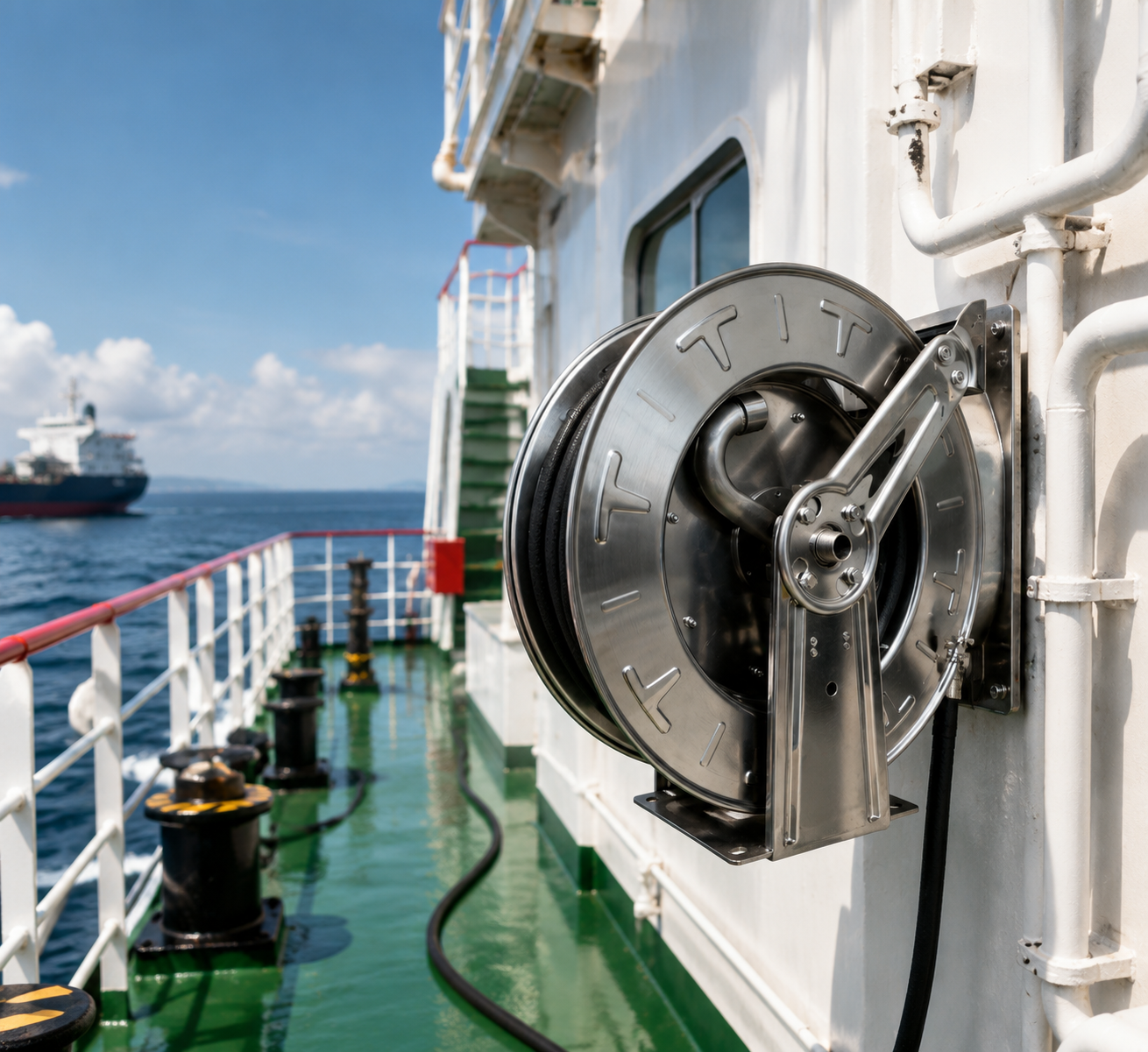
A Marine Hose Reel is a hose management device specifically used for ships, ports, offshore platforms, and other marine environments. It stores hoses through a rotating drum structure and helps operators quickly deploy and retract hoses. It is commonly used for transferring water, fuel, hydraulic oil, compressed air, and cleaning fluids.
Depending on hose length and operating frequency, marine hose reels are available in manual, spring-driven, and powered configurations. For handling long or heavy hoses on large vessels and offshore platforms, a Motor-Driven Hose Reel can significantly reduce manual handling while improving retrieval efficiency.
Compared with standard industrial hose reels, marine hose reels require stronger environmental adaptability to withstand salt spray, humidity, vibration, and long-term outdoor exposure.
Choosing the right marine hose reel can reduce hose damage, improve workplace organization, and enhance the efficiency of daily marine operations.
3.Common Applications of Marine Hose Reels
Different marine application scenarios have different requirements for hose reels. Therefore, before selecting a marine hose reel, it is necessary to determine the appropriate product type based on the specific working environment and operational needs.
3.1 Ship Maintenance
During daily ship maintenance, hoses are required for equipment cleaning, compressed air supply, and various fluid transfer tasks. Without effective hose management, long hoses can easily become tangled, worn, or occupy valuable deck space, while also increasing operational risks for workers.
Marine hose reels help crew members quickly deploy and retract hoses, keeping maintenance areas cleaner and more organized while improving repair efficiency. For shipyards and maintenance facilities, durable hose reels must also meet frequent-use requirements to ensure long-term stable operation.
3.2 Ship Fuel Transfer
Ships, fuel supply stations, and marine service vehicles often require long hoses for fuel transfer. Marine Fuel Hose Reels provide sufficient hose capacity, reliable structural strength, and stable fluid connection performance.
Large-capacity drums, heavy-duty frames, and full-flow swivel joints ensure more stable fuel transfer. For fuel handling systems that use long or large-diameter hoses, a Heavy Duty Hose Reel provides the strength and hose capacity required for continuous operation.
In fuel handling applications, proper hose storage is particularly important because damaged or poorly managed hoses can increase maintenance requirements and create safety risks.
3.3 Offshore Platform Applications
Offshore platforms require equipment that can continuously operate in complex environments. Offshore Hose Reels are commonly used for water supply systems, hydraulic equipment, chemical fluid transfer, and equipment cleaning. For hydraulic fluid management, a dedicated Hydraulic Hose Reel helps ensure reliable performance under high-pressure operating conditions.
By using stainless steel components, corrosion-resistant coatings, and sealed internal structures, marine hose reels provide excellent corrosion resistance and mechanical strength to withstand saltwater, high humidity, and harsh weather conditions.
3.4 Ship Cleaning and Rinsing Operations
Ship cleaning is an important part of daily maintenance. Ships, docks, and marine facilities typically require high-pressure water hoses and cleaning hoses to remove salt, dirt, and other contaminants. Installing a suitable marine hose reel can prevent hoses from being dragged across the deck, reduce unnecessary wear, and allow operators to complete cleaning tasks more efficiently.
4.How to Choose the Right Marine Hose Reel?
Selecting the right marine hose reel requires comprehensive consideration of the operating environment, hose specifications, and usage frequency. Proper configuration not only ensures smooth hose operation but also reduces long-term maintenance costs.
4.1 Consider Hose Size and Reel Capacity
Hose diameter and length are important factors when selecting a hose reel. If the reel capacity is too small, it cannot fully accommodate the required hose length. However, an oversized reel will increase equipment costs and require more installation space.
In marine and ship applications, small-diameter hoses are typically used for cleaning, compressed air, and daily maintenance operations, while large-diameter hoses are more commonly used for fuel transfer, water supply systems, and heavy-duty fluid transfer applications.
The reel capacity needs to match the hose diameter and length. Larger hose diameters usually mean a shorter hose length that can be stored on the reel. Therefore, selecting the proper drum size ensures even hose retraction, reduces bending and stress, and extends hose service life.
4.2 Choose Corrosion-Resistant Materials
Saltwater, moisture, and long-term outdoor exposure in marine environments can cause equipment corrosion. Therefore, material selection directly affects the reliability of marine hose reels.
Common material options include:
- Stainless steel construction, providing higher corrosion resistance
- Powder-coated steel frames, improving surface protection
- Sealed bearings, preventing water and contaminants from entering internal structures
Using corrosion-resistant materials can reduce equipment corrosion and improve long-term operational stability, especially in high-humidity environments such as ships, ports, and offshore platforms.
4.3 Select the Appropriate Drive Method
Different applications require different hose reel operating methods. The appropriate drive type should be selected based on hose weight, usage frequency, and installation environment.
a. Manual Hose Reel
Manual hose reels are suitable for small vessels, maintenance areas, and applications with low hose usage frequency. They feature simple structures, easy operation, and low maintenance requirements, making them suitable for applications with limited automation needs.
b. Spring-Driven Hose Reel
Spring-driven hose reels can automatically retract hoses after use, reducing manual operation and keeping work areas organized. This type is suitable for ship maintenance areas, service platforms, and applications requiring frequent hose deployment and retraction.
c. Motor-Driven Hose Reel
Motor-driven hose reels are suitable for large ships, ports, offshore platforms, and other applications requiring the handling of long and heavy hoses. Through motor-powered operation, they reduce manual workload and improve continuous operation efficiency, making them especially suitable for high-frequency use environments.
5.What Key Features Should Marine Hose Reels Have?
Besides basic size and drive methods, several key design features can further improve the reliability, safety, and service life of marine hose reels.
5.1 Corrosion-Resistant Construction
Salt spray and humidity in marine environments accelerate the corrosion of metal components. The use of corrosion-resistant materials and protective coatings can effectively extend equipment service life and reduce maintenance requirements.
5.2 Large Capacity Drum
A large-capacity drum can store longer hoses while reducing hose bending and compression, improving stability during the retraction process.
5.3 Smooth Hose Retrieval
An effective hose retrieval system prevents hose tangling, overlapping, and uneven arrangement, reducing wear during operation and improving hose management efficiency.
5.4 Heavy-Duty Frame
A reinforced frame can withstand vibration, impact, and loads caused by long-term operation in marine environments, ensuring structural stability.
5.5 Full-Flow Swivel Joint
A high-quality swivel joint maintains continuous fluid transfer during drum rotation while reducing pressure loss and improving system efficiency.
5.6 Easy Maintenance Design
A maintenance-friendly structure simplifies routine inspection and servicing procedures, reduces equipment downtime, and helps ships and marine facilities maintain stable operation.
6.CYCO Marine Hose Reel Solutions
CYCO marine hose reels are specifically designed for ships, ports, offshore platforms, and other marine application environments, providing reliable hose storage and management solutions.
The products feature durable structural designs combined with corrosion-resistant materials, smooth hose retrieval systems, and flexible installation options to help users improve operational efficiency while protecting hose equipment.
Whether used for ship cleaning, fluid transfer, equipment maintenance, or offshore service operations, CYCO provides hose reel solutions that meet the requirements of complex marine environments.
7.Conclusion
In summary, the selection of marine hose reels should be based on actual application requirements—the application scenario determines functional requirements, hose specifications determine reel capacity, environmental conditions determine material grades, and usage frequency determines the choice of drive method. Once properly selected, a hose reel is no longer just a storage tool, but a key piece of equipment that improves operational efficiency, ensures workplace safety, and extends hose service life.
Based on this concept, CYCO continuously provides high-quality and highly adaptable hose reel solutions for the marine and offshore engineering industries, helping users maintain efficient operations in complex and changing marine environments.
Related Posts
Electric Hose Reels for Oil & Gas Industry
July 6, 2026
Chemical Hose Reels: Safety & Material Guide
July 20, 2026