Dual Hose Reel Applications & Selection: A Practical Guide
October 14, 2026 | Industrial Hose Reels
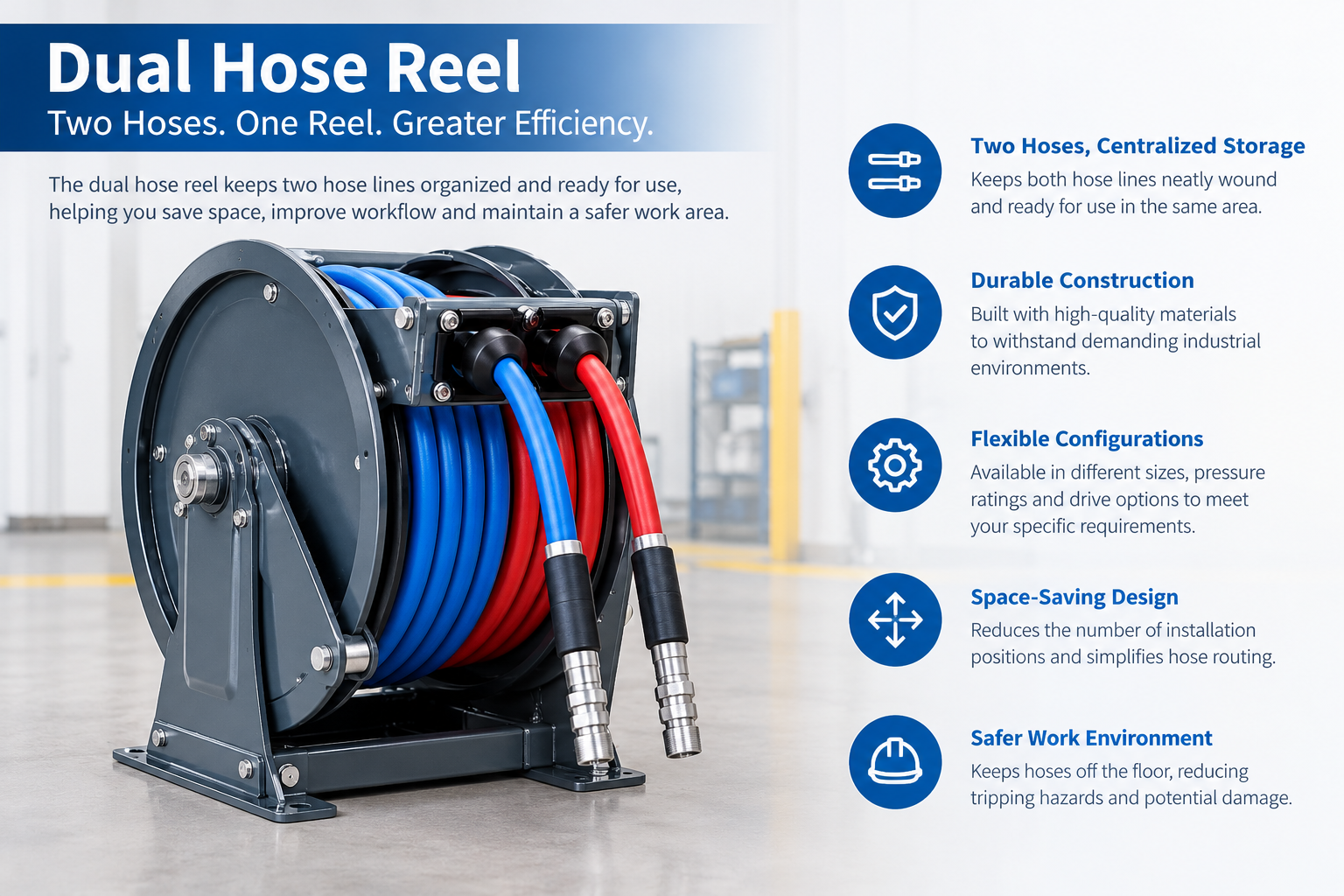
A dual hose reel is used in applications that require two hose lines to be deployed and stored together. Depending on the configuration, the two lines may carry hydraulic oil, different types of fluids, compressed air, or water. Some systems use two independent reels mounted side by side, while others integrate two fluid paths into a single reel assembly.
Choosing the right dual hose reel involves more than confirming that it can accommodate two hoses. Hose size, working pressure, media compatibility, operating requirements, and installation space all affect its suitability for actual working conditions. Understanding these factors helps purchasing personnel identify a configuration that meets the equipment’s needs.
Common Applications of Dual Hose Reels
Hydraulic Equipment and Mobile Machinery
Hydraulic systems often require two hose lines to power tools or operate equipment. For example, hydraulic attachments on construction machinery may need supply and return lines, while some hydraulic tools require two hydraulic connections to function properly.
Dual hose reels can help organize and manage these lines when operators move equipment or extend hoses to a work location. This configuration is suitable for mobile machinery, lifting equipment, service vehicles, and hydraulic service systems. For applications involving hydraulic supply, return, or dual-pressure lines, buyers can also explore relevant configurations of hydraulic hose reels.
The specific configuration depends on the hydraulic circuit. Supply and return lines may have different flow requirements, while some tools require two pressure lines rather than the more common combination of a pressure line and a return line. The reel and its internal fluid paths must therefore meet the requirements of the actual hydraulic circuit.
Automotive Service and Equipment Maintenance
Automotive service facilities often need multiple fluid or utility connections throughout the work area. For example, a service bay may use compressed air to power pneumatic tools while another hose delivers a different medium. Some applications may also require two dedicated fluid lines.
Dual hose reels can centralize these connections in the same area. Depending on the product structure, the two hoses may operate independently, allowing technicians to use one without necessarily deploying the other.
When selecting a reel for a maintenance facility, consider vehicle parking positions, required hose lengths, and whether both lines need to be used simultaneously. These factors help determine the installation location and whether a combined dual hose reel or two independent reels would be more suitable.
Industrial Cleaning and Washdown Operations
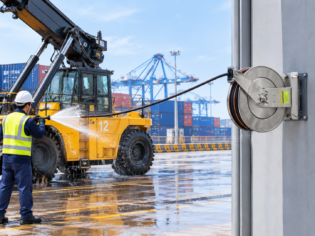
Industrial cleaning operations may require two hoses connected to different water supplies, cleaning processes, or utility connections. When both lines need to serve the same work area, a dual hose reel can provide centralized storage and access.
However, the two hoses should not automatically be assumed to have identical operating conditions. They may carry water at different temperatures or pressures, or come into contact with different cleaning chemicals. Each hose must be suitable for its medium, and the reel’s fluid-contact components must also be compatible with the substances being conveyed.
For installations exposed to frequent washdown, moisture, or cleaning agents, evaluate the corrosion resistance and environmental suitability of the reel frame, bearings, rotary joints, and other components.
Lubrication and Fluid Transfer
Maintenance stations and industrial service vehicles may need to deliver different lubricants or other fluids through separate hoses. When the reel structure is suitable for the relevant media, a dual hose reel can help organize the lines while keeping their fluid paths separate.
Media compatibility is particularly important in these applications. Seals, rotary joint passages, hose linings, and fittings must be suitable for the fluids being handled. Different fluid paths should remain isolated to prevent incompatible products from mixing.
The required hose inner diameter and flow rate should also be determined separately for each line. Two hoses mounted on the same reel do not necessarily need identical specifications.
Manufacturing and Mobile Service Operations
Production equipment and mobile maintenance systems may require two utility lines to connect machinery or serve a work area. In these situations, industrial hose reels can help manage hoses used in industrial operations. When two hoses follow similar routes and serve the same work area, combining them in a dual hose reel may simplify hose routing.
Before choosing this configuration, determine whether the two hoses need to move together or operate independently. If one hose must reach farther or the two lines have significantly different usage frequencies, separate reels may better accommodate the operating requirements.
Dual Hose Reel vs. Two Independent Hose Reels
Both configurations can manage two hoses, but their suitability depends on the hose arrangement and actual operating requirements.
A dual hose reel can consolidate mounting positions and place two connections in the same area. This arrangement is particularly useful when both lines serve the same equipment or workstation and follow similar routing paths.
Two independent hose reels may be more suitable when hose lengths, inner diameters, working pressures, or usage frequencies differ significantly. Each hose reel can be selected and installed according to its own requirements, and maintenance can be performed separately.
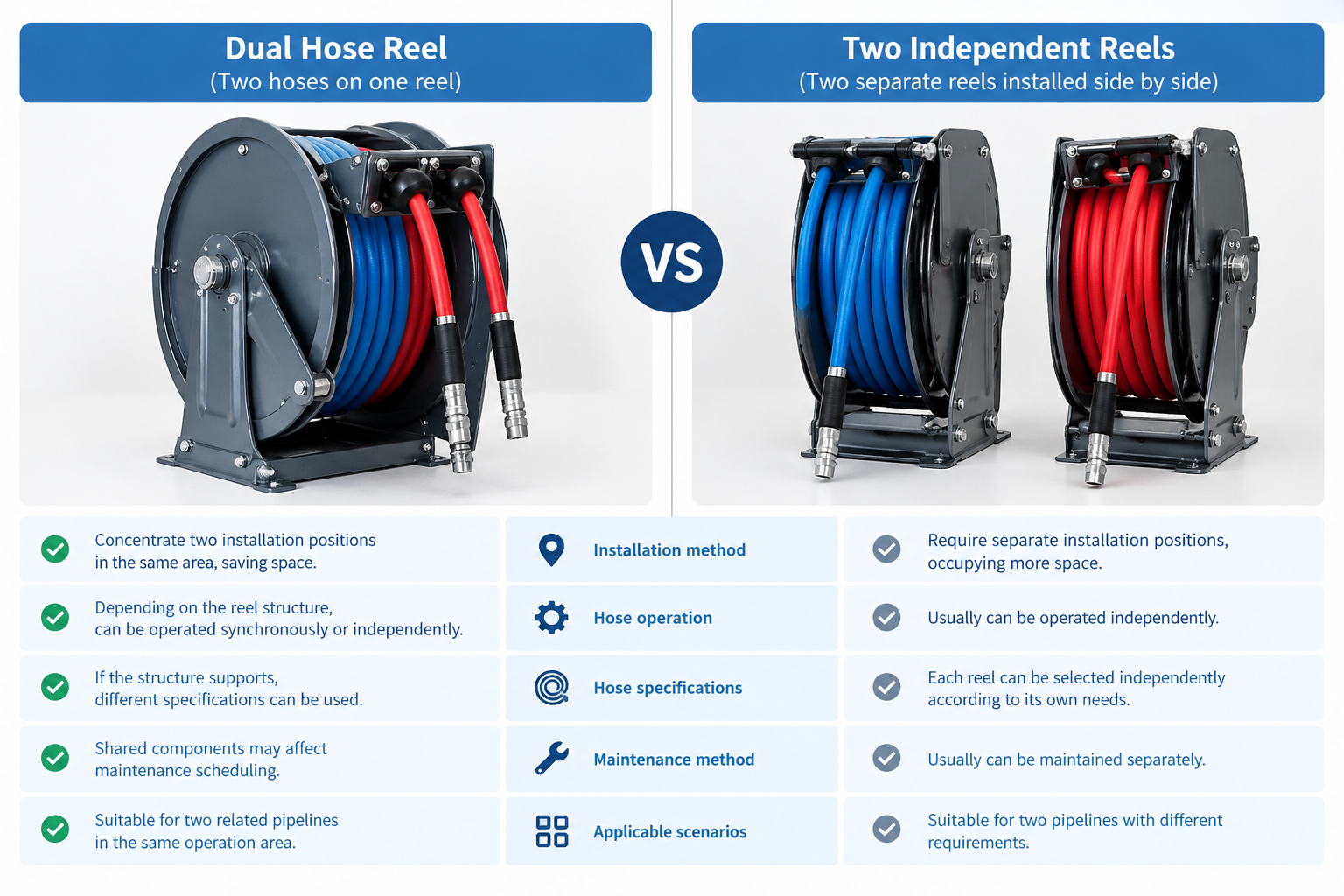
It is also important to distinguish between an integrated assembly and a side-by-side arrangement. Some double hose reels incorporate two fluid paths into one reel structure, while others consist of two hose reels mounted together. These configurations may differ in hose capacity, retraction mechanisms, fluid routing, and independent operating capability.
| Comparison factor | Dual hose reel | Two independent reels |
|---|---|---|
| Installation | Can consolidate mounting positions | Requires separate mounting arrangements |
| Hose operation | Depends on the reel mechanism | Each reel can generally be operated separately |
| Hose specifications | Different specifications may be possible if supported by the design | Each reel can be selected independently |
| Maintenance | Shared components may affect maintenance scheduling | Each reel can generally be maintained separately |
| Suitable applications | Two related lines serving the same work area | Two lines with significantly different requirements |
The choice should be based on the actual hose layout and operating process rather than assuming that a dual hose reel is always more compact or economical.
Key Selection Factors for Dual Hose Reels
1. Hose Length and Inner Diameter
First, determine the actual working range the hoses must cover, including the length needed to reach the farthest work location. Consider the distance between the reel outlet and the equipment, the operator’s range of movement, and the space needed to route the hoses without sharp bends or obstructions.
Hose length also affects reel capacity. Longer hoses and larger outer diameters generally require a larger drum or a reel with a different capacity rating.
The hose inner diameter should be selected according to the required flow rate and allowable pressure loss. An undersized hose may restrict flow, while an unnecessarily large inner diameter can increase the overall size and weight of the reel.
Evaluate both hoses separately. If the two lines have different flow requirements or need to reach different working distances, their lengths and inner diameters may differ.
2. Working Pressure and Flow Rate
Working pressure is a key selection parameter, particularly in hydraulic and other high-pressure applications. Confirm the maximum working pressure required for each hose and verify that the reel, rotary joints, fittings, and connecting components are suitable for the corresponding operating conditions.
The allowable working pressure of the complete system is limited by the ratings of its components and the actual operating conditions. Even if a hose has a high pressure rating, a lower-rated rotary joint or other component may prevent the entire reel assembly from operating safely at that pressure.
The flow requirements of each line should also be checked. For example, two hydraulic lines serving the same machine may have different flow requirements. Pressure and flow rate are separate parameters, so meeting one requirement does not guarantee that the other is satisfied.
3. Media Type and Material Compatibility
Before selecting a reel, identify the medium carried by each hose. Hydraulic oil, lubricants, water, compressed air, and cleaning fluids may require different hose constructions, seals, and fitting materials.
If the two lines carry different media, confirm material compatibility for each one separately. Hose linings, sealing materials, rotary joint passages, and connectors must be suitable for the relevant fluid and temperature range.
For applications sensitive to fluid contamination, also verify that the reel maintains adequate separation between the two fluid paths. Sharing a frame or drum does not necessarily mean that the hoses share the same internal passage.
4. Retraction Mechanism and Operating Requirements
The appropriate drive mechanism depends on hose frequency of use, hose weight, and the level of control required by the operator.
- Spring-driven hose reels: Suitable for applications requiring frequent hose extension and automatic retraction, provided the mechanism can handle the hose load and is compatible with the specific configuration.
- Manual hose reels: These allow operators to control hose extension and retraction directly and are suitable for applications that do not require powered operation or automatic retraction. See the relevant range of manual hose reels.
- Motor-driven hose reels: Suitable for long or heavy hoses and applications requiring powered winding.
For a double hose system, confirm whether the hoses retract together or independently. Check the locking mechanism, retraction controls, and whether both lines can be operated simultaneously when required.
5. Installation Space and Hose Routing
Before selecting a model, evaluate the available installation space. Consider the overall reel dimensions, mounting-hole positions, hose outlet direction, and access needed for future inspection and maintenance.
Hose routing is just as important as mounting location. Each hose needs sufficient clearance to avoid rubbing against nearby equipment, contacting sharp edges, or interfering with the other hose during extension and retraction.
For reels installed on vehicles or mobile equipment, also consider vibration, structural loads, and mounting orientation. The supporting structure must be able to withstand the weight of the reel assembly and the loads generated during operation.
6. Working Environment and Maintenance Requirements
Indoor service workshops, outdoor machinery, washdown areas, and corrosive environments place different demands on reel construction. Select suitable frame materials, surface treatments, bearings, springs, and seals according to environmental exposure and expected service life.
Maintenance access should also be considered during selection. Both hoses, their connections, and the reel’s moving components should be accessible for inspection and replacement.
If the equipment will operate in a hazardous area with explosion-protection requirements, verify that the complete configuration is approved or otherwise suitable for the specific environment. A metal reel frame alone does not establish suitability for hazardous-area use.
Common Mistakes When Selecting Dual Hose Reels
A common mistake is selecting a reel based only on the combined length of the two hoses while overlooking the capacity required for each one. Actual capacity should be checked against each hose’s outer diameter, length, winding arrangement, and the manufacturer’s stated usable capacity.
Another mistake is assuming that both hoses have the same pressure and flow requirements. Even when two lines serve the same machine, they may perform different functions. Evaluate each line according to its actual operating conditions.
Purchasing personnel should also avoid overlooking rotary joints and connectors. These components form part of the fluid delivery system rather than serving merely as installation accessories. Their pressure ratings, passage sizes, sealing materials, and thread specifications must match the application.
Finally, centralized mounting alone does not make a dual hose reel the better choice. If the hoses need to move independently, have substantially different usage frequencies, or follow different routing paths, two independent reels may be more suitable.
Dual Hose Reel Selection Checklist
Before requesting a quotation from suppliers, prepare the following information:
- Number of hoses and whether independent operation is required
- Type, inner diameter, outer diameter, and required length of each hose
- Working pressure, required flow rate, and operating temperature
- Conveyed media and material compatibility requirements
- Required drive and retraction mechanisms
- Installation location, available space, and hose outlet direction
- Working environment and any special compliance requirements
Providing this information helps suppliers evaluate reel configurations according to the actual application rather than making recommendations based only on general product descriptions.
Conclusion
When two hoses need to support related operations in the same work area, a dual hose reel can provide a practical hose management solution. Its suitability depends on the relationship between the two lines, their individual operating requirements, and the installation space available on site.
Checking hose capacity, pressure, flow rate, media compatibility, retraction method, and installation conditions before purchasing helps identify a configuration that meets the application’s needs and reduces problems caused by mismatched component ratings or unsuitable hose routing.
Related Posts
Industrial Hose Reel Price Guide: Cost & Quotation Analysis
October 16, 2026
Hose Reel Solutions for Manufacturing Plants
July 22, 2026
Best Hose Reel Solutions for the Paper Industry
August 27, 2026