Compact Hose Reel: How to Balance Size and Hose Capacity
October 19, 2026 | Industrial Hose Reels
Compact hose reels are suitable for small workshops, inside equipment shells, maintenance service vehicles and industrial operation areas with limited installation space. The smaller floor space helps to arrange the equipment reasonably and store and manage the hoses without occupying too much working space. However, reducing the overall size of the reel may also affect its pipe storage capacity and the convenience of hose drawing and recycling.
Therefore, choosing a compact hose reel is not just looking for the smallest model. The reel must be able to accommodate hoses with the required length and diameter, while leaving enough space for normal winding of hoses, equipment installation and daily maintenance. Knowing how the reel structure affects the storage capacity will help the purchaser to avoid selecting products that can be installed in the designated position but cannot meet the actual use requirements.
1. What Is a Compact Hose Reel?
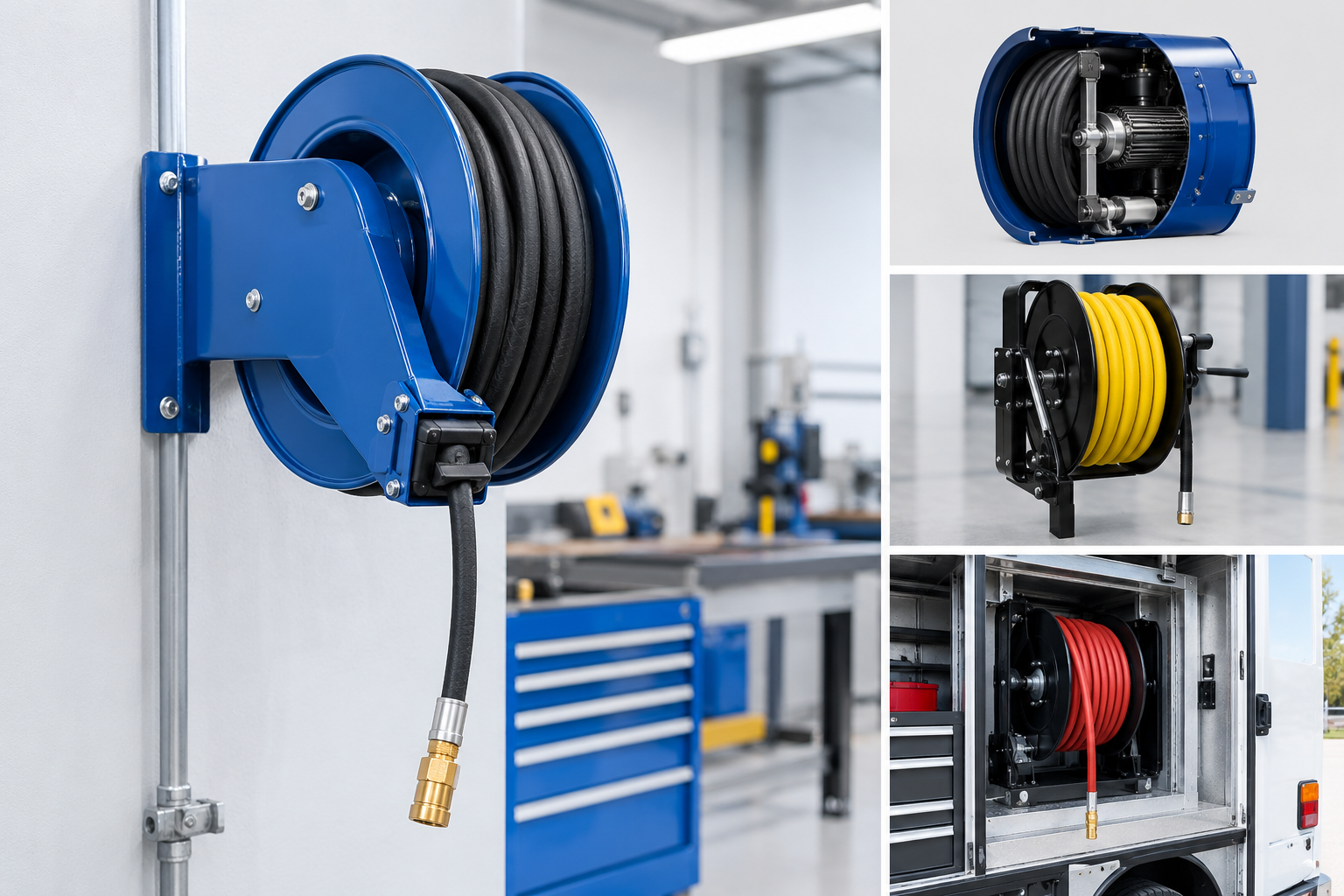
The compact hose reel is designed to accommodate and manage hoses in a small installation space. According to the application scene and operation requirements, it can be driven by manual, spring or other driving methods. “Compact” describes the overall size and space utilization of the reel, not a specific drive type.
The compact reel has obvious application value when the traditional size reel will hinder the operation of nearby equipment, reduce the available space in the work area, or occupy the position required by other operations. For example, a maintenance workstation may need to install a reel between two devices, while a service vehicle needs to accommodate multiple tools and hose systems simultaneously in a limited compartment space.
However, a smaller enclosure does not necessarily mean that the space utilization efficiency is higher. Internal drums, hose winding paths, driving mechanisms and structural parts also take up space. Compact reels need reasonable layout among these components, which not only provides practical storage capacity, but also does not affect normal operation.
1.1 Compact Design and Space Requirements
When evaluating the compact hose reel, the complete size of the equipment after installation should be considered, not just the shell size. Frame, mounting bracket, hose connector and surrounding equipment may affect the actual space required for the whole device.
Installation clearance is equally important. Even if the reel can be installed close to the designated area, it may affect the hose movement, joint inspection or routine maintenance due to lack of sufficient space. If the reel adopts spring-driven mechanism, it must also ensure that the hose can be pulled out and recovered smoothly without being hindered by nearby structures.
Therefore, the design of compact hose reel should reduce unnecessary space occupation, while retaining the space needed for safe and convenient operation.
1.2 Different Reel Structures for Compact Applications
The compact hose reel can adopt different operating mechanisms. If the frequency of hose use is low and you want to adopt simple mechanical operation, manual hose reel may be more suitable. Spring-driven hose reel can realize automatic recovery, and for applications that need longer hoses or more frequent operations, power-driven system can also be considered, provided that its capacity and structure meet the requirements of installation space and actual use.
There are manual, spring-driven and motor-driven types of compact hose reels. Different types have different ways of releasing and recycling hoses, so the use frequency, operation mode and available installation space of hoses should be considered when choosing.
2. How Does the Design of Compact Hose Reel Limit the Storage Capacity?
The storage capacity of the reel mainly depends on the available space inside for winding the hose. Even if the external dimensions of the two models are similar, the lengths of hoses they can accommodate may be different, because there are differences in drum dimensions, side plates, internal mechanisms and reserved gaps.
Therefore, the purchaser needs to distinguish between the overall occupied space of the reel and the space that can really be used to store the hose.
2.1 Drum Diameter and Available Winding Space
The diameter of the drum will affect the winding mode of the hose and how many layers of hose the drum can accommodate. The larger winding diameter may provide more pipe storage space under a certain width condition, but it will also increase the overall size of the reel.
Smaller reels help to reduce the space occupied by reels, but may limit the length of hoses that can be accommodated. In addition, according to the drum structure and hose characteristics, a smaller drum may also make the hose bend more tightly. If the bending degree exceeds the allowable range of the hose, the hose may be deformed, knotted or worn prematurely.
Therefore, when selecting the reel, both the reel size and the minimum bending radius specified by the hose manufacturer should be considered. The hose cannot be forced to bend with an excessively small radius in order to reduce the overall size.
When comparing different models, check the effective size of the drum and the capacity marked by the manufacturer for the actual hose specifications. It is impossible to accurately judge whether the reel meets the use requirements only by its external diameter.
2.2 Drum Width and Internal Clearance
The width of the drum determines how many hoses can be accommodated in each layer. A wider reel may accommodate more hoses without increasing the winding diameter, but it will also increase the overall width of the reel and the installation space. If the lateral space of the installation location is limited, a narrower drum may be more suitable. However, when the outer diameter of the hose is large, excessively reducing the drum width may limit the length of the hose that can be accommodated.
In addition, the effective width of the reel will be less than the total width of the surface of the reel. Side plates, hubs, internal joints and other structural parts all take up space, thus reducing the area actually available for winding hoses. Hoses must be arranged normally in this space, and cannot be forced to squeeze on other parts, and the operation of the reel cannot be affected by unreasonable winding method.
Therefore, when comparing different products, we should pay attention to the effective width of the reel, not the total width of the whole reel.
2.3 Trade-Off Between Hose Outer Diameter and Storage Capacity
The length of hose is not the only factor that determines the storage capacity. The outer diameter of the hose will also have a significant impact, because the larger the outer diameter, the more space each layer usually takes up.
For example, two hoses with the same length may need more storage space if one of them has a larger outer diameter. A compact reel that can accommodate a long thin hose may not be able to accommodate a thick hose of the same length.
Therefore, the marked capacity of the reel should be checked according to the outer diameter and length of the actual hose. If manufacturers provide capacity tables corresponding to different hose specifications, they should choose the data that matches the hose they plan to use, instead of just judging according to the maximum capacity marked on the product.
2.4 Recycling Mechanism and Internal Space Allocation
The recycling mechanism will also affect how much space inside the reel can be used to store hoses. In the spring-driven coil, the spring assembly and related components will occupy a part of the structural space. Power-driven reels may require extra space for motors, gears and other driving parts.
A smaller shell may also require a finer layout of the internal structure. However, in any case, the compact design should ensure that the hose can be wound neatly and the related mechanisms can operate normally without interference.
3. What Factors Need to Be Checked Before Choosing a Compact Hose Reel?
After determining the available installation space, the next step is to define the hose specifications and actual operation requirements. This can gradually narrow the product selection range without sacrificing the necessary performance.
3.1 Required Hose Length and Storage Capacity
First, determine the actual distance of the hose from the reel to the farthest working position. The hose must be able to reach the target position, while avoiding overstretching or adopting an arrangement that is easy to generate additional stress.
Then, confirm the hose length and outer diameter required for the application, and check whether the reel can meet both conditions. According to the marked capacity of the thinner hose, it cannot be directly judged that the reel can also accommodate the thicker hose with the same length.
In addition, just because the capacity marked on the reel is consistent with the required hose length, don’t assume that this model is suitable. It should also be confirmed whether this capacity data is suitable for the planned hose specifications and whether the corresponding winding method is suitable for daily operation.
3.2 Installation Clearance and Equipment Accessibility
Measure the height, width and depth of the installation area, and count the installation bracket and connecting parts beyond the main body shell. If the reel is installed on a service vehicle, the surrounding equipment, storage compartment and the space required by the operator when using the hose should also be considered.
The installation position should ensure that the hose can extend along the predetermined path to avoid repeated rubbing against sharp edges or surrounding equipment. The reel itself should also be convenient for inspection, connector maintenance and daily maintenance.
If the installation space is particularly limited, you can compare the complete dimensions of multiple models after installation. Even if the shell of a certain model is slightly larger, it may be a more practical choice as long as it can provide more suitable storage capacity or more convenient maintenance conditions and will not hinder the normal use of the work area.
3.3 Hose Weight and Working Conditions
The compact hose reel must be able to bear the weight of the hose and the load generated during normal operation. The weight of hose usually increases with the increase of length, and there are great differences due to different structures and materials. Longer or heavier hoses may put forward higher requirements for the structural strength and operating strength of the reel.
Working pressure, conveying medium, operating temperature and frequency of use should also be considered. Reels, hoses, rotary joints and connecting parts must match the actual application. For industrial applications, it is recommended to confirm these basic requirements before screening products according to size. This can avoid choosing a hose reel that can’t meet the working conditions in other aspects in order to save space.
4. What Scenarios Is the Compact Hose Reel Suitable for?
The compact hose reel is especially valuable when the installation space is limited, but it is still necessary to use the hose conveniently. Whether it is suitable or not depends on the relationship between available space, required hose length and actual working conditions.
4.1 Small Workshops and Workstations
In a small workshop, the compact hose reel can store the hose near the use position without occupying too much floor or workbench space. This is especially useful for maintenance workshops and areas where multiple tools need to share limited space.
If the installation surface and reel structure allow, wall mounting or equipment installation can be considered to free up floor space. However, it is still necessary to ensure that the hose can easily reach the work area and the installation position will not hinder the use of nearby tools or equipment.
4.2 Industrial Equipment Area
There may be insufficient hose storage space around industrial equipment, especially in the scene where hoses need to be used for cleaning, maintenance, gas supply or fluid transportation. Compact industrial hose reel helps to arrange hoses near equipment and reduce unnecessary accumulation.
However, the actual working environment must be considered when choosing. Chemicals, heat, moisture, wear or frequent operation may affect the required specifications of hoses and reels. Installation space should be evaluated in combination with these working conditions, rather than taking space size as the only basis for selection.
4.3 Service Vehicles and Mobile Work Areas
Service vehicles usually need to store hoses, tools, spare parts and other equipment in a limited compartment space at the same time. Compact hose reel can help to make more rational use of storage space, but its capacity must still meet the requirements of actual maintenance tasks.
The installation method, hose length and operating mechanism of the reel should match the vehicle layout. Hoses should be accessible without blocking doors, storage compartments or other equipment. In addition, when evaluating the installation structure, the vibration and impact generated during the running of the vehicle should also be considered.
5. When Should I Choose a Larger Hose Reel?
Compact hose reels are not always the most efficient solution. If the application needs to accommodate a long hose with a large outer diameter, it may require a larger drum diameter or a wider winding area. If the minimum bending radius of the hose cannot meet the structural requirements of a smaller reel, it is also necessary to consider a larger model.
When the hose is heavy, used frequently, or the working environment requires a stronger structure, a larger size reel may also be more suitable. In these cases, simply reducing the reel size may adversely affect the storage capacity, hose operation or maintenance space.
Before choosing a larger model, you can re-evaluate the actual limit. Sometimes the existing space can be used more effectively by adjusting the installation position, reducing unnecessary hose length, or choosing a reel structure with more reasonable spatial layout. However, any adjustment must ensure that the hose length and working requirements are still met.
Summary
Compact hose reel can help workshops, industrial equipment areas and service vehicles to better manage hoses in the case of limited installation space. Before selecting a product, you should confirm the length and diameter of the required hose, check the capacity specifications provided by the manufacturer, and measure the complete installation space. At the same time, the bending requirements, working conditions and maintenance space of the hose should also be considered.
Suitable compact hose reel should not only make effective use of installation space, but also meet the storage capacity and operational performance required by practical application, rather than simply pursuing smaller overall size.
Related Posts
DEF Compatible Hose Reels: What Specifications Can’t Be Ignored?
October 10, 2026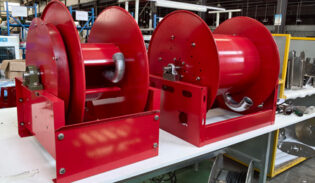
Primary Categories and Characteristics of Industrial Hose Reels
October 28, 2025