How to Choose Garden Hose Reel Materials for Different Climates
October 19, 2026 | Garden Hose Reels
The garden hose reel is exposed to the outdoor for a long time, which may be affected by environmental factors such as sunshine, rainfall and temperature change. These conditions will affect the durability, structural stability and maintenance requirements of the reel. Choosing a suitable garden hose reel should not only consider the appearance and price, but also comprehensively judge the local climate, hose weight and frequency of use.
Plastics, powder coated steel, aluminum and stainless steel have different characteristics. Understanding the performance of these materials in different environments is helpful for home users and buyers of gardening equipment to choose garden hose reels that are more suitable for outdoor space and actual use needs.
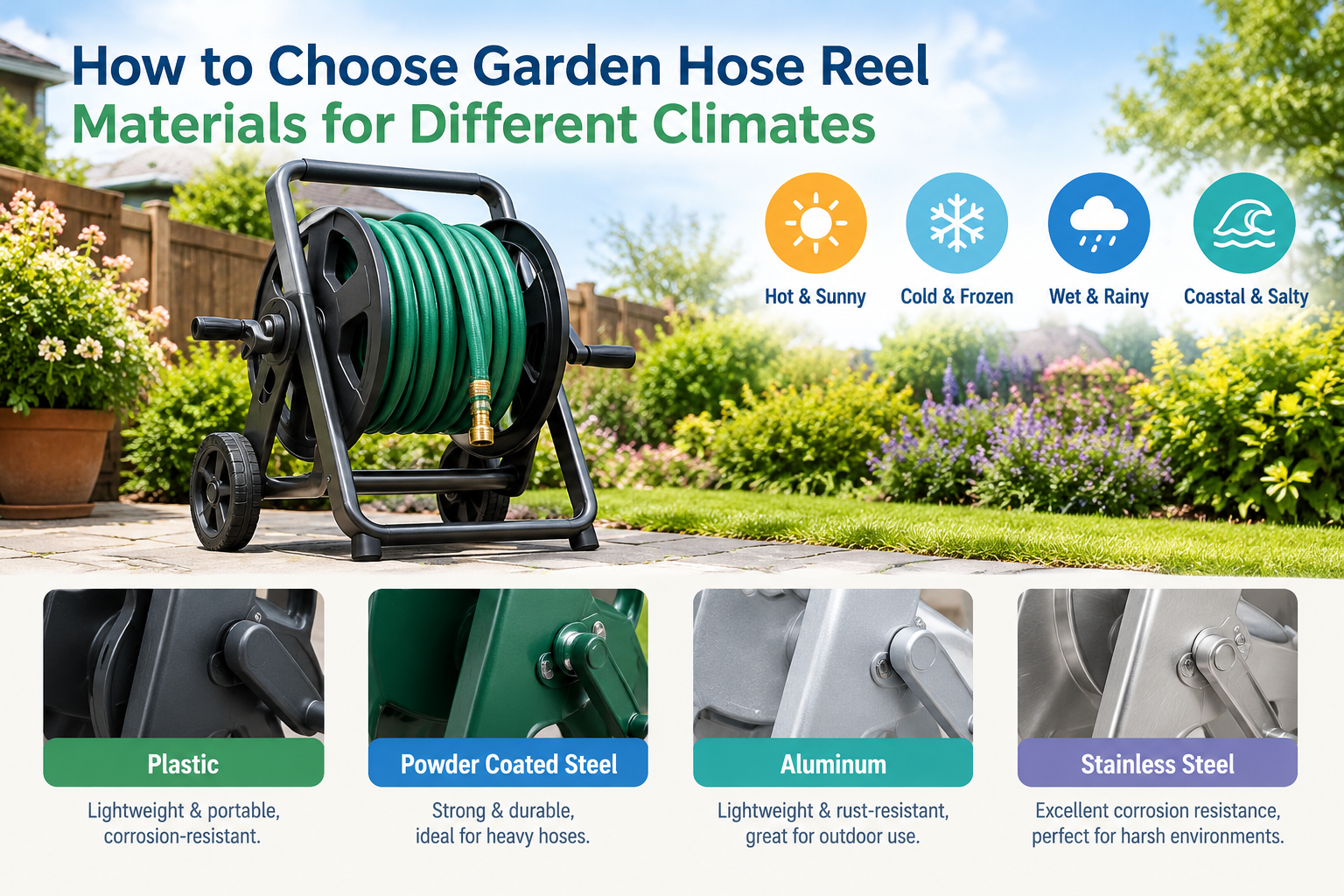
1. How Does the Climate Affect the Material of Garden Hose Reel?
1.1 Hot Weather and Strong Sunshine
In a hot and sunny environment, long-term ultraviolet radiation may gradually cause some plastic materials to age, fade, brittle or crack. High temperature may also affect the strength and dimensional stability of some plastics. The specific degree of influence depends on the material formula, ultraviolet stabilizer and product structure.
Metal reels face different challenges. If the paint surface or powder coating is damaged, the underlying metal may be exposed to wet environment, thus increasing the risk of corrosion. Aluminum and stainless steel have different corrosion resistance characteristics, but the actual performance still depends on the specific alloy, surface treatment and use environment.
For gardens that are often exposed to direct sunlight all day, plastic scrolls with proven ultraviolet resistance or metal scrolls with appropriate outdoor protective coating should be selected. If conditions permit, storing the garden hose reel in the shade when not in use will also help to reduce unnecessary environmental exposure.
1.2 Cold Weather and Frozen Environment
Low temperature may reduce the impact resistance of some plastics, making them easier to crack when falling or being hit. Metal reels can usually maintain good structural rigidity, but whether they are suitable for cold environment still depends on the material grade, structural design and expected service conditions.
Cold weather will also affect the hose itself. Hoses may harden at low temperatures, making it more difficult to pull out and recycle. If the hose is forcibly wound on the drum with too small diameter, it may increase the stress borne by the hose and its connecting parts.
When selecting the garden hose reel for cold areas, the reel material, the minimum working temperature of the hose and the recommended minimum bending radius should be considered at the same time. When freezing weather is expected, the residual water in the hose should be drained and stored according to the manufacturer’s instructions.
1.3 Wet and Rainy Environment
Frequent rainfall, irrigation or high humidity environment will make the corrosion resistance of metal hose reel particularly important. Carbon steel may rust when the protective coating is scratched, peeled off or worn. Regular inspection of surface coatings, fasteners and joints will help to find potential problems in time.
Plastic hose reels do not rust like carbon steel, so they may have certain advantages in humid environment. However, its frame and moving parts still need to have sufficient strength, especially when carrying long or heavy hoses.
According to the specific environment, aluminum, stainless steel or well-protected coated steel hose reels can also be considered. No matter which material you choose, you should try to avoid long-term water accumulation in the garden hose reel and check the exposed parts regularly.
1.4 Coastal Areas and Salt Exposure Environment
Coastal gardens face additional corrosion risks because salt deposition may accelerate the corrosion of certain metals. Metal hose reels that perform well in ordinary residential gardens may need more frequent maintenance at the seaside.
Stainless steel has certain corrosion resistance, but different grades of stainless steel behave differently in chloride-rich environment. There are also differences in salt spray resistance between aluminum alloy and coated steel. Even if the main frame is kept in good condition, fasteners, brackets and joints may still be corroded.
For coastal environment, products with material grade and surface protection suitable for actual salt exposure conditions should be selected. With the permission of the manufacturer, it is also helpful to wash the salt deposits with clean water regularly.
2. Comparison of Common Garden Hose Reel Materials
Climatic conditions help to determine the material properties that need to be paid attention to, but the final choice also depends on the structure of garden hose reel, hose capacity and usage.
2.1 Plastic Garden Hose Reel
Plastic garden hose reels are usually light in weight and easy to move, and are suitable for small gardens, courtyards and daily watering scenes. Compared with ordinary carbon steel, plastics will not have similar corrosion problems.
Its performance depends on the type of plastic, ultraviolet stabilizer, wall thickness and structural design. Poor quality plastics may become fragile after long-term exposure to the sun or repeated temperature changes. Lighter frames may also be unsuitable for carrying longer and heavier hoses.
If portability and convenience of operation are the main considerations, plastic hose reels deserve priority. But for outdoor use all year round, it should be confirmed whether the product is suitable for the local temperature range and can withstand long-term ultraviolet radiation.
2.2 Powder Coated Steel Garden Hose Reel
Steel garden hose reel usually has good structural strength and is suitable for carrying heavy hose components. For large gardens, long hoses and scenes requiring frequent operations, steel hose reels may be a suitable choice.
Its main limitation is that corrosion may occur after the coating is damaged. The quality of protective coating, steel structure, and the design of edges and joints will all affect the long-term performance of products.
If high strength and stability are needed, powder coated steel hose reel is a worthy choice, provided that its surface protection is suitable for outdoor environment and can be maintained when necessary. In wet or coastal areas, special attention should be paid to the corrosion resistance grade of products.
2.3 Aluminum Garden Hose Reel
Aluminum garden hose reel has the characteristics of relative lightness and certain structural rigidity, which can meet the needs of many outdoor applications. Under similar component sizes, aluminum is usually easier to move than steel, and it will not produce red rust like ordinary carbon steel.
However, aluminum is not completely non-corrosive. Some alloys and surface states are more easily affected in certain environments, including the erosion of salt and certain chemicals. Frame thickness, connection design and overall structure will also affect the bearing capacity.
For users who need portable metal hose reels, aluminum hose reels may be a suitable choice. Before purchasing, it should be confirmed whether the marked hose capacity, materials and surface treatment are suitable for the local climate.
2.4 Stainless Steel Garden Hose Reel
Stainless steel garden hose reel may have certain advantages in humid and corrosive environment. However, its corrosion resistance depends on stainless steel grade, surface condition and surrounding environment.
If the grade of stainless steel used in the product is suitable for the actual environment, stainless steel reels can be used in areas that are often exposed outdoors or near the coast. But stainless steel does not mean that it is completely maintenance-free, especially in the case of salt accumulation or contact between different metals.
For ordinary family gardens, choosing stainless steel is not always necessary. Before purchasing, we should judge whether it is worthwhile to choose stainless steel instead of plastic, aluminum or coated steel in combination with environmental exposure, product structure quality and maintenance requirements.
3. Comparison of Garden Hose Reel Materials in Different Climates
The following table can help to preliminarily screen materials, but it is not an absolute ranking for all products, because the material quality and structural design of different products may be quite different.
Main purchasing factors of materials that can be considered in climatic or environmental conditions.
| Climatic or Environmental Conditions | Materials That Can Be Considered | Main Purchasing Factors |
|---|---|---|
| Strong heat and sunshine | UV-resistant plastic, UV-resistant metal with proper protection | Heat resistance and durability of surface treatment. |
| Cold, easy to freeze | Plastic or metal verified by corresponding environment | Low-temperature performance and structural strength. |
| Wet and rainy | Plastic, aluminum, stainless steel or well-protected steel | Corrosion resistance, drainage and maintenance. |
| Coastal areas | Materials and surface treatments suitable for salt-exposed environment | Stainless steel grade, coating quality and fasteners. |
| Used outdoors all year round | Weather-resistant plastics or properly protected metals | Temperature range, ultraviolet resistance and maintenance requirements. |
No material can adapt to all climates. In some circumstances, a well-structured plastic hose reel may be more durable than a poorly protected metal hose reel; For heavier hoses, properly treated metal frames may also provide better support than light plastic structures.
4. How to Choose the Right Hose Reel Material for the Garden?
4.1 Select Materials According to Local Climate
First, determine the most important risks in the local environment. In the garden with strong sunshine, anti-ultraviolet performance may be a priority factor; In rainy areas, corrosion resistance and drainage design are more important; In coastal areas, we should focus on the influence of salt exposure on metal materials and surface protection.
If the garden is hot in summer and cold in winter, the range of annual temperature change should be considered, rather than selecting hose reels only according to the performance of a certain season.
4.2 Consider the Length, Diameter and Weight of the Hose
The garden hose reel must match the hose used. The longer the hose or the larger the diameter, the more storage space is usually needed; A heavier hose will increase the load on the drum, frame and mounting point.
For example, according to the specific structure and specifications, rubber hoses may be heavier than some PVC or PU hoses of the same specifications. The hose reel suitable for short and light watering hoses may not be able to carry longer and heavier hoses.
The capacity marked by the manufacturer for the corresponding hose diameter should be checked. For the movable garden hose reel, the stability of the base, the strength of the wheel and the convenience of movement after loading the hose should also be considered.
4.3 Evaluation of Structural Design and Surface Protection
The durability of the garden hose reel is not only determined by the frame material. Wall thickness, reinforcement structure, joints, fasteners and surface treatment quality will all affect the performance of products in outdoor environment.
For plastic hose reels, check their ultraviolet resistance and applicable temperature range. For coated steel hose reels, attention should be paid to the quality and coverage of protective coating. For aluminum and stainless steel hose reels, it should be confirmed whether the specific material specifications are suitable for the expected use environment.
4.4 Consider Maintenance and Seasonal Storage.
Maintenance requirements should match the actual use. Outdoor hose reels should be cleaned and inspected regularly, paying special attention to joints, fasteners, moving parts and places where water is easy to accumulate.
If freezing weather may occur in winter, the hose should be emptied and stored according to the manufacturer’s instructions. In hot areas, reducing long-term direct sunlight helps to protect materials that are prone to aging. In coastal areas, removing accumulated salt helps to reduce the risk of corrosion.
No matter what kind of main material is used for the garden hose reel, proper storage and regular maintenance will help to prolong its service life.
5. Summary: Choose the Garden Hose Reel Material by Climate and Use Requirements
Choosing garden hose reel materials according to different climates requires comprehensive consideration of weather resistance, structural strength, hose capacity, portability and maintenance requirements. Plastic is suitable for everyday gardening scenes that pay attention to portability; Steel may provide better structural support; Aluminum reel has both lightweight and metal structure characteristics; Stainless steel is suitable for environments that require corresponding corrosion resistance.
The final choice should be based on the specific product, not just the name of the material. By evaluating the local climate, hose size and weight, surface protection and expected maintenance methods, users can choose hose reels that are more in line with the garden environment and long-term use requirements.
Related Posts
Can a Heavy-Duty Water Hose Reel be used as a…
August 20, 2026
Negative vs. Positive Pressure: Hose Reel Design
October 15, 2026
Oil Hose Reel Solutions for Lubrication Systems
July 23, 2026