Industrial Hose Reel Price Guide: Cost & Quotation Analysis
October 16, 2026 | Industrial Hose Reels
The price of industrial hose reel varies with reel type, material, pressure grade, hose capacity and application requirements. Even if the two hose reels are similar in appearance and use, there may be obvious differences in their prices, because the internal components, driving mechanism and working specifications may be different.
For the purchasing team, understanding these cost factors is helpful to compare supplier quotations and make a reasonable equipment budget. The product with the lowest initial purchase price may not have the best cost performance, especially when the installation, maintenance, spare parts replacement and downtime costs need to be considered.
This article will introduce the main factors that affect the industrial hose reel price, the contents that should be included in the quotation, and how to compare the quotations from different manufacturers.
1. What Factors Determine Industrial Hose Reels Price?
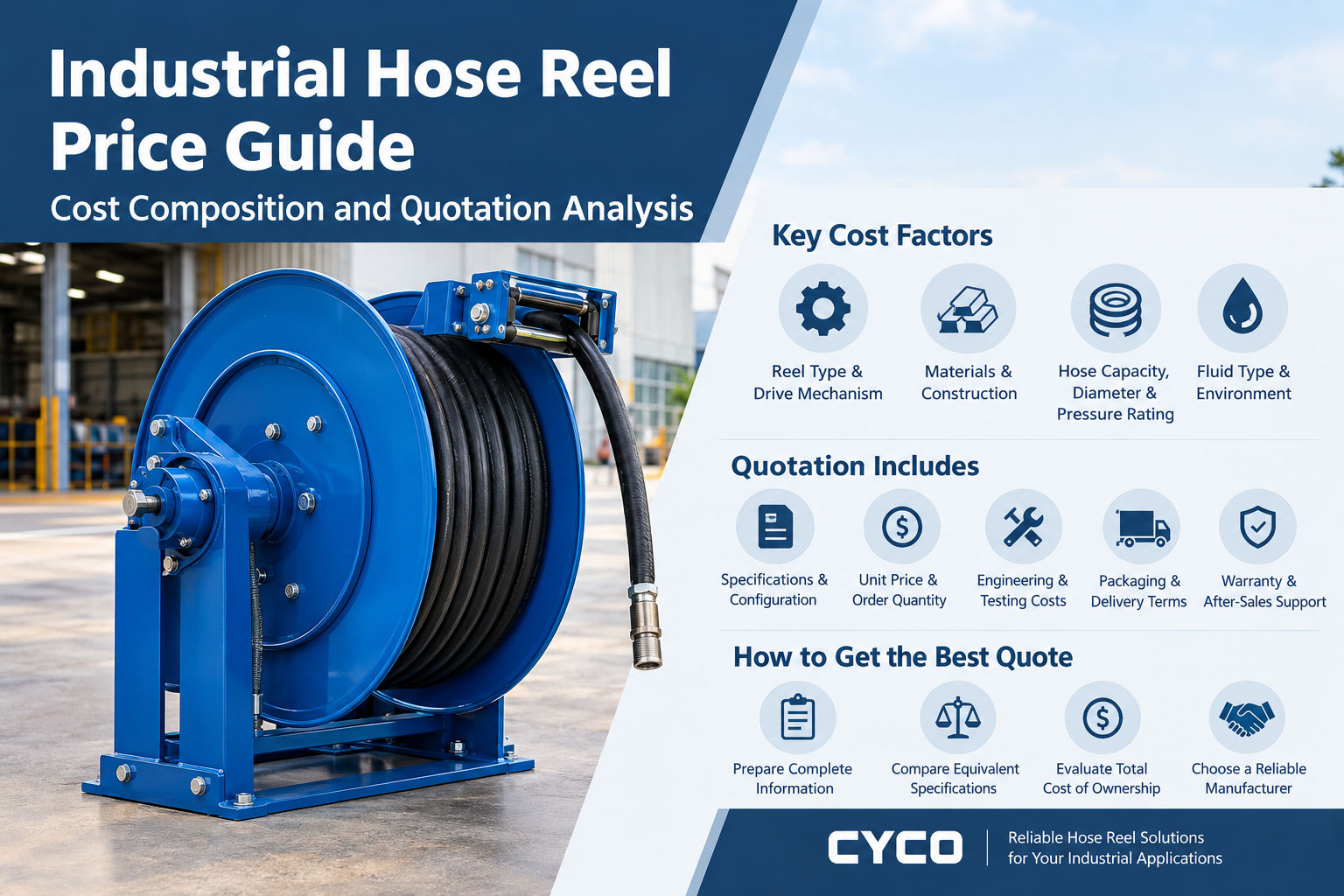
Industrial hose reel price depends on the material, mechanical structure, working requirements and manufacturing complexity. Understanding these factors can help the purchaser to know which specifications are necessary and which costs can be controlled reasonably.
1.1 The Reel Type and Driving Type
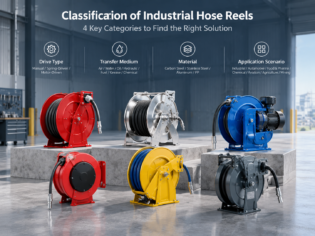
Driving mechanism is one of the main factors affecting the cost of hose reel. Manual, spring-driven and electric hose reels adopt different components and working principles.
Manual hose reel usually has a simple mechanical structure, which is suitable for the scene where the operator can retract the hose manually. Its cost depends on factors such as frame strength, drum capacity and hose fixing mechanism.
Spring-driven hose reel uses spring mechanism to recover hose. Its structure includes related components that control the recycling process and support repeated operations. Therefore, spring specifications, recovery performance and protection function will all affect the final price.
Electric hose reels need to be equipped with a drive system, and may also contain control devices, electrical components or other power-related equipment. Its cost depends on the motor configuration, torque requirements, control mode and expected working conditions.
When selecting the driving mode, the hose weight, frequency of use, working environment and available power should be considered comprehensively. Choosing a driving mechanism whose complexity exceeds the actual demand may increase the procurement cost, but it cannot bring obvious operational benefits.
1.2 Materials and Structures
Material selection not only affects the manufacturing cost, but also affects the service life of products. Carbon steel is often used in applications that require a strong supporting structure, while stainless steel may be more suitable in environments where there is a risk of corrosion, frequent washing is required or there are specific requirements for material compatibility.
However, the material itself cannot completely determine the quality and price of the hose reel. Plate thickness, frame structure, surface treatment, shaft structure and the quality of key components will also affect the final cost.
For example, hose reels installed in a drying workshop may not need the same anti-corrosion measures as hose reels exposed to humid environment, cleaning chemicals or outdoor conditions for a long time. If all applications use stainless steel, it may cause unnecessary cost increase; However, if the anti-corrosion protection is insufficient, it may also lead to premature damage and replacement of the product.
Therefore, the purchaser should evaluate the material requirements according to the actual working environment, conveying medium and expected maintenance conditions.
1.3 Hose Capacity, Diameter and Pressure Grade
The hose capacity will affect the size and structural requirements of the hose reel. The longer the hose or the larger the diameter, the more hose reel space is usually needed, which may increase the overall size, weight and material consumption of the reel.
The weight of the hose and its bending characteristics are also important. Reels used to carry heavy hoses may need to have stronger frames, shafts, drums and installation structures than light hose reels.
Pressure requirements will bring other design considerations. Hoses, rotary joints, seals, joints and other pressure-bearing parts must be suitable for the expected working conditions. Higher pressure levels may require stronger components, stricter manufacturing control or additional testing.
It is important to note that the pressure rating of the hose does not automatically represent the pressure rating of the whole hose reel assembly. Purchasing personnel should confirm the applicable pressure range of complete components, and not just judge according to the specifications of a certain component.
Providing accurate hose size, working pressure, conveying medium and required capacity is helpful for manufacturers to provide configuration quotations that meet actual needs and avoid affecting procurement costs due to incomplete specifications or improper selection.
1.4 Transport Medium and Working Environment
The conveying medium will affect the materials and components required for the reel. Air, water, oil, hydraulic oil, chemicals and other media may have different compatibility requirements for hoses, seals and rotary joints.
Environmental conditions will also affect product configuration. Outdoor installation may require additional anti-corrosion protection, while equipment used in frequent washing areas needs materials and structures suitable for cleaning methods.
Applications involving special temperature, highly corrosive chemicals or specific safety requirements may require additional engineering design and verification. These requirements will increase the cost, but should be evaluated according to the actual application, rather than adding configuration without clear technical basis.
2. How Does Customization Demand Affect the Industrial Hose Reels Price?
When the standard model meets the application requirements, unnecessary customization costs can usually be reduced. If the installation space, hose size, working conditions or equipment interface are beyond the standard configuration range, it may need to be customized.
2.1 Installation Mode and Structure
Wall-mounted, floor-mounted, vehicle-mounted and equipment-integrated hose reels may require different brackets, supporting structures and mounting accessories.
Customizing the installation structure may increase the cost of processing and engineering design, and may also affect the packaging and installation requirements. Purchasing personnel should provide available installation space, load requirements and related equipment drawings as soon as possible.
2.2 Rotating Joints, Hose Guides and Accessories
Accessories may occupy a considerable part of the cost, especially when the application requires special connection methods or additional operation functions.
Depending on the specific configuration, accessories may include hose guides, adjustable stops, rotary joints, special joints, protective covers and installation accessories. Each component should have a clear practical purpose.
An effective way to control costs is to distinguish between necessary components and optional functions. However, components that are essential for pressure bearing, safe operation or media compatibility cannot be cancelled at will just to reduce the quotation.
2.3 Non-Standard Specifications and Special Requirements
Customized hose length, special drum size, special materials, alternative drive system and non-standard interface may increase design workload or production adjustment cost.
According to the requirements of the project, the manufacturer may also charge for prototyping, tooling, samples, special tests or customized documents. Because these costs need to be allocated to the product quantity, the impact on small batch orders may be more obvious.
Before putting forward customization requirements, the purchaser should first confirm whether the existing models can meet the requirements. If the standard configuration conforms to the actual working conditions, there is usually a chance to obtain shorter delivery time and lower cost.
3. What Content Should an Industrial Hose Reel Quotation Include?
A clear quotation should specify the product configuration and commercial terms, so that the purchaser can compare different suppliers under the same conditions.
3.1 Product Specifications and Configuration
The quotation should indicate the product model, driving mode, material, hose capacity, pressure grade, installation method and accessories included. If the product contains hoses, the hose specifications should also be listed; If the hose is not included, it should be clearly stated.
Any configuration inconsistent with the procurement requirements shall be indicated in the quotation. Otherwise, the lower quotation may only be due to the different product configurations, rather than the supplier’s real price advantage.
3.2 Unit Price, Order Quantity and Minimum Order Quantity
The unit price of the product may vary according to the ordered quantity, production arrangement and customization requirements. Some manufacturers will provide ladder prices according to the purchase quantity, while others may set minimum order quantities for specific models or customized products.
The purchaser should confirm that the quotation is applicable to the actual ordered quantity, and know whether the price is still valid when purchasing repeatedly in the future. For larger procurement projects, suppliers can also be required to provide quotations corresponding to different order quantities to evaluate the possible cost changes caused by centralized procurement.
3.3 Engineering Design, Tooling and Testing Costs
Customized projects may incur additional expenses beyond the unit price, such as design work, tooling, prototyping, sample evaluation and special testing.
The quotation should specify which services are included and which need to be charged separately, and at the same time explain whether these charges will be repeated in subsequent orders. This difference is especially important when comparing standard product quotations with quotations that include engineering design or verification services.
3.4 Terms of Packaging, Transportation and Delivery
The price of the product itself does not represent the final purchase cost. Packaging, freight, insurance, import duties, taxes and other applicable fees may all affect the actual payment amount.
For international procurement, the buyer shall confirm the place of delivery, mode of transportation, delivery cycle and applicable international trade terms. These terms determine how buyers and sellers allocate expenses, responsibilities and risks.
If conditions permit, we should try our best to use the same delivery conditions for quotation comparison. For example, the ex-factory price cannot be directly compared with the delivery price including transportation, otherwise the wrong cost conclusion may be drawn.
3.5 Warranty and After-Sales Support
Warranty scope, spare parts supply, maintenance arrangement and technical support will all affect the long-term use cost of products.
Procurement personnel should know the warranty period, covered parts, exclusions, and the handling process in case of product problems. At the same time, whether replacement parts can be obtained within a reasonable time should also be considered.
Products with higher quotations may contain more services or support, but the value of these services should be evaluated according to the actual operation requirements, and it cannot be directly assumed that the higher the price, the more cost-effective.
4. How to Get an Accurate Quotation for Industrial Hose Reels?
To some extent, the accuracy of quotation depends on whether the information provided by the purchaser is complete. The requirement description is too general, which may cause the manufacturer to provide only a preliminary estimate, or the recommended configuration can not meet the actual work requirements.
When contacting the manufacturer of industrial hose reels, it is recommended to prepare the following information:
- Application Scenario and Conveying Medium: explain the specific use, conveying medium and working environment of the hose reel.
- Hose Specification: Provide hose length, inner diameter, outer diameter and related material requirements.
- Working Conditions: describe the working pressure, temperature range, frequency of use and special environmental conditions.
- Reel Configuration: define the driving type, installation mode and available installation space.
- Accessories and Connection Methods: list the required joints, hose guides, stops and other necessary components.
- Ordered Quantity: describes the estimated purchase quantity and whether there are duplicate purchase requirements in the future.
- Delivery Requirements: provide the delivery place, target delivery date, and packaging or documentation requirements.
- Customization and Test Requirements: explain the non-standard configuration and the necessary verification or inspection requirements.
Providing drawings, on-site photos, existing product models or equipment interface information can help manufacturers evaluate the demand more accurately. If some specifications have not been determined, the actual working conditions should be explained and the manufacturer should be asked to recommend the appropriate configuration.
Complete inquiry information helps suppliers find technical limitations as soon as possible, reduce repeated revisions and provide more convenient quotations.
5. How to Compare the Quotations of Different Industrial Hose Reel Manufacturers?
After collecting quotations, the next step is to confirm whether the products and business conditions provided by hose reel manufacturers are comparable.
5.1 Compare the Same Product Specifications
First, prepare a unified specification list for all suppliers, specifying hose capacity, working pressure, conveying medium, materials, driving mode, installation mode and necessary accessories.
Next, check the differences between each supplier’s plan and the procurement requirements. For example, if the quotation lacks necessary joints, uses different materials, or uses parts with lower rated pressure, it cannot be directly compared with the quotation with complete configuration.
If the technical details are not clear, the supplier shall be required to provide written confirmation before making a purchase decision.
5.2 Evaluate the Total Cost of Ownership
The total cost of ownership includes not only the purchase price, but also the losses caused by installation, routine maintenance, spare parts replacement, energy consumption, maintenance and equipment downtime.
For example, in the scene with high frequency of use, although the initial price of electric hose reel is higher than that of manual model, it may reduce the labor of operators. On the contrary, in scenes with low frequency of use, electric drive may not bring obvious benefits.
Which scheme is more economical depends on the actual workload, expected service life and maintenance cost. Purchasing personnel should compare the real usage scenarios, instead of simply thinking that the cheapest or most expensive model must have the best cost performance.
5.3 Identify Additional Costs That May Be Overlooked
Before placing an order, it should be confirmed whether the quotation includes all necessary accessories, installation parts, technical documents, packaging and transportation costs.
For customized products, it should also be verified whether the engineering design fee, sample fee and special test fee have been included in the quotation. At the same time, we should know whether there will be additional costs or extended delivery time if the product is modified after confirmation.
Clarifying these matters in advance will help to avoid unexpected expenses and reduce the risk of delivery delay caused by missing parts or incomplete specifications.
6. Summary
The industrial hose reel price depends on the driving type, material, hose capacity, pressure requirements, working environment and customization. Commercial factors such as order quantity, test cost, packaging, transportation and warranty conditions will also affect the final purchase cost.
For purchasing personnel, a more reliable method is to define the required specifications first, compare suppliers’ quotations under the same conditions, and comprehensively evaluate the total cost of ownership, instead of just focusing on the initial purchase price.
Cooperation with experienced industrial hose reel manufacturers is also helpful to determine the appropriate standard configuration, clarify the customization requirements, and avoid paying extra fees for unnecessary functions in practical applications.
CYCO provides industrial hose reel solutions for different work requirements, and can provide corresponding configurations according to specific applications. Purchasing personnel can submit hose specifications, working conditions, installation requirements and order quantities to obtain quotations suitable for project requirements.
Related Posts
Welding Hose Reel Safety for Farms and Mobile Welding
October 12, 2026