Ground-Mounted Hose Reel: Application and Selection Guide
November 2, 2026 | Industrial Hose Reels
Introduction
Industrial hose reels can be installed in different locations according to the site space, hose use requirements and actual working conditions. Although wall-mounted and ceiling-mounted reels are common in workshops and production areas, some application scenarios require a stable installation point on the ground. In this case, the ground-mounted hose reel can provide practical solutions for hose management near mechanical equipment, industrial equipment and fixed workstations.
The ground-mounted hose reel is fixed on the ground or supporting foundation through the base or mounting structure. It can be used for storing and retracting different types of hoses, including water hoses, air hoses, oil hoses and hydraulic hoses. Compared with the portable hose reel, this installation method can provide a fixed operating position, which is suitable for the scene where the hose needs to be unfolded and recovered repeatedly in a specific working area.
However, choosing a floor-mounted hose reel is not just about determining the installation position. Hose weight, working pressure, reel capacity, installation conditions and surrounding working environment will all affect its applicability. Understanding these factors is helpful for industrial facilities to choose hose reels that meet the actual operation requirements.
What Is a Floor-Mounted Hose Reel?
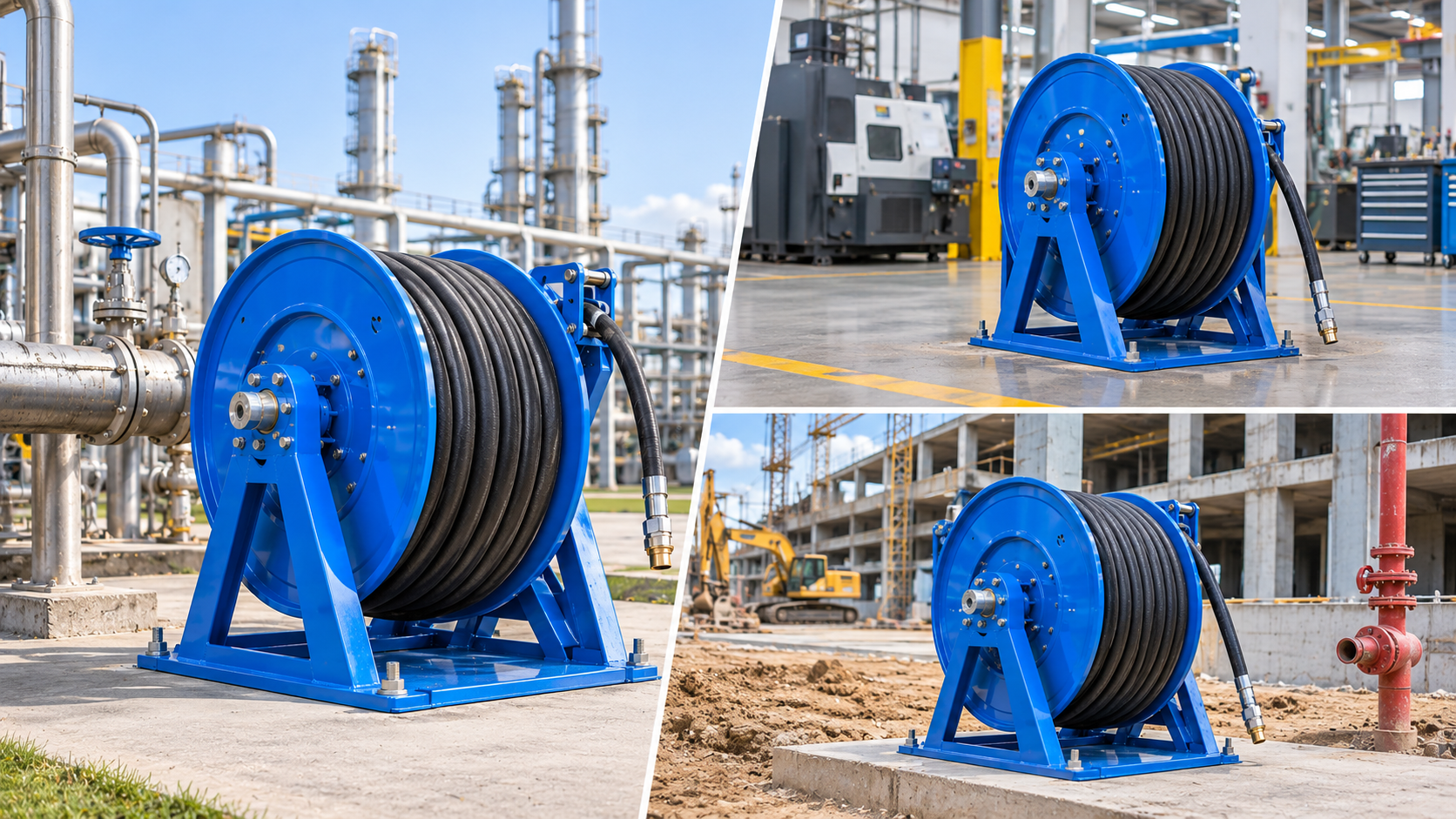
The ground-mounted hose reel is a kind of hose storage and management equipment installed on the ground or reinforced concrete and other special foundations. It is fixed on the supporting surface through the base and appropriate installation fittings, so that the hose reel can be kept in the specified position during the hose deployment and recovery.
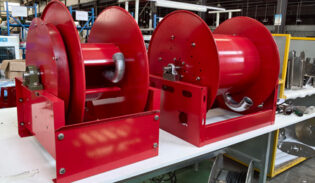
Its main components usually include drum, supporting frame, bottom plate, hose connecting parts and driving mechanism. According to the specific model, the hose reel can be operated manually, driven by spring or driven by motor. Spring-Driven Hose Reels can be considered for applications that need to automatically recycle hoses. The specific configuration depends on the hose size, application requirements and frequency of use.
Unlike mobile hose reels that can be moved between different working areas, ground-mounted hose reels are fixed in one place. It is also different from the wall-mounted hose reel, which carries the weight of equipment through the wall structure, while the ground-mounted hose reel transfers the load to the ground or infrastructure.
Why Choose a Floor-Mounted Hose Reel?
When the fixed hose supply point needs to be set near the ground, and the on-site wall or ceiling structure can not meet the load-bearing requirements of the reel, the ground installation method is very necessary.
Stable Support for Heavy Hose Reels
Industrial hoses may have a large weight, especially hoses with large diameter, long length or reinforced structure. The combination of the hose weight and the weight of the hose reel structure, coupled with the force generated during the expansion and recovery of the hose, will put forward higher requirements for the installation structure.
Properly fixed ground-mounted hose reels can transfer loads to the ground or infrastructure. This is especially useful for some large hose reels that are difficult to be supported by walls or high structures. However, the actual stability still depends on the strength of the supporting surface, the base structure, the anchoring method and the installation quality.
Flexible Tube Convenient for Fixed Workstation to Use
Some industrial operations need to use hoses repeatedly at the same workstation. The ground-mounted hose reel can be set near the equipment or service point to provide a fixed hose use position for the operator, without having to move the independent reel to the work area every time.
This installation method is suitable for fixed cleaning stations, mechanical equipment maintenance areas, and production equipment that needs to be connected with air, water or other fluid pipelines regularly.
Flexible Arrangement of Installation Location in the Work Area
As long as the installation location has enough space and suitable basic conditions, the ground-mounted hose reels can be arranged according to the factory layout.
This installation method will be more practical when the nearby wall has been occupied by hoses, electrical equipment or other machinery. At the same time, it is also convenient to establish a special hose supply point in the open work area.
Convenient Inspection and Maintenance
If the installation location is easy to access, the ground-mounted hose reel can make it easier for maintenance personnel to check the drum, hose connection, fixing fittings and driving mechanism.
During installation, sufficient space should be reserved around the hose reel for normal operation and routine maintenance of the hose. If the hose reel is too close to other mechanical equipment, it may increase the inspection difficulty and limit the moving range of the hose.
Common Application Scenarios of Ground-Mounted Hose Reel
The ground-mounted hose reel is suitable for industrial environment where hoses need to be used frequently in fixed working positions. The specific application depends on the type of hose, the required working pressure and the available installation space on site.
Industrial Cleaning Station
Industrial cleaning operations usually require the use of water hoses to clean different parts of machinery, production equipment and work areas. The ground-mounted hose reel can be installed near the designated cleaning station to provide a fixed hose supply point for the site.
For high-pressure cleaning applications, the rated working pressure and temperature of hoses, reels, rotary joints and connecting parts must meet the actual requirements. At the same time, the installation structure of the hose reel also needs to be able to withstand the force generated during the expansion and recovery of the hose.
Manufacture Plant
The manufacturing plant may need to use compressed air, water, lubricating oil and other industrial media in the production area. When a workstation needs to use hoses regularly, the ground-mounted hose reel can help to establish a dedicated hose management point.
For factories that use multiple media at the same time, different hoses and connection interfaces should be distinguished by clear labels and identification systems to avoid misuse.
Equipment Maintenance Area
Maintenance personnel usually need to use hoses to clean equipment, supply compressed air or transport lubricating oil when overhauling mechanical equipment. The hose reel is fixedly installed near the maintenance workstation, so that the hose can be accessed at any time, and the operator does not need to carry the storage equipment between different tasks.
The position of the hose reel should ensure that the hose can reach the equipment that needs maintenance, and at the same time avoid the hose from passing through the main traffic passage or interfering with the operation of nearby equipment.
Building Construction and Infrastructure Projects
Water hoses may be needed for concrete washing, equipment cleaning and daily site maintenance at the construction site. In areas where fixed service points have been set, ground-mounted hose reels can be used as fixed hose storage locations.
Because the ground is often uneven, heavy vehicles pass through and the operation layout is constantly changing in the construction environment, it is necessary to pay special attention to the supporting foundation and installation position. The hose reel shall not obstruct the passage of vehicles, material handling or people walking.
Outdoor Industrial Facilities
Outdoor work areas may lack suitable wall installation conditions, and it is necessary to extend hoses to different equipment distributed in open areas. When the ground or foundation can provide sufficient support, the ground hose reel can be installed at the designated service point.
For outdoor installation, reel materials, surface treatment technology, fasteners and exposed parts suitable for local weather and working environment should be selected. At the same time, it is also necessary to consider the drainage situation to avoid water accumulation around the installation base.
Difference Between Floor-Mounted and Wall-Mounted Hose Reels
Both floor-mounted and wall-mounted hose reels can provide fixed hose storage methods, but they are different in support structure and installation requirements.
| Comparison Factor | Ground-Mounted Hose Reel | Wall-Mounted Hose Reel |
|---|---|---|
| Supporting structure | Floor or dedicated foundation | Wall or structural support |
| Load transfer | Transfers loads to the floor or foundation | Transfers loads to the wall structure |
| Installation location | Open areas and fixed service points | Locations with suitable walls |
| Space requirements | Requires floor space around the base | Uses wall space and reduces floor occupation |
| Main installation considerations | Floor strength, base dimensions and anchors | Wall strength, mounting brackets and fixing points |
| Typical applications | Fixed industrial workstations and equipment areas | Workshops, production lines and maintenance stations |
The two installation methods are not applicable in all cases. When there is no suitable wall support near the ground, or the hose reel needs to be installed near the ground equipment, the ground installation may be more practical. If the site floor space is limited and the wall can safely carry the reel, wall-mounted installation may be more suitable.
The actual load, available supporting structure, hose arrangement and maintenance requirements should be considered comprehensively when selecting, rather than making a decision only based on the installation method.
Key Points of Selection of Ground-Mounted Hose Reel
When selecting the ground-mounted hose reel, besides considering the specifications of the hose and the reel itself, it is also necessary to focus on evaluating the base structure, ground bearing capacity and actual installation conditions. These factors directly affect the stability of the hose reel after fixing, and also determine whether the equipment can adapt to long-term use.
Base Size and Supporting Structure
Ground-mounted hose reels are usually fixed to the ground through the bottom plate or supporting base. The size, thickness, structural form and the position of fixing holes of the base should be checked during type selection to ensure that it can match the intended installation area.
For large or heavy reels, the connection strength between the support frame and the base should also be considered. The base should not only bear the static weight of the reel and hose, but also adapt to the force generated in the process of hose pulling and recycling.
Ground Bearing Capacity and Fixing Mode
The structure and bearing capacity of the installation floor are the conditions that need to be confirmed first when selecting the floor-mounted hose reel. There are differences in the supporting capacity of soil floor, concrete floor and other industrial floors, so it is necessary to choose the appropriate ground-mounted hose reel according to the ground conditions.
Before type selection, the ground thickness, structural strength and surface condition should also be confirmed, and the appropriate anchorage mode should be selected according to the actual foundation. If the weight of the equipment is heavy, or the hose will produce obvious tension during use, it should be further evaluated whether it is necessary to strengthen the foundation.
Installation Height and Hose Outlet Direction
The ground installation position will directly affect the deployment path of the hose. If the hose reel is installed too low or too high, or the outlet direction of the hose does not match the use position of the equipment, the hose may repeatedly rub against the ground, the edge of the equipment or other structures during use.
Therefore, the installation height and outlet direction of the hose reel should be determined according to the hose connection position and actual operation scope to ensure the hose can be pulled out and recovered smoothly. For the scene where equipment in different directions needs to be connected, the relative position between the hose reel and the work area should also be considered.
Installation Space and Reel Operation Range
The floor-mounted hose reel needs to occupy a certain floor space. When selecting the type, we should not only consider the size of the base itself, but also reserve the space needed for drum rotation, hose deployment, operator passage and later maintenance.
If the hose reel is installed in an area with dense equipment or frequent traffic, special attention should be paid to whether the base will form ground obstacles and whether the normal operation of channels and other equipment will be affected after the hose is fully deployed.
Corrosion Resistance and Drainage Conditions
The base of the ground-mounted hose reel is usually close to the ground for a long time, which is easily affected by wet environment, cleaning water, oil pollution and chemical media. For outdoor or frequently washed industrial areas, attention should be paid to the corrosion resistance of bases, fasteners and supporting frames.
At the same time, the drainage conditions in the installation area should also be checked to avoid long-term accumulation of stagnant water around the base and anchorage points. For the environment with corrosive medium, appropriate materials and surface treatment methods should be selected according to the actual contact situation.
Precautions for Installation of Ground-Mounted Hose Reel
Correct installation is an important condition to ensure the stable operation of the hose reel. Even if the capacity of the hose reel itself is sufficient, if the supporting surface or fixing method is not suitable, problems such as equipment movement, vibration or abnormal wear may still occur.
First, check the installation area. The ground should be kept flat and firm, and can bear the load generated by the equipment under actual operating conditions. If the concrete floor has problems such as cracks, loose ground or insufficient bearing capacity, it should be evaluated before installation.
Secondly, the position of the hose reel should be determined according to the use range and arrangement direction of the hose. The hose should be able to extend smoothly to the work area, avoiding repeated rubbing against sharp edges or surrounding structures. At the same time, sufficient operation and maintenance space should be reserved around the hose reel.
Subsequently, the base shall be fixed with suitable mounting fittings according to the ground structure and the manufacturer’s installation instructions. After fixing, it is necessary to check whether the reel frame is stable and whether the fixing points are firm.
Finally, the operation test should be carried out under controlled conditions. Unwind and recover the hose, and make sure that the hose reel rotates smoothly, the hose moves according to the predetermined path, and the reel remains stable during operation. If applicable, check whether there is leakage at the connection parts, and solve the problems such as alignment or lack of space before it is officially put into use.
Maintenance and Inspection
Regular inspection helps to find problems in time and avoid affecting hose operation and equipment safety. The specific inspection frequency should be determined according to the working environment, frequency of use and the manufacturer’s suggestion.
Check the mounting base and anchorage points for signs of looseness, corrosion, cracks or displacement. If it is found that the position of the hose reel changes or abnormal vibration occurs, the reason should be found out before deciding whether to continue using it.
Check the hose for cuts, abrasion, cracking, leakage or deformation. At the same time, check whether the rotary joint, joint fittings and connection parts are loose or leaking. Drum, central shaft, guide parts and drive mechanism should also be inspected regularly to pay attention to abnormal noise, running resistance or wear.
For spring-driven and motor-driven models, maintenance should be carried out according to the maintenance instructions provided by the manufacturer. Without proper operating procedures or professional guidance, the spring mechanism or electric drive parts should not be disassembled without authorization.
Keep the area around the hose reel clean and tidy, and clean up the deposits, accumulated water and unnecessary obstacles in time. A clean installation area helps to find equipment damage and maintain a safe operation channel.
Conclusion
Ground-mounted hose reel provides a practical choice for industrial facilities that need to store and use hoses in ground position. It is especially suitable for heavy hose applications, fixed service stations, and work areas that lack suitable wall or ceiling support structures.
Choosing the right model can’t just consider the hose capacity. Hose size, working pressure, driving mode, base structure, installation conditions and hose arrangement will all affect the applicability of the equipment. Through comprehensive evaluation of these factors before installation and regular inspection, industrial facilities can establish stable and reliable hose management points to better adapt to equipment layout and daily operation requirements.
Related Posts
Hose/wire Reel Drive Types and Characteristics
December 18, 2025
Dual Hose Reel Applications & Selection: A Practical Guide
October 14, 2026