How Layflat Hose Reel Systems Improve Mine Dewatering
October 20, 2026 | Industrial Hose Reels
Mine drainage needs not only a water pump with sufficient drainage capacity, but also a drainage system that can adapt to field changes. With the continuous expansion of mining area, accumulated water may appear in different locations, and drainage pipelines need to be adjusted accordingly to ensure the normal operation of mining. The original pipeline layout may become inconvenient when the working face moves or it needs to drain the accumulated water in the new area.
Traditional rigid pipes are suitable for fixed installation, but it may be necessary to disassemble pipe sections, carry pipe components and reconnect them when rearranging. The layflat hose provides a more flexible choice for temporary drainage, and the layflat hose reel system helps to manage the laying, recycling and storage of the hose. The combination of the two can make the drainage operation easier to adapt to the changing field conditions.
Challenges Faced by Traditional Mine Drainage Pipelines
In open-pit mines and other large-scale excavation sites, the drainage demand will change with the progress of the operation. Rainfall, groundwater inflow, excavation depth and the location of temporary sump may all affect the drainage route of accumulated water.
When the drainage route is relatively stable, rigid pipeline is a practical choice. However, if the pipeline needs to be moved frequently, workers may have to disassemble multiple pipe sections, transport the components to new locations, and then reassemble the pipeline. When the drainage distance is long, or the pipeline needs to cross the uneven ground, these tasks may consume a lot of time and manpower.
Pipe connections also need special attention. Each reconnection may increase the risk of leakage, incorrect installation or delay caused by parts needing inspection and replacement.
With its flexible structure, layflat hose can alleviate some of these problems. After the pressure relief and drainage are completed according to the manufacturer’s requirements, the layflat hose can be flattened and stored, thus reducing the storage space and facilitating transportation. This feature makes it suitable for temporary drainage pipelines that need to be laid, recycled or moved repeatedly.
However, only using flexible hoses can’t solve all the handling problems. Long hoses may still be heavy after being filled with water, and it is easy to accumulate if they are not managed properly; If you drag on unsuitable ground, it may also cause wear. Suitable hose reel system can further improve these practical problems.
How to Simplify Mine Drainage with Layflat Hose Reel System
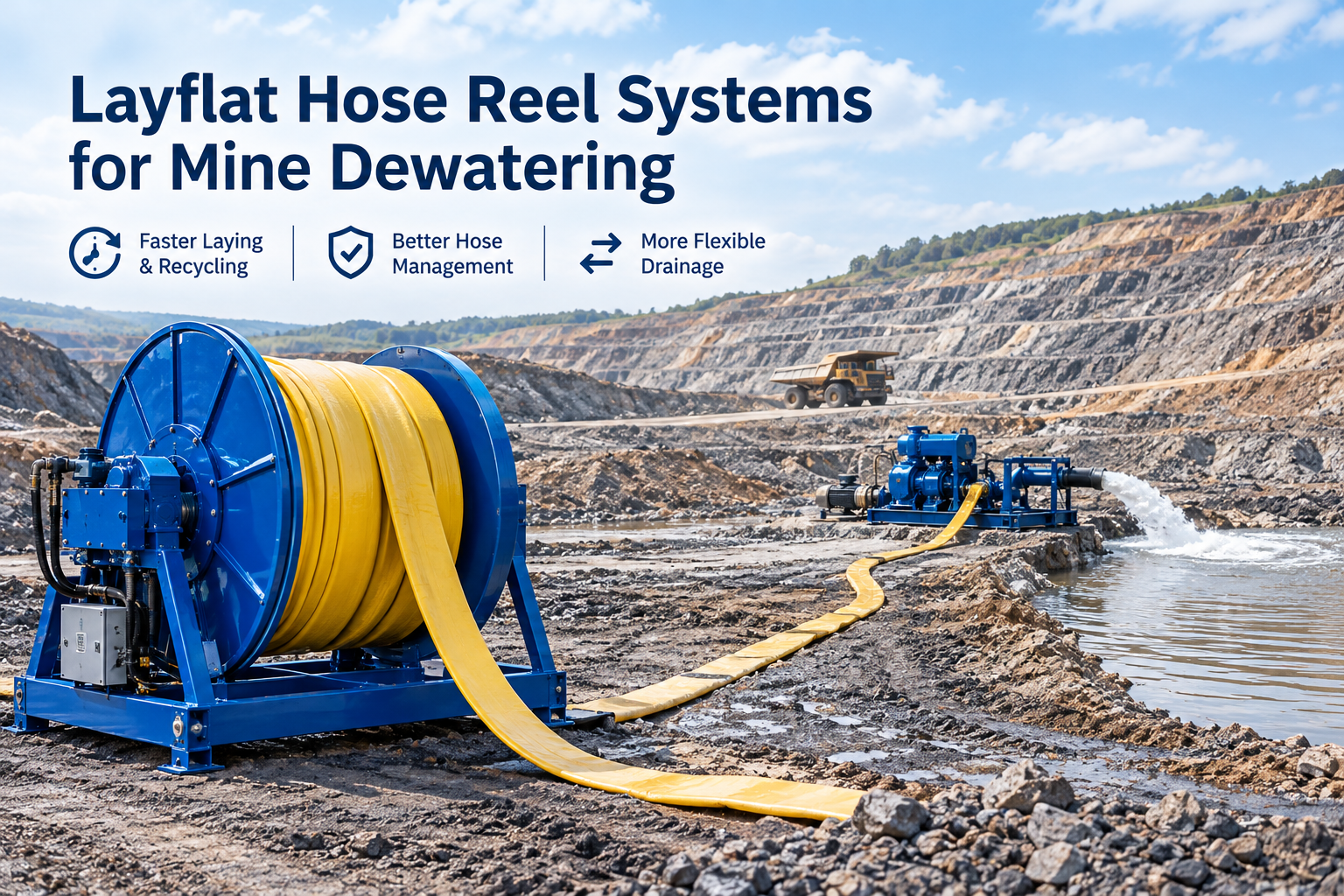
Layflat hose reel system usually consists of reel, supporting frame and corresponding hose retracting mechanism. According to the specific application requirements, the reel can be operated manually or equipped with a power drive device to assist in recovering the hose.
During the laying process, the hose is paid out from the reel and arranged along the predetermined drainage route. When the drainage task is completed, or the pipeline needs to be adjusted, the staff can recycle the hose according to the equipment operation procedures and wind it on the drum in an orderly manner.
When the drainage layout needs to be adjusted frequently, the advantages of this system will be more obvious.
Speed Up the Laying and Recycling of Hoses
When the temporary drainage pipeline needs to be moved, the staff should not only deal with the hose itself, but also manage the related connecting parts. The reel can store the hoses in a centralized way and let them out in order as needed, thus reducing the need for manual sorting after long-distance hoses are scattered in the work area.
For long hoses or applications requiring frequent recycling, the power-driven reel can reduce the physical burden in the recycling process. How much time can be saved actually depends on the length and diameter of the hose, the ground conditions, the connection mode and the operation mode of the reel.
Better Management of Long-Distance Drainage Hoses
Mine drainage route may pass through transportation roads, excavation platforms and temporary operation areas. If the hose is coiled or scattered on the ground at will, it may hinder the passage of people and equipment, be entangled, or be unnecessarily damaged by mechanical rolling.
The reel with proper size can collect the hoses that are not used for the time being and provide a more controllable way to release the hoses. This not only helps to manage the hose inventory, but also facilitates the staff to check whether there is obvious damage to the hose before the next use.
Reasonable planning of pipelines is equally important. Hoses should avoid sharp edges, excessive bending, traffic areas and other potential hazards. If the hose must cross the road, appropriate protective measures should be taken according to the site conditions, or the route should be re-planned.
Adjust the Drainage Route More Flexibly
With the development of mining, the pump may need to be moved to a new sump or the drainage position may be changed. Flexible drainage hoses are usually easier to rearrange than pipelines consisting of multiple rigid pipe sections.
Hose reels support this flexibility by simplifying the recycling and storage process. For mine operations that require frequent removal of drainage equipment, the reel can reduce the workload of manual sorting, transportation and rearrangement of scattered hoses.
However, the reel must still match the size, weight and operation requirements of the hose. If the hose exceeds the capacity of the reel, or does not meet the minimum bending requirements when winding, it may be difficult to wind it normally, or even cause damage to the hose.
Improve Hose Storage and Protection
Hoses may be damaged by friction, squeezing, kinking, improper bending or harsh environment. Messy storage methods will increase these risks and make it more difficult to check before use.
A suitable reel can fix the hose in order during storage and transportation. The uniform winding mode is also convenient for workers to check the visible damage and prepare for the next laying. Before recycling, the staff should follow the manufacturer’s requirements and carry out pressure relief, drainage and safety treatment on the hose.
Analysis of Typical Mine Drainage Scenarios
Suppose that a large amount of water accumulated in an open pit mine during continuous rainfall. Water gathered in a temporary low-lying area, and a water pump was installed at the site to discharge the accumulated water to the designated collection point. With the development of mining, the original sump is no longer applicable, and the drainage system needs to be rearranged.
If the traditional rigid pipeline is used, the staff may need to dismantle multiple pipe sections, carry related components and reconnect the pipeline along a new route. For the fixed drainage system, this method may be able to meet the requirements; However, if it is necessary to relocate repeatedly, it may increase labor input and on-site coordination.
If a properly designed layflat hose reel system is adopted, the staff can recycle the drainage hose, move the equipment as needed, and then re-lay the hose along the adjusted route. When the hose is long, the handling load is heavy or the recycling frequency is high, the power-driven reel can be considered. For scenes with short hoses and low migration frequency, manual reels may be enough.
No matter which scheme is adopted, the staff still need to check the new drainage route, confirm the status of hoses and joints, verify the compatibility between pumps and hoses, and ensure that the drainage point can receive the corresponding water. If the pipeline becomes longer or the height difference increases, it is necessary to re-evaluate the lift that the pump can provide and the pressure loss of the system.
In this scene, the main value of the reel is not to improve the output capacity of the pump, but to make the hose management more orderly and make the drainage layout more convenient to adjust with the change of site conditions.
How to Choose a Suitable Layflat Hose Reel for Mine Drainage
The actual effect of reel system depends on its matching degree with hose and field operation conditions. Before selecting equipment, we should focus on the following factors.
Hose Length, Diameter and Reel Capacity
Firstly, the actual specifications of the hose should be confirmed, and the effective winding width, core diameter, flange diameter and allowable bearing capacity of the reel must meet the expected hose storage requirements. Because different types of hoses may have different structures and storage characteristics, even if the nominal diameter is the same, the required reel capacity may be different, so it should be confirmed for specific hose models.
In addition, a proper gap should be reserved to avoid the hose from being squeezed between the side plates of the reel, or the uneven winding will affect the normal winding.
Choose Manual or Power Drive
Manual hose reel is suitable for scenes with short hose, small handling load and low migration frequency. Its operating structure is usually relatively simple, and it may also be applicable when there is no power equipment on site.
For long hoses, frequent recycling operations, or applications where manual handling is impractical, motor-driven hose reels are generally more suitable. If there is a compatible hydraulic power source in the field, the hydraulic driving scheme can also be considered, but the driving device, braking mechanism and control mode must be selected according to the actual load.
Matching of Working Pressure and Water Pump
The rated working pressure of layflat hose used for drainage must meet the actual working conditions of water pump and system. The pipeline pressure loss, height difference, flow demand and possible pressure fluctuation should be considered in the evaluation. Hoses, joints, connectors and rotating connecting parts used in the reel system must be suitable for the expected working conditions.
Ground Conditions and Environmental Impact
The mine environment may expose hoses and reels to mud, abrasive ground, dust, wet environment and changeable weather for a long time. Therefore, the reel frame, bearings, driving parts and surface protection treatment should be adapted to the installation and maintenance conditions on site.
Installation methods are as important as mobile requirements. The fixed reel is suitable for the relatively stable pumping station, and the mobile scheme may be more practical when the drainage point changes frequently. If the reel is installed on a vehicle or equipment platform, it must also ensure that the installation structure can withstand the expected load and the force generated during operation.
Hose Inspection and Safe Recovery
Before each laying, check the hose for cuts, abrasion, joint damage and other obvious defects. During the recycling process, excessive pulling, sharp bending and uneven winding should be avoided. If there is still water in the hose, it should be drained and treated safely according to the manufacturer’s requirements.
The reel must run within the rated capacity. During use, workers should stay away from moving parts and running paths of hoses. These safety measures are particularly important when using power-driven devices.
Can the Layflat Hose Reel Improve the Drainage Performance?
The layflat hose reel can improve the actual management efficiency of mine drainage operation by simplifying the laying, recycling, transportation and storage of temporary drainage hoses. These advantages are especially obvious when the drainage route needs to be adjusted frequently, or when long-distance hoses need to be carried repeatedly on site.
However, the overall drainage performance still depends on the pump, hose diameter, pipeline length, height difference, connecting parts and system resistance. The reel can’t make up for the problems such as insufficient pump capacity, too small hose size or unreasonable drainage route design.
In order to achieve better results, it is necessary to select compatible equipment, reasonably plan the hose route and do routine maintenance, which can reduce unnecessary delays in handling and sorting, and make the on-site drainage system easier to adapt to operational changes.
Conclusion
Mine drainage needs equipment that can adapt to the change of excavation area, water level fluctuation and temporary drainage route. Layflat hose provides a flexible choice for water delivery, and a suitable hose reel system helps to keep long-distance hoses in order and make repeated laying and recycling easier to manage.
For mine operations that require frequent relocation of drainage pipelines, reasonable matching of hose capacity, reel structure, drive system and installation method can simplify hose management and provide support for more flexible field drainage.
Related Posts
Grease Hose Reel: Guide to Selection and Application
November 5, 2026
Why Do Workshops Need Hose Reels?
March 18, 2026