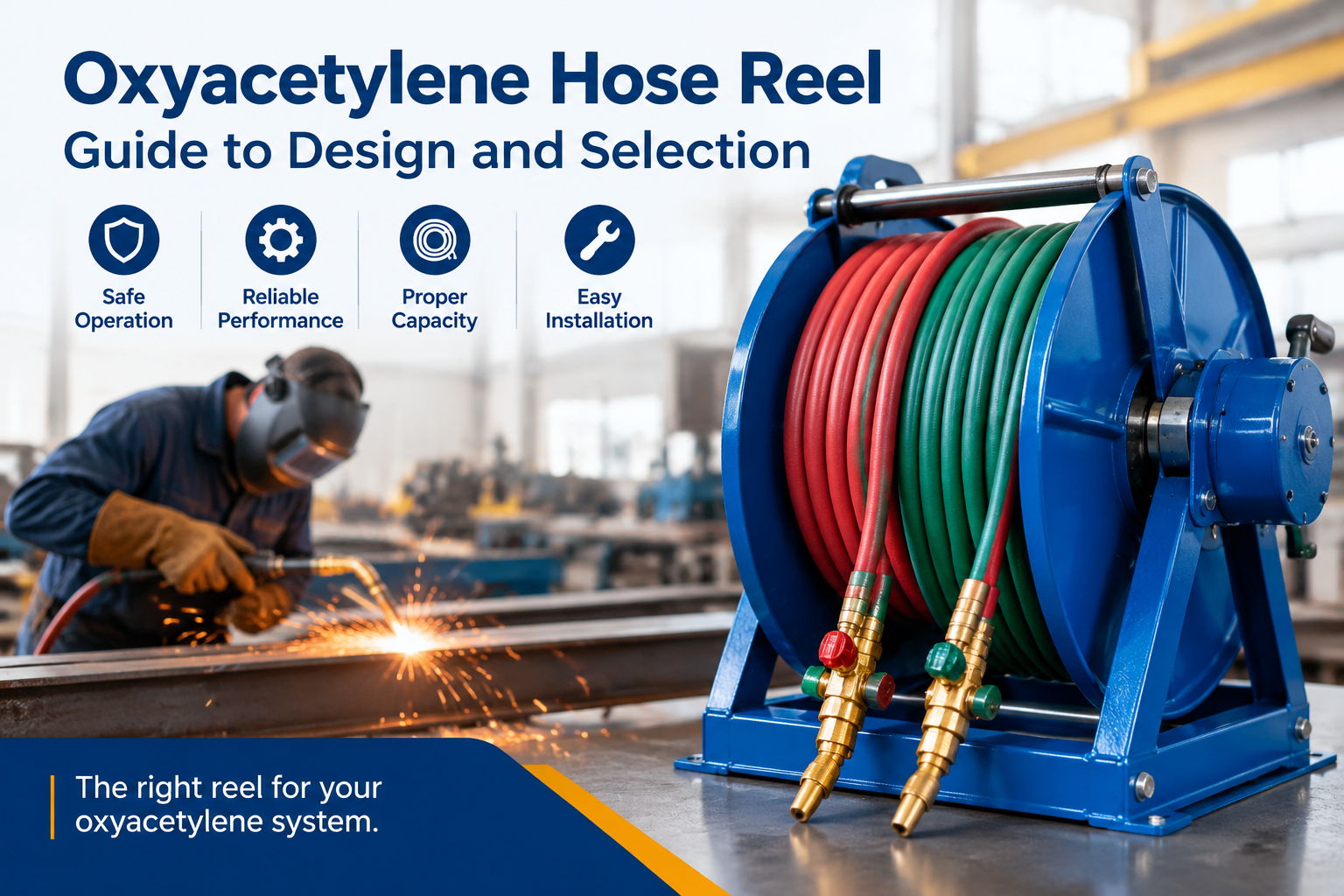
Oxyacetylene Hose Reel: Guide to Design and Selection
October 22, 2026 | Industrial Hose Reels
Oxyacetylene hose reel is used to store and manage two gas hoses in oxyacetylene system. This kind of system transports oxygen and acetylene respectively, and is widely used in metal cutting, heating, brazing and maintenance. The configuration of the reel will affect the storage capacity, expansion range, winding performance and gas connection mode of the hose.
Choosing the reel of oxyacetylene hose should not only consider how long the reel can hold, but also evaluate the hose arrangement, reel structure, gas transmission requirements, driving mechanism and installation space. Understanding these factors is helpful to select reels that meet the actual equipment and working conditions.
1. The Working Principle of Oxyacetylene Hose Reel
Oxyacetylene hose reel is used to receive and unfold hoses connected to oxygen and acetylene gas supply systems. Depending on the specific structure, the reel can only be used for hose storage, or it can contain components that allow gas to pass through when the reel rotates.
In the storage-only configuration, the reel is responsible for winding and unwinding the hose, but it is not necessarily a part of the gas flow path. The gas is transported through the hose and its connectors, while the reel provides mechanical support and orderly storage.
The structure of gas conveying reel is more special. If gas needs to pass through rotating components, it must be equipped with suitable rotating connectors, compatible seals, and internal channels designed for the specified gas and working conditions.
2. Choose Double Hose Reel or Independent Reel
The arrangement of oxygen and acetylene hoses will affect the size, winding mode and operation convenience of the reel. Common configurations include a double hose reel and two independent reels.
Double Hose Reel Configuration
Double hose reel can accommodate oxygen hose and acetylene hose in the same set of components. This configuration helps to simplify the operation when two hoses usually need to be deployed and recovered at the same time.
The reel must be able to accommodate the overall size of the combination of two hoses. The drum width, guiding structure and winding surface should be suitable for the hose assembly to avoid excessive extrusion, distortion or unreasonable overlap. If two hoses are bonded together, the external dimensions and bending requirements of the whole assembly need to be considered.
Double hose configuration may be more practical for welding stations where two hoses are arranged along the same path and need to have similar working ranges.
Independent Hose Reel Configuration
Independent reels allow oxygen hoses and acetylene hoses to be stored separately. This configuration may be more suitable when two hoses need different lengths, are arranged along different paths, or need to be positioned separately.
However, two reels need to occupy more installation space, which may also increase the complexity of hose path management. The positions of the two reels should be arranged reasonably to ensure that both hoses can reach the required working area, and at the same time, unnecessary tension or unreasonable wiring should be avoided.
3. How to Calculate the Required Hose Reel Capacity?
To calculate the required capacity of oxyacetylene hose reel, it is necessary to determine the hose length, measure the hose outer diameter, and estimate the space occupied by the hose after winding on the reel. For the double hose configuration, both hoses must also be included in the calculation.
Step 1: Determine the Required Hose Length
Measure the hose routing path from the air supply point to the farthest working position. The extra length required to bypass the equipment and the space required for the hose to move during operation should also be considered.
The length of hose should meet the actual working distance and avoid unnecessary allowance. The longer the hose, the more space it takes up on the reel, which may also increase the overall size of the reel.
Step 2: Calculate the Geometric Volume of the Hose
In the preliminary estimation, the approximate geometric volume of a single hose can be calculated by using the following formula:
V = (π × D² / 4) × L
Among them:
(V) = approximate volume of cylindrical geometry of hose.
(D) = outer diameter of hose
(L) = required hose length
For example, the approximate geometric volume of a hose with an outer diameter of 12 mm and a length of 20 m is:
V = (π × 0.012² / 4) × 20 ≈ 0.00226 m³
After conversion, it is about 2.26 liters.
However, this does not mean that the actual capacity of the reel is 2.26 liters. After the hose is wound, there will be gaps between the hose rings, and the winding mode and the size of the drum will also affect the actual occupied space.
Step 3: Consider the Configuration of Double Hose
For the double hose assembly, the required storage space depends on the overall size of the two hoses and the specific winding method. If the outer diameter and length of two hoses are the same, the sum of the geometric volumes of the two hoses is about twice that of a single hose.
However, the actual capacity required by the reel is not necessarily twice that of a single hose reel. The final result depends on whether the two hoses are bonded together, whether they are wound side by side, and whether multi-layer winding is adopted.
Therefore, the hose reel manufacturer should be required to confirm the available capacity according to the specific double hose assembly, instead of directly applying the capacity data of a single hose.
Step 4: Check the Drum Size and Bending Radius
The drum must provide enough winding space and ensure that the bending radius of the hose is within the allowable range. The drum core diameter, winding width and available winding depth will all affect the actual capacity.
The following formula can be used to preliminarily estimate the number of hose turns required for single-layer winding:
N ≈ L / (π × Dc)
Among them:
(N) = approximate number of turns required for single-layer winding.
(L) = hose length
(D_c) = approximate winding diameter of the center line of this layer of hose.
For example, if the approximate winding diameter is 300 mm and the hose length is 20 m, then:
N ≈ 20 / (π × 0.3) ≈ 21.2
This means that if the hose is always wound at this diameter, a single layer needs about 22 turns. The actual number of turns may be different, because the winding diameter of the hose will also increase with the increase of winding layers.
The required winding width also depends on the outer diameter of the hose and the spacing between adjacent hose loops. For the double hose assembly, the winding mode must also consider the overall shape of the combined two hoses.
Step 5: Confirm the Rated Capacity of the Reel
According to the calculated hose length, outer diameter and winding requirements, the appropriate reel size is preliminarily determined. Also, the manufacturer shall be required to confirm that the selected model can accommodate the complete hose assembly without exceeding the recommended bending radius or winding limit.
For oxyacetylene hose reels, the capacity must be verified according to the actual hose configuration. For example, just because a certain model can accommodate a specific single hose of 20 m does not mean that it can also accommodate a dual hose assembly of 20 m with the same nominal diameter.
The final selection should be based on the rated capacity provided by the manufacturer and the size of the actual hose assembly, not just the geometric volume.
4. Consider Gas Flow and Connection Structure
The reel of oxyacetylene hose must meet the requirements of gas conveying system. The length, inner diameter, connection size of the hose and the possible flow channel inside the reel will all affect the gas conveying performance.
The hose is too long or the inner diameter is not suitable, which may lead to pressure loss. The suitable hose specification depends on the gas type, required flow rate, working pressure, welding gun specification and suggestions of relevant equipment manufacturers.
For the reel used only for storage, it is mainly necessary to confirm that the hose will not be bent, squeezed or forced to form inappropriate bending during deployment and arrangement. The reel shall not affect the original working performance of the hose.
For the reel where gas needs to pass through the rotary joint, it is necessary to further evaluate the internal channel and connection structure. Rotating joints and related components must be clearly suitable for the specified gas. Even if the inner diameter of the hose is large, if the connector or internal channel forms flow resistance, it can not ensure sufficient gas transmission.
Before purchasing, we should confirm the required connection type of import and export, applicable gas, working pressure and the flow information provided by the manufacturer. These details are helpful to judge whether the proposed reel is compatible with the complete gas supply system.
5. Select the Appropriate Reel Drive Mode
The driving mechanism will affect the way the hose is unfolded, recycled and stored. According to the application requirements and whether there is a suitable gas compatible model, the oxyacetylene hose reel can be driven by hand, spring or power.
Manual Hose Reel
Manual hose reel allows the operator to directly control the movement of hose. This method may be suitable for installation scenes with low frequency of use, short hose assemblies, or no need for automatic recycling.
When selecting a manual hose reel, the weight and flexibility of the whole hose assembly, the expected frequency of use, and the operating force required to evenly wind the hose should be considered. The rated capacity of the reel must also meet the requirements of the specified hose configuration.
Spring-Driven Hose Reel
The spring-driven hose reel can automatically recover the hose after use. When the hose needs to be unfolded and retracted frequently, this mechanism is helpful to improve the storage efficiency.
However, the spring mechanism must adapt to the weight, flexibility and winding characteristics of the hose assembly. The recovery mechanism originally used for a single light hose may not be suitable for a heavier double hose assembly.
Automatic recovery function does not mean that the reel has gas compatibility. The complete reel, including all gas contact parts, must be confirmed for applicability.
Power-Driven Hose Reel
If there are suitable models to choose from, larger or heavier hose assemblies can also consider using power-driven reels. Need to check the drive system, rated load, control mode and installation requirements.
When selecting the driving mode, the hose size, frequency of use, available space and working restrictions specified by the manufacturer should be considered comprehensively. The driving mode itself does not determine whether the reel is suitable for oxygen and acetylene.
6. Evaluate the Reel Structure and Installation Requirements
The reel structure must be able to support the hose assembly and bear the load generated during the winding and unwinding of the hose. The reel size, shaft structure, frame stiffness and guide device will all affect the performance of the reel in the process of repeated use.
For double hose configuration, the guide device should be able to adapt to the shape of the whole hose assembly and help the hose to be evenly wound. If independent reels are used, each reel needs a reasonable hose path and sufficient operating clearance.
Before determining the model, the installation requirements should be considered in advance. Wall installation requires a supporting surface with sufficient strength, and space is reserved for the drum and moving parts. The reel installed on the equipment may need to adopt a compact structure to adapt to the limited installation area and avoid blocking other nearby components.
The position of the reel should ensure that the hose can reach the working area to avoid excessive tension or sharp bending. Insufficient installation clearance may also increase the difficulty of hose replacement, connection operation and daily maintenance.
Before ordering, you should confirm the installation direction, overall size, fixed point position and the space required for equipment operation. If customized reels are required, the manufacturer shall be provided with installation drawings or specific dimensions as far as possible.
7. Confirm Material and Gas Compatibility
When selecting the reel of oxyacetylene hose, material compatibility is very important, especially when gas needs to pass through the reel assembly.
A complete gas flow path may include hoses, joints, seals, rotary joints and internal channels. Each component must be suitable for the specified gas and working conditions. Materials and components used for ordinary air or water cannot be used for oxygen or acetylene by default.
Oxygen equipment needs special attention to cleanliness and pollution control. Oil, grease and other incompatible substances shall not enter the oxygen system. Acetylene system also needs to use components specially suitable for this gas.
The manufacturer shall be required to specify the applicable gas type of the reel, and confirm whether the applicability description is for the whole set of components or only for some parts. At the same time, the allowable working pressure, connection specifications, and restrictions on hose types or installation methods should also be confirmed.
If the reel is only used to store the hose and does not convey gas through the rotary joint, it should be clear which parts belong to the gas flow path. This can avoid judging the gas compatibility of the reel only by its mechanical structure.
8. What Specifications Should I Prepare Before Purchasing?
Clear specification information is helpful for suppliers to recommend suitable standard models or judge whether customized solutions are needed.
Before making an inquiry for oxyacetylene hose reel, it is recommended to prepare the following information:
Gas types: oxygen and acetylene, and whether the two hoses need to be stored together.
Reel function: is it only used for storage, or does it need to transport gas through rotating connectors?
Hose specification: length, inner diameter, outer diameter, structure and minimum bending radius.
Job requirements: required gas flow, working pressure and applicable equipment specifications.
Reel configuration: double hose reel or independent reel.
Driving mode: Manual, spring-driven or power-driven can be selected if there is a suitable model.
Installation details: wall, workbench, equipment or other installation locations.
Connection requirements: import and export types, thread specifications and approved adapters.
Technical documents: gas compatibility, working restrictions, installation instructions and maintenance information.
This information is helpful to compare the quotations of different suppliers according to the unified standard, and can also reduce the risk of type selection and avoid buying reels that have enough storage capacity but cannot meet the requirements of gas system connection or operation.
Conclusion
The selection of oxyacetylene hose reel should be judged according to the complete hose configuration and gas system requirements, not just considering how many hoses the reel can accommodate. Double or independent reel configuration, hose capacity, gas flow, driving mechanism, installation structure and component compatibility will all affect the final choice.
First of all, it should be determined whether the reel is only used to store hoses or whether gas needs to be transported through rotating connectors. Subsequently, confirm the hose specifications, work requirements and installation restrictions with the relevant equipment manufacturers.
A clear product specification will help the purchaser to find an oxyacetylene hose reel suitable for practical application, and also help the supplier to evaluate the required configuration more accurately.
Related Posts
Top 10 Industrial Hose Reel Manufacturers in the World [2026]
October 8, 2026
Dual Hose Reel Applications & Selection: A Practical Guide
October 14, 2026