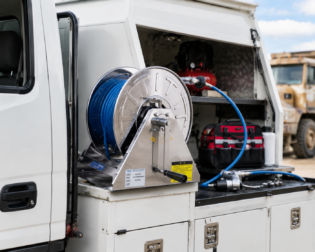
Working Principle of Direct-Drive Air Rewind Hose Reel
October 28, 2026 | Air Hose Reel
Introduction
In industrial environment, hoses are usually used to transport air, water, oil and other fluids to equipment and workstations. Proper management of these hoses is very important for ensuring operation safety, improving operation efficiency and maintaining the reliability of fluid transportation.
Unlike the spring driven hose reel which relies on springs to store energy, the air rewind hose reel uses compressed air to drive the rewind mechanism. In the direct drive structure, the pneumatic motor transmits the rotating force to the reel drive mechanism through direct mechanical connection, and the specific structure depends on the product design. Understanding the working principle of this system is helpful for purchasing personnel to evaluate its performance, operation requirements and applicability to different industrial applications.
What Is a Direct-Drive air rewind Hose Reel?
Direct-drive pneumatic hose rewind reel is a kind of hose management equipment which uses compressed air drive system to drive the reel to rotate, thus realizing hose rewind. The operator can start the driving device through the control mechanism, so that the hose can be wound on the drum without completely relying on manual operation or traditional spring rewind.
“Direct drive” usually refers to the way the motor transmits power to the reel. Different from the structure of chain or belt transmission, the direct drive system can connect the motor with the reel shaft by direct coupling. However, the specific structure of different manufacturers and models may be different, so the product specifications should be checked when comparing different drive systems.
This kind of reel is suitable for occasions where the hose is long, heavy or needs to be paid out and retracted frequently. If there is a stable supply of compressed air on site and a power-assisted rewind hose is needed, such equipment can also be considered.
Main Components and Their Functions
Although the structures of different models are different, most direct-drive air rewind hose reels contain the following key components, which cooperate with each other to realize hose management.
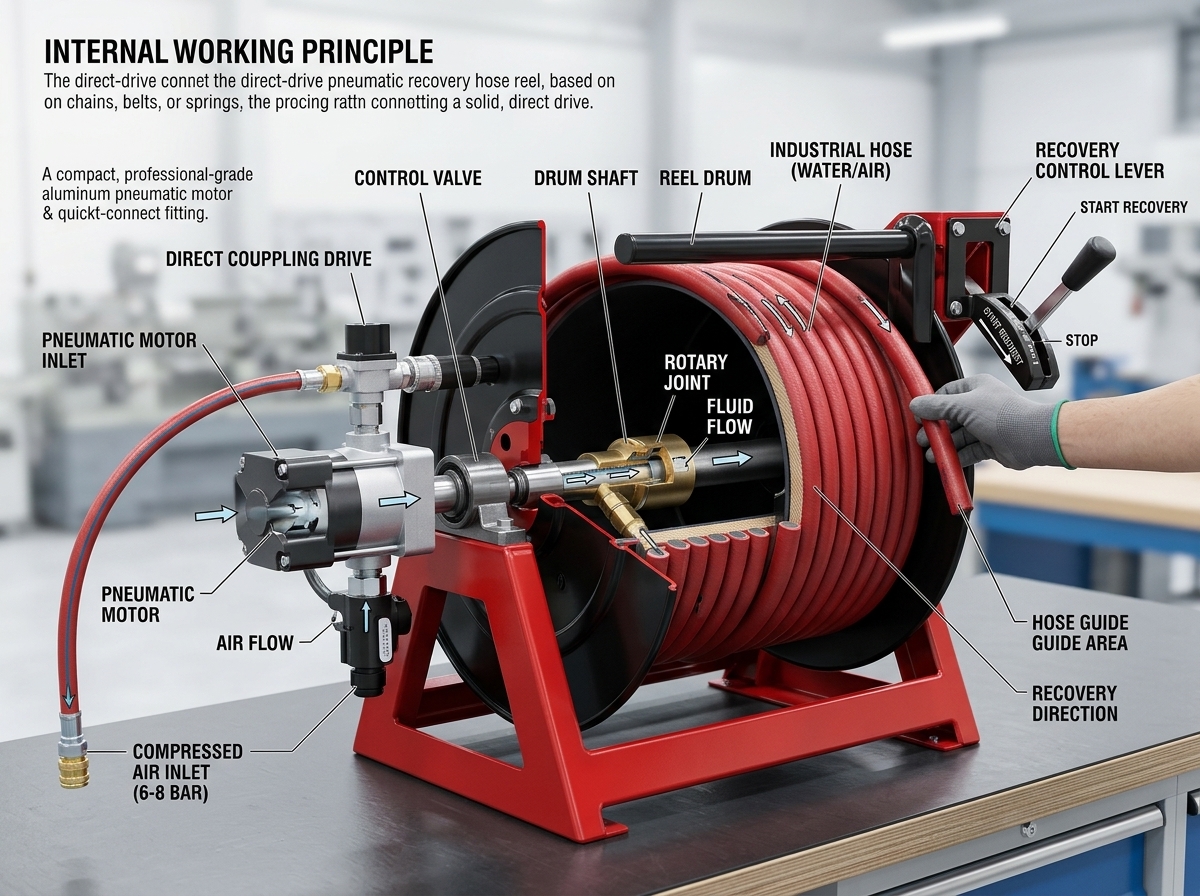
1. Pneumatic Motor
The pneumatic motor converts the energy of compressed air into rotary motion. When compressed air enters the motor, it will drive its internal mechanism to run and generate torque, thus driving the reel driving mechanism to rotate. The actual performance of the motor depends on many factors, including air pressure, air flow, motor specifications and the load generated by the hose.
2. Direct Drive Mechanism
The direct drive mechanism transfers the torque generated by the pneumatic motor to the reel shaft or drum. Direct connection can reduce the number of transmission parts between the motor and the reel, thus simplifying the driving structure. However, the actual torque, rotating speed and bearing capacity of the reel depend on the whole drive system.
3. Drum and Frame
The drum is used to store the hose when it is not in use, and the frame supports the rotating assembly and keeps the structure stable. The width, diameter and strength of the drum will affect the accommodating length and capacity of the hose and the space required for equipment installation.
4. Control Valve and Air Source
The control valve is used to adjust the compressed air entering the motor, so that the operator can start, stop or control the hose rewind according to the specific configuration. The air source must provide the working pressure and air flow that meet the requirements of the motor. If the gas supply capacity is insufficient or the gas path is limited, the rewind performance of the reel may decrease.
5. Hose Connection and Rotary Joint
For the reel that needs to transport fluid through the rotating drum, the rotary joint can maintain the fluid connection between the fixed liquid supply pipeline and the rotating reel. The rated pressure, material compatibility and flow capacity of rotary joint must meet the requirements of practical application. Not all air rewind reels adopt the same fluid connection structure, so it needs to be confirmed according to the specific model.
How Does the Direct-Drive air rewind Hose Reel Work?
Its operation process can be divided into the following four stages.
Step 1: Release the Hose
The operator pulls the hose out of the drum and extends it to the required working position. According to the reel structure, the reel will rotate when the hose is pulled out. Hoses should be arranged along appropriate paths to avoid sharp bends, twisting or continuous friction with rough edges.
Step 2: Start the Pneumatic Drive Device
After the hose is used, the operator starts the rewind control device. Compressed air enters the pneumatic motor, converts pneumatic energy into rotating force, and then transmits it to the reel shaft or drum through the driving mechanism.
Step 3: Reel the Hose
The drum starts to rotate, and the hose is gradually wound back. During the recycling process, the hoses should be arranged neatly to avoid overlapping, uneven winding or local extrusion of the hose surface.
Some models are equipped with pipe arrangement or guide mechanism, which can help the hose to be wound evenly; Other models require the operator to properly guide the hose during the recycling process. The specific operation mode depends on the reel structure.
Step 4: Stop Retracting
When the hose reaches the predetermined storage position, the operator should stop the pneumatic drive through the designated control device, fix or limit the hose according to the manufacturer’s instructions, and follow the corresponding operating procedures to reduce the safety hazards.
What Factors Will Affect the Recycling Performance?
The performance of direct-drive air rewind hose reel is closely related to the actual working conditions. The following factors will affect whether the hose recycling is smooth and stable.
Air pressure and air flow: the air motor needs sufficient air source to generate the required torque and speed, and the air source requirements shall be confirmed according to the specifications provided by the manufacturer. It is not enough to pay attention to the air pressure, and the air flow rate of the air supply pipeline is as important as the air supply capacity.
Length, diameter and weight of hose: The longer the hose and the larger the diameter, the greater the load on the reel. Heavier hoses may require more driving torque, especially when the drum has wound more hoses. Therefore, the outer diameter, total length, weight and conveying medium of the hose should be considered comprehensively when selecting the type.
Reel size and winding mode: the reel must be able to accommodate the required length of hose, while avoiding exceeding the rated capacity or forcing the hose to produce too small bending radius. Uneven winding may increase friction, reduce effective storage capacity, and make subsequent tube laying more difficult.
Driving and control settings: the rewind speed is too fast, which may cause the hose to hit the surrounding equipment or wind unevenly. Reasonable speed control and clear stop operation are helpful to improve the safety of operation. If the product supports speed regulation, it should be set according to the manufacturer’s instructions.
Installation and maintenance: A stable installation structure, a reasonable arrangement of gas passages and sufficient installation space are helpful to keep the reel running stably. Wear of driving parts, damaged hoses, blocked gas path or failure of rotary joints may also affect the rewind performance.
Which Scenarios Is the Direct-Drive air rewind Hose Reel Suitable for?
Direct-drive pneumatic hose reel can be used in industrial environment with compressed air supply and frequent hose release and rewind.
In manufacturing plants, this kind of hose reel can be used for gas supply management of pneumatic tools, production equipment and maintenance stations. In automobile maintenance and equipment maintenance workshops, they help to manage the working hoses around the maintenance workshop. In the industrial maintenance area, the qualified reels can also be used for some water pipes, oil pipes or other fluid hoses, provided that the reels, hoses, seals and connecting parts are compatible with the conveying medium.
How to Choose a Suitable Direct-Drive air rewind Hose Reel?
Choosing a suitable hose reel should be based on the actual operation requirements, not just the drive type.
First of all, make clear the conveying medium and the required working pressure and temperature. Then determine the length, inner diameter, outer diameter and total weight of the hose. These parameters are helpful to determine the drum capacity and the load that the drive system needs to bear.
Secondly, check whether the pressure and flow rate of compressed air meet the requirements of the motor, and confirm the rated rewind capacity, control mode, installation options of the reel, and whether the pipe arranging mechanism is needed. If the fluid needs to be transported through the rotary joint, the rated pressure and material compatibility of the rotary joint should also be checked.
Finally, consider the frequency of use and maintenance conditions of the equipment. Each shift requires a reel that is frequently used, and the requirements for continuous working ability may be different from those for occasional use. By comprehensively comparing these factors, we can ensure that the selected model is suitable for the actual working conditions, rather than just inferring based on the product name.
Maintenance Suggestion: Ensure the Stable Operation of the Equipment
Regular inspection helps to find anomalies in time before problems affect production. Check whether the hose is cut, worn, kinked or deformed, and check whether the drum and frame are damaged and whether the mounting fasteners are loose.
Keep the pressure of air source within the specified range, and check whether there is air leakage or blockage at the air pipe and joint.
If it is found that the recycling speed is slow, uneven winding or abnormal noise occurs, it should be stopped and the reasons should be investigated according to the manufacturer’s instructions. Possible causes include insufficient air flow, excessive hose load, abnormal winding or worn drive components. Don’t increase the air pressure above the rated upper limit to make up for the performance degradation.
Before overhauling the motor or drive mechanism, the compressed air supply should be cut off and isolated, and the energy isolation procedure should be carried out according to the regulations. If the maintenance involves hoses or fluid connections, the residual pressure in the system must also be considered.
Conclusion
Direct-drive pneumatic hose reel uses compressed air to drive hose rewind, which is suitable for industrial working environment where hoses need to be released and recovered frequently. Its running performance depends on the cooperation among pneumatic motor, driving mechanism, drum, hose load and air source.
For industrial purchasers, the most important selection factors include hose capacity, working conditions, motor requirements, control functions and maintenance requirements. Only by matching these factors with the actual application can we choose a suitable reel and ensure the stability and reliability of daily hose management.
Related Posts
Best Air Hose Reels for Industrial and Home Use
May 20, 2026
Hose Reels for Paper Mills: Applications in Paper Production
September 17, 2026