304 vs. 316 Stainless Steel Hose Reels: Which Is Better for Your Application?
November 13, 2026 | Stainless Steel Hose Reels
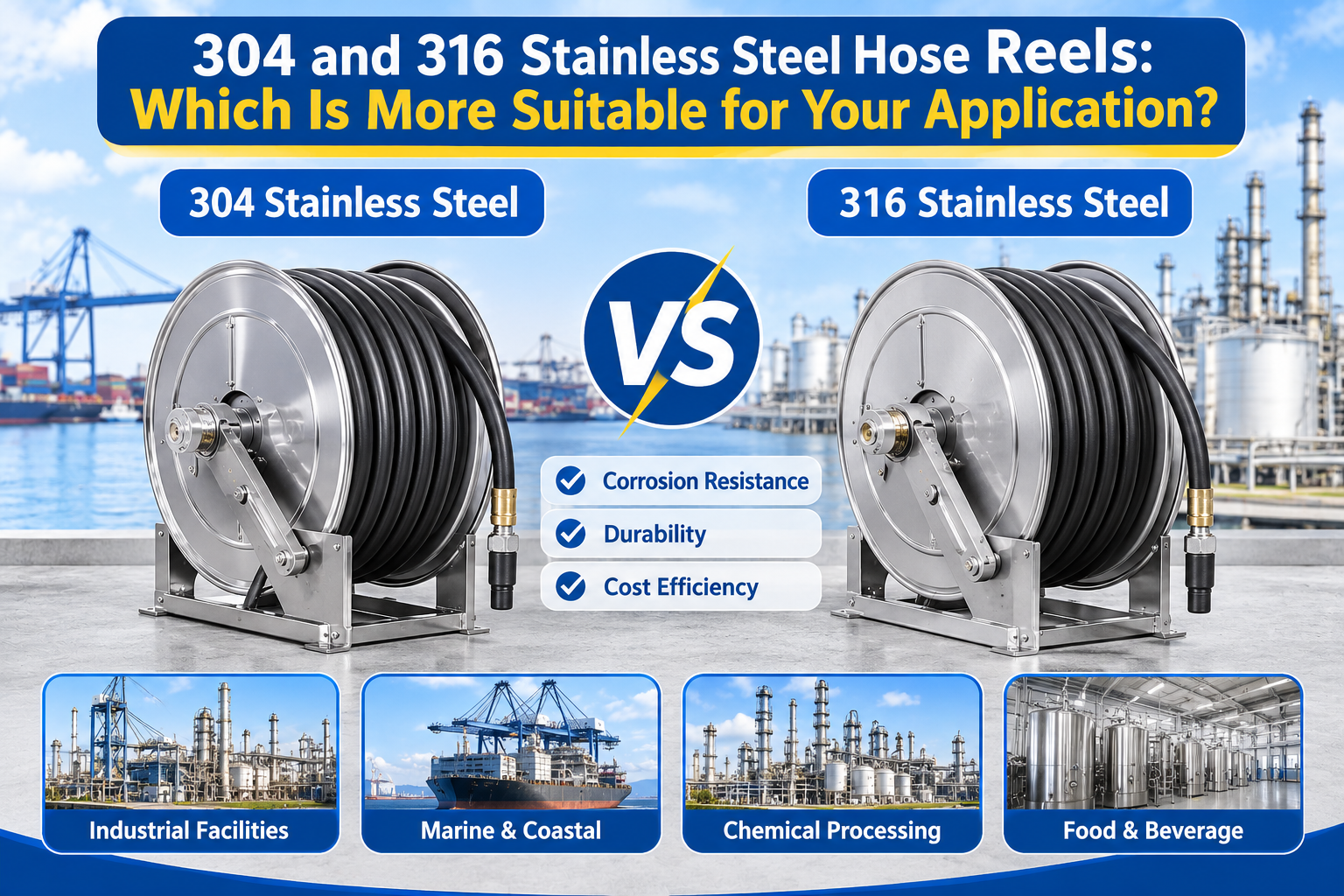
Stainless steel hose reels are commonly used in industrial environments where corrosion resistance, durability, and regular cleaning are important. However, not all stainless steel offers the same level of protection. Among the most commonly used grades, 304 and 316 stainless steel are often compared when selecting hose reel materials.
Although both grades provide good corrosion resistance, their performance differs in environments involving salt, chemicals, and prolonged moisture exposure. Choosing between them is not simply a matter of selecting the more corrosion-resistant option. The actual working conditions, maintenance requirements, and overall equipment cost should also be considered.
This article compares 304 and 316 stainless steel hose reels and explains which grade may be more suitable for different industrial applications.
1. What Is the Difference Between 304 and 316 Stainless Steel?
Both 304 and 316 are austenitic stainless steels. Their corrosion resistance mainly comes from a thin chromium-rich oxide layer that forms naturally on the metal surface and helps protect it from rusting.
The main difference is that 316 stainless steel contains approximately 2–3% molybdenum, while 304 generally does not. This additional element improves resistance to chloride-related corrosion, particularly pitting and crevice corrosion.
| Comparison | 304 Stainless Steel | 316 Stainless Steel |
|---|---|---|
| Main alloy characteristics | Chromium and nickel | Chromium, nickel, and molybdenum |
| General corrosion resistance | Good in many ordinary environments | Better in more corrosive environments |
| Chloride resistance | More susceptible to chloride attack | Improved resistance to chloride attack |
| Salt exposure | Better suited to limited or mild exposure | More suitable for coastal and salt-exposed conditions |
| Chemical environments | Suitable for many mild industrial environments | Offers better resistance to certain aggressive environments |
| Material cost | Generally lower | Generally higher |
The difference becomes more important when a hose reel is regularly exposed to salt deposits, chemical splashes, or moisture that remains on its surface.
However, 316 should not be treated as corrosion-proof. Its performance still depends on the concentration of corrosive substances, temperature, surface condition, and maintenance practices.
2. How Do 304 and 316 Perform in Different Working Environments?
The working environment is one of the most important factors when choosing between these two grades. A material that performs well in a dry workshop may not provide the same service life near the coast or in a chemical processing facility.
2.1 Coastal and Salt-Exposed Environments
Salt is particularly challenging for stainless steel because chloride ions can damage its protective surface layer. This may lead to pitting corrosion, which appears as small localized holes, or crevice corrosion around joints and narrow gaps.
304 stainless steel is generally suitable for ordinary indoor environments and locations with limited exposure to salt. However, repeated contact with seawater spray, salt mist, or accumulated salt deposits can increase its risk of corrosion.
316 stainless steel provides better protection in these conditions because its molybdenum content improves resistance to chloride-induced corrosion. It is often a more appropriate choice for hose reels installed near coastlines, marine facilities, and outdoor locations exposed to road deicing salts.
However, 316 is not suitable for every direct seawater application. Continuous immersion, warm stagnant seawater, and salt accumulation inside narrow gaps can still cause localized corrosion. More highly alloyed materials may be necessary for severe marine conditions.
2.2 Chemical Processing Environments
Chemical exposure requires more careful material selection than simply choosing between 304 and 316.
Different chemicals can react with stainless steel in different ways. Their effects depend on chemical composition, concentration, temperature, exposure duration, and other operating conditions.
304 stainless steel can handle many common industrial environments, including exposure to certain organic chemicals and mild processing conditions. It may be sufficient for applications where chemical contact is occasional and the operating conditions are relatively mild.
316 stainless steel offers improved resistance to certain chemical environments, particularly those involving chlorides and some industrial pollutants. This makes it worth considering for chemical handling facilities where the reel structure may be exposed to corrosive splashes or contaminated moisture.
However, molybdenum does not make 316 resistant to every chemical. Strong acids, certain concentrated solutions, and high-temperature chemical processes may require a different alloy.
Another important consideration is that the hose reel material and the hose material perform different functions. Selecting a 316 stainless steel reel does not automatically make the complete assembly suitable for a particular chemical. The hose tube, seals, swivel joint, and fittings must also be compatible with the fluid being handled.
2.3 Wet and High-Humidity Environments
High humidity, frequent washdowns, and water exposure are common in food processing facilities, equipment maintenance areas, and industrial workshops.
In these environments, 304 stainless steel can provide good corrosion resistance when the water contains relatively low levels of chlorides and the equipment is cleaned and dried properly.
316 stainless steel may be a better option when moisture is combined with salt, cleaning chemicals, or other corrosive substances. It provides an additional level of protection where ordinary stainless steel may experience staining or localized corrosion.
It is important to distinguish between clean water and chloride-containing water. Moisture alone does not necessarily require 316 stainless steel. The substances dissolved in the water and the way moisture accumulates on the reel are often more important.
3. Which Hose Reel Components Need to Be Considered?
When comparing 304 and 316 stainless steel hose reels, it is important to look beyond the main frame. A hose reel consists of several components, and corrosion can affect different parts in different ways.
| Hose Reel Component | What to Consider |
|---|---|
| Frame and mounting bracket | Exposure to moisture, salt, chemicals, and outdoor conditions |
| Reel drum | Contact with the hose, water accumulation, and surface cleaning |
| Swivel joint | Fluid compatibility, sealing performance, pressure, and corrosion resistance |
| Hose fittings and connections | Direct exposure to the transferred medium and external contaminants |
| Fasteners and small components | Corrosion around threads, joints, and connection points |
For example, a reel may have a 316 stainless steel frame but use 304 fasteners or fittings. If these components are exposed to the same corrosive environment, they may become the weak points of the assembly.
The swivel joint deserves particular attention because it is responsible for maintaining fluid transfer while the drum rotates. Its material selection must consider both the external environment and the fluid passing through it.
For this reason, buyers should confirm which components are made from 304 or 316 stainless steel rather than relying only on a general product description.
4. 304 vs. 316: Which One Should You Choose?
Neither grade is the best choice for every application. The decision should be based on actual exposure conditions and the expected service requirements.
| Application Environment | Suggested Material | Main Reason |
|---|---|---|
| General industrial workshops | 304 | Good corrosion resistance under ordinary conditions |
| Indoor equipment maintenance | 304 | Usually sufficient when exposure to corrosive substances is limited |
| Outdoor coastal facilities | 316 | Better resistance to salt-related corrosion |
| Marine equipment areas | 316 or a higher-grade alloy | Improved chloride resistance, depending on exposure severity |
| Chemical processing areas | 304 or 316, depending on the chemical | Compatibility must be checked against the specific chemical and operating conditions |
| Frequent washdown environments | 304 or 316 | Depends on water quality, cleaning agents, and chloride exposure |
| High-salt or continuous seawater exposure | Material assessment required | Even 316 may not provide sufficient protection |
For many general industrial applications, 304 stainless steel offers a practical balance between corrosion resistance and material cost. There is little benefit in paying for 316 if the working environment does not require its additional resistance.
On the other hand, when a hose reel is regularly exposed to salt deposits, chloride-containing water, or certain corrosive substances, the higher initial cost of 316 may be justified by its improved resistance to localized corrosion.
For severe chemical or marine conditions, neither grade should be selected without reviewing the actual operating environment.
5. How to Reduce Corrosion on Stainless Steel Hose Reels
Choosing the appropriate material is only part of corrosion control. Installation, surface condition, and routine maintenance also influence how long a stainless steel hose reel performs reliably.
Remove salt and chemical deposits regularly. Salt, cleaning agents, and chemical residues should not be allowed to accumulate on the reel. Rinse exposed surfaces with clean water when appropriate for the application, and follow the chemical supplier’s cleaning recommendations.
Prevent water from collecting around joints. Narrow gaps, fasteners, and poorly drained areas can retain moisture and contaminants. Proper installation and drainage help reduce the risk of crevice corrosion.
Keep the surface clean. Iron particles from carbon steel tools or nearby equipment can contaminate stainless steel surfaces and cause rust staining. Use suitable cleaning tools and avoid carbon steel brushes.
Inspect welded areas and connections. Welds, fasteners, fittings, and swivel joints should be checked for discoloration, pitting, and other signs of corrosion. Damaged or poorly finished areas may require additional attention.
Check the complete material specification. Confirm the stainless steel grade of the frame, drum, swivel joint, and fittings. Also verify that the hose and seals are compatible with the transferred medium.
These practices are important for both 304 and 316 stainless steel. A higher material grade cannot compensate for poor fabrication, unsuitable component selection, or inadequate maintenance.
6. Frequently Asked Questions
Is 316 stainless steel always better than 304 for hose reels?
No. 316 offers better resistance to chloride-related corrosion, but 304 is suitable for many ordinary industrial environments. The better choice depends on the actual exposure conditions and material requirements.
Can 304 stainless steel hose reels be used outdoors?
Yes. 304 stainless steel can be used outdoors in many environments with limited corrosive exposure. However, locations near the sea or areas exposed to road salt may require 316 or another more corrosion-resistant material.
Is 316 stainless steel suitable for seawater?
316 is more resistant to chloride corrosion than 304, but it is not immune to seawater corrosion. Continuous immersion, stagnant water, salt accumulation, and narrow gaps can still cause pitting and crevice corrosion. Severe marine applications may require more highly alloyed materials.
Does choosing a 316 stainless steel hose reel mean the hose is suitable for chemicals?
No. The reel structure and the hose assembly have separate material requirements. The hose tube, seals, swivel joint, and fittings must all be checked for compatibility with the specific chemical.
Conclusion
The main difference between 304 and 316 stainless steel hose reels is their resistance to corrosive environments. 304 is a practical option for many general industrial applications, while 316 provides additional protection in environments involving salt, chlorides, and certain chemical exposures.
Before choosing a material, consider where the reel will be installed, what substances it may contact, and which components require corrosion protection. A suitable material specification for the entire reel assembly is more important than selecting a higher stainless steel grade based on its name alone.
Related Posts

Hose Reel Solutions for the Food and Beverage Processing Industry
September 10, 2026
Features of Stainless Steel Hose Reels
September 26, 2025