Retractable Hose Reel and Manual Hose Reel: Which Is Better?
November 12, 2026 | Manual Hose Reel, Spring-Driven Hose Reel
Introduction
Nowadays, water transportation, compressed air, oil transportation, grease transportation and other industrial operations are inseparable from industrial hose reels. Choosing a suitable hose reel is beneficial to the operation, storage and use of hoses in industrial workplaces. Telescopic hose reel and manual hose reel are two common types, each with its own advantages. Although the two kinds of reels have the same basic purpose, they are different in operation mode, mechanical structure, manual participation and maintenance requirements. Understanding these differences is helpful for enterprises to choose suitable hose reels according to equipment requirements, frequency of use and working environment.
1. What Is a Retractable Hose Reel?
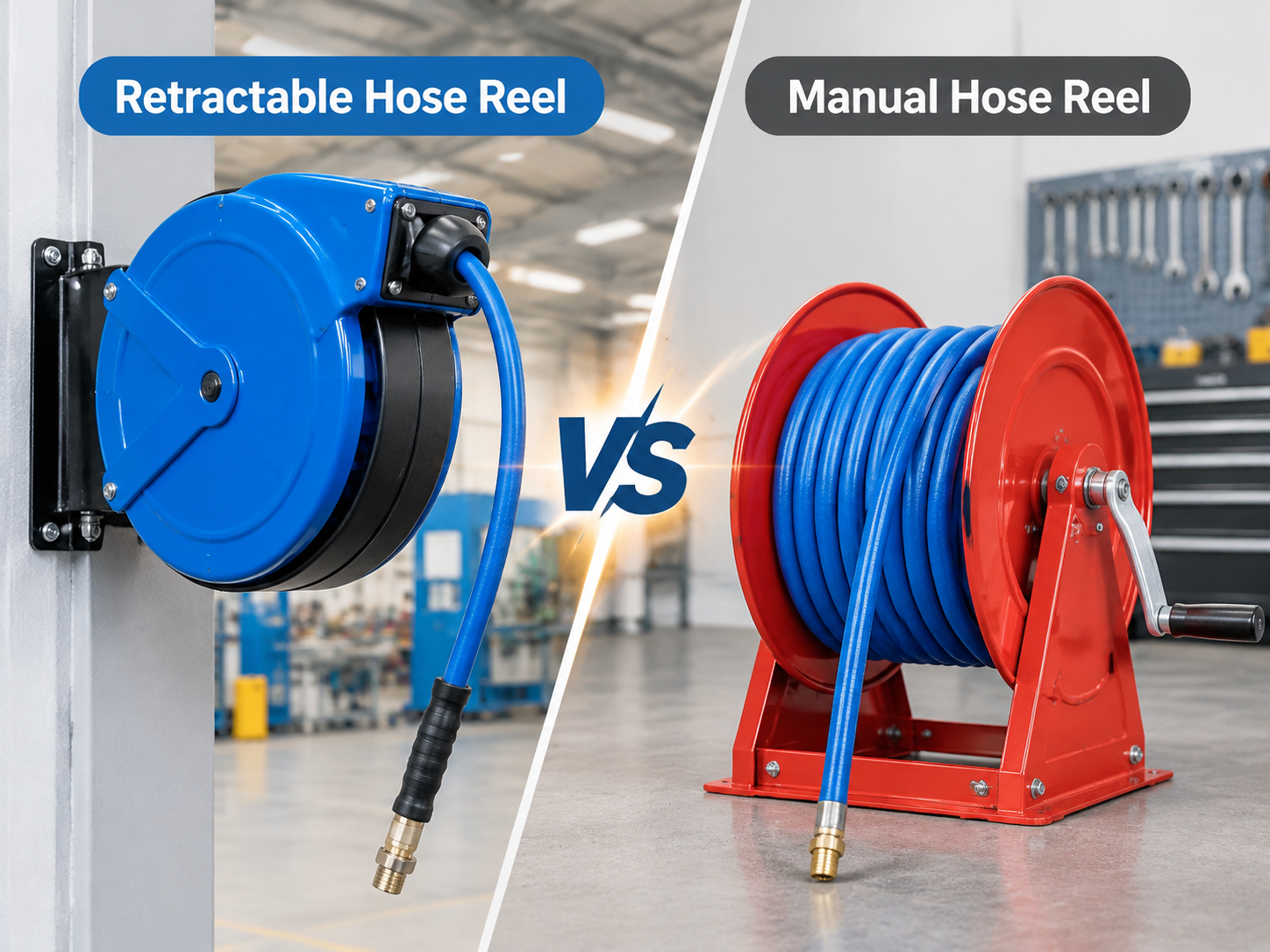
The retractable hose reel stores the hose by rotating the drum, and uses the recovery mechanism to rewind the hose after use. In this paper, the retractable hose reel mainly refers to the spring-driven retractable hose reel.
When the operator pulls out the hose, the drum rotates with it, and the internal spring stores energy. The locking mechanism can fix the hose at the required length. When the operator releases the lock, the spring will drive the drum to rotate and retract the hose.
Telescopic hose reels are widely used in manufacturing plants, automobile maintenance workshops, equipment maintenance areas and other places where compressed air, water, oil or other fluids need to be used regularly.
2. What Is a Manual Hose Reel?
The manual hose reel drives the drum to rotate through the hand crank, and the hose is rewound and stored. The operator can directly control the whole winding process, and decide the speed of shaking the handle and the length of retracting the hose by himself.
Manual hose reels are widely used in garden watering, ship decks, small processing plants, warehouses and other places where water and oil hoses need to be manually retracted.
3. Retractable Hose Reel and Manual Hose Reel: Main Differences
Both kinds of hose reels can help to arrange hoses and reduce the situation that hoses are exposed to the working environment at will. The main difference between them lies in the way of hose recycling and the degree to which operators need to participate.
| Comparison Factor | Retractable Hose Reel | Manual Hose Reel |
|---|---|---|
| Rewinding method | Spring-powered automatic retraction | Hand-crank operation |
| Operator involvement | Less effort during retraction | Requires manual winding |
| Hose control | Locking mechanism holds the hose at a selected length on many models | Operator controls winding through the crank |
| Operating speed | Convenient for frequent hose retrieval | Depends on operator speed and effort |
| Mechanical structure | Includes a spring and retraction mechanism | Uses a crank and, depending on the model, a gear system |
| Maintenance focus | Spring, locking mechanism and swivel joint | Crank, gears, drum and swivel joint |
| Typical consideration | Retraction force and hose compatibility | Cranking effort and mechanical advantage |
3.1 Convenience of Operation
Retractable hose reel can reduce the operation force required for hose retraction. The operator can pull out the required length and fix the hose in the corresponding position through the locking mechanism. After use, the hose can be retracted without manually turning the crank.
Manual hose reel requires the operator to wind the hose back by himself. This is usually not a problem in workplaces where hoses are used less frequently, but if hoses need to be wound repeatedly every day, it may increase the operating burden.
3.2 Hose Recovery and Control
Spring-driven reel can recover the hose conveniently, but it still needs to guide the hose correctly during the recovery process. If the hose is allowed to retract quickly and uncontrollably, it may twist, overlap or hit nearby objects.
Manual hose reel allows the operator to control the winding speed and hose arrangement more directly. When the hose needs to be wound neatly on the drum, this method has certain advantages, especially for long or heavy hoses.
3.3 Mechanical Structure and Maintenance
These two designs have different maintenance requirements. Retractable hose reel contains additional components such as spring and locking mechanism, so it needs to be checked periodically for wear, damage or operational failure.
The winding structure of manual hose reel is usually simple, but the crank, gear, bearing and rotating connection parts still need to be inspected regularly.
3.4 Use Cost
Telescopic hose reels are usually equipped with springs and automatic recovery mechanisms, so the initial purchase cost is relatively high, and the corresponding maintenance costs need to be borne later. However, for scenes where hoses are frequently used, it can reduce the time for manual collection and release.
The structure of manual hose reel is relatively simple, the initial purchase cost is usually low, and the maintenance is relatively direct, but the hose needs to be recovered manually, and long-term use will produce certain labor input.
Generally speaking, retractable hose reels are more suitable for frequently used scenes, while manual hose reels are more suitable for scenes with low frequency of use and emphasis on procurement costs.
4. Advantages and Limitations of the Two Types
4.1 Retractable Hose Reel
Advantages
- Automatic hose recovery: the hose is automatically recovered through the spring mechanism to reduce manual winding operation.
- Suitable for frequent use: suitable for workplaces where hoses need to be pulled out and retracted repeatedly.
- Easy to control the length of use: some models are equipped with locking mechanism, which can fix the hose in the required position.
- Reduce hose scattering: after use, the hose can be taken back to the drum to keep the working area clean and tidy.
Limit
- The recovery force of the spring needs to match the length, diameter and weight of the hose.
- Springs and locking mechanisms need regular inspection and maintenance.
- In the process of recycling, it is necessary to control the hose to avoid damage or safety risks caused by rapid rebound.
- Compared with the manual reel with simple structure, the procurement cost of some models is higher.
4.2 Manual Hose Reel
Advantages
- Directly control the winding process: the operator can control the recovery speed and winding mode of the hose by hand crank.
- The mechanical structure is relatively simple: there is no need for automatic spring recovery mechanism, which reduces the maintenance requirements of related components.
- Suitable for different frequencies of use: For scenes that are used occasionally or do not need to recycle hoses quickly, it can meet the daily storage needs.
- The recycling process is controllable: the operator can adjust the shaking speed according to the length and weight of the hose, thus reducing the problem of uneven winding of the hose.
Limit
- Manual crank rotation is required to complete hose recovery.
- When handling long or heavy hoses, it may require a large amount of operation.
- The recovery speed depends on the operator, which will increase the workload when used frequently.
- Sufficient space should be reserved to ensure that the hand crank can rotate normally.
5. What Kind of Hose Reel Should I Choose for Different Application Scenarios?
The choice of retractable hose reel and manual hose reel depends not only on the frequency of use, but also on the use, length, weight and field operation mode of hose. Different working environments have different requirements for the speed and control mode of hose retraction.
Manufacturing Plant
Manufacturing plants usually use compressed air pipes, water pipes and lubricating oil pipes in production lines, assembly stations and equipment maintenance areas. For example, pneumatic tools need to be frequently connected with compressed air pipes, and equipment cleaning and maintenance may require the use of water pipes or oil pipes.
For air hoses installed in fixed stations and frequently taken by operators, the retractable hose reel can automatically recover the hoses after use, reducing the accumulation of ground pipelines. For pipelines with low frequency and long hose length in centralized maintenance area, manual hose reel is convenient for operators to control the winding process according to actual needs.
Industrial Fluid Transportation
In the process of manufacturing, equipment lubrication and industrial fluid transportation, hose reels may be used to store hoses for conveying water, hydraulic oil, lubricating oil or grease. This kind of application needs to focus on media compatibility, working pressure and the weight of the hose itself.
For the fluid hose that needs to be used frequently in the fixed conveying station, if the length and weight of the hose meet the requirements of the spring recovery mechanism, the retractable hose reel can simplify the daily retracting operation. For long, heavy or phased fluid hoses, manual hose reels are more convenient for operators to control the winding speed and process.
Automobile Maintenance and Equipment Maintenance Workshop
Automobile maintenance workshops usually need to use air hoses, lubricating oil hoses and grease hoses to provide fluid transportation for pneumatic tools, lubricating equipment and vehicle maintenance.
For the compressed air hose installed above the maintenance workshop or on the wall, the retractable hose reel can allow technicians to pull out the hose as needed and take it back after the operation, thus reducing the occupation of the hose on the ground and the maintenance passage. Manual hose reel can provide direct operation control for the equipment used for conveying lubricating oil or grease, with long hose and manual control of retraction.
Mobile Equipment and Outdoor Field Work
Construction machinery, service vehicles and outdoor maintenance equipment usually need to carry water pipes, air pipes or other fluid hoses for cleaning, water supply and equipment maintenance in different working positions.
If the equipment needs to expand and retract the hose frequently, and the installation position can ensure the smooth operation of the hose, the retractable hose reel can reduce the manual storage work on site. Manual hose reel is usually more suitable for operations that require a long distance to pay off the hose, the frequency of hose use is not fixed, or the operator needs to control the recovery process according to the field situation.
The installation position of the reel will directly affect the use range and operation convenience of the hose. According to the site layout, the installation methods such as wall, ceiling, floor or mobile equipment, as well as the pull-out direction and activity range of the hose should be considered.
If the installation position can ensure the smooth pull-out and recovery of the hose, and the manual storage operation needs to be reduced, the retractable hose reel will be more suitable. Manual hose reel is also a practical choice if sufficient rotation space can be reserved for the crank on site and the operator can easily access the reel.
6. How to Choose Between Retractable Hose Reel and Manual Hose Reel?
The choice of retractable hose reel or manual hose reel needs to be judged in combination with hose specifications, use frequency, working environment and long-term use cost. The application conditions of the two reels are different, and the key is to choose the recycling method that matches the actual operation requirements.
6.1 Hose Length, Diameter and Weight
The length, diameter and weight of the hose will affect the storage capacity and recovery capacity of the reel. Longer, thicker or heavier hoses require more reel space, which will also increase the load during recycling.
If the retractable hose reel is selected, it should be confirmed that the spring recovery force can meet the weight and length requirements of the whole hose. If the hose is long or heavy, and the spring recovery capacity is insufficient, the manual hose reel may be more suitable, but it is necessary to ensure that the crank and gear structure can bear the corresponding load.
6.2 Frequency of Use
If the hose needs to be pulled out and retracted many times a day, it is recommended to give priority to the retractable hose reel, whose automatic recovery function can reduce repetitive manual operation.
If the hose is only used for equipment maintenance, temporary cleaning or occasionally conveying fluid, manual hose reel is usually enough, and it can also avoid paying extra cost for the infrequent automatic recovery function.
6.3 Working Pressure and Fluid Compatibility
First of all, it should be confirmed whether the two kinds of reels have pressure grades suitable for actual working conditions, and whether the hoses, rotary joints and seals are compatible with the conveying medium.
If both kinds of reels have products that meet the requirements, they can be further selected according to the hose recovery method: when frequent retraction is needed and the hose weight meets the spring recovery ability, the retractable hose reel can be selected; If the hose is heavy, and it is necessary to take it in stages or manually control the recycling process, you can consider manual hose reel.
6.4 Installation Location and Available Space
The installation position of the reel will directly affect the use range and operation convenience of the hose. According to the site layout, the installation methods such as wall, ceiling, floor or mobile equipment, as well as the pull-out direction and activity range of the hose should be considered.
If the installation position can ensure the smooth pull-out and recovery of the hose, and the manual storage operation needs to be reduced, the retractable hose reel will be more suitable. Manual hose reel is also a practical choice if sufficient rotation space can be reserved for the crank on site and the operator can easily access the reel.
6.5 Maintenance and Comprehensive Cost
If the enterprise has the maintenance conditions to regularly check the spring, locking mechanism and other components, and wants to reduce the daily manual collection and release time, it can consider the retractable hose reel.
If we pay more attention to lower initial purchase cost, simple mechanical structure and direct maintenance, manual hose reel may be more suitable. However, the time spent on manual winding should also be considered, especially if the hose is used frequently.
Finally, the purchase price, maintenance cost and long-term labor input should be comprehensively compared, rather than judging which reel is more economical only by the initial price.
7. FAQs
Is the Retractable Hose Reel Better Than the Manual Hose Reel?
This is not the case in all cases. Retractable hose reel is usually more suitable for scenes where hoses are frequently used, because it can reduce manual winding operations. Manual hose reel may be more practical for applications that are used occasionally, need precise control of winding process, or prefer manual mechanism.
Can the Manual Hose Reel Carry Heavy Hoses?
Yes, but only if the rated specifications of the reel match the length, diameter and weight of the hose. Drum, frame, crank and gear transmission structure must be able to bear the corresponding load. Manual reel equipped with gear transmission system can reduce the operation force required for winding heavy hose.
Does the Retractable Hose Reel Need More Maintenance?
Retractable hose reel contains additional components such as spring and locking mechanism, which need to be inspected regularly. However, the actual maintenance needs depend on the product structure, working conditions and frequency of use. Manual hose reels also need to check their mechanical parts regularly.
Can Both Retractable Hose Reels and Manual Hose Reels Be Used for Oil and Water?
Sure. Both types have products suitable for different fluid transportation scenarios. The selected reel must be equipped with hoses and rotary joints compatible with the conveying medium, and meet the corresponding pressure grade and working conditions.
How to Judge Whether the Retractable Hose Reel Can Adapt to My Hose?
Check the product specifications provided by the manufacturer to confirm the hose length, inner diameter and outer diameter, weight, pressure grade and recovery capacity. The spring mechanism must be able to adapt to the complete hose assembly, not just the nominal length of the hose.
Conclusion
Retractable hose reel and manual hose reel adopt different hose storage and recovery methods. The retractable model is suitable for scenes where hoses are frequently used, and the automatic recycling function can reduce repetitive manual operations. Manual model can provide direct winding control, which is a practical solution for installation sites that are used occasionally or prefer to adopt simple mechanical structure.
The best choice depends on hose specifications, frequency of use, working pressure, installation space and maintenance requirements. Through comprehensive evaluation of these factors, enterprises can choose hose reels that are more suitable for their own work needs, ensure the reliable operation of equipment, and properly store hoses between operations.
Related Posts
When Should You Choose a Stainless Steel Manual Hose Reel?
October 8, 2026
Why Spring Fatigue Happens in Retractable Hose Reels
June 10, 2026