How Does Hose Length Affect Water Pressure in Garden Irrigation?
November 19, 2026 | Garden Hose Reels
Introduction
The end of a garden hose closest to the faucet may have a strong water flow, but by the time the water reaches the other end, the flow rate has noticeably decreased. This is especially noticeable when watering flower beds, vegetable gardens, lawns, or multiple outdoor areas that are farther away.
Hose length, inner diameter, water flow rate, connectors, and water supply conditions all affect water pressure, which in turn determines whether water can reach the point of use effectively.
Understanding these factors helps you plan your irrigation system more effectively, avoid unnecessary water supply limitations, and maintain consistent watering results.
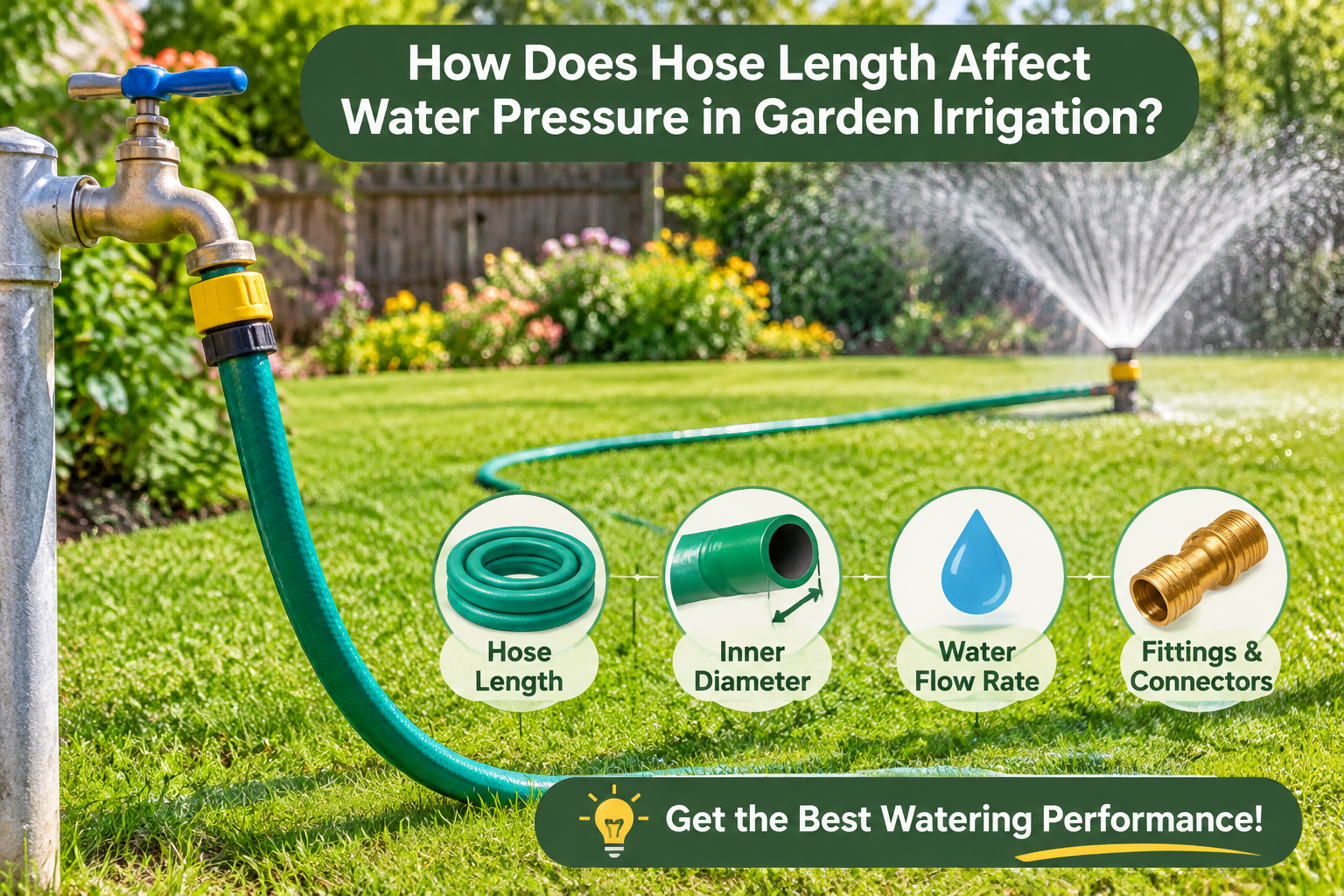
4 Factors Affecting Water Pressure in Garden Hoses
1. Hose Length
Longer garden hoses typically create greater resistance to water flow. As water flows through the hose, it rubs against the inner walls, gradually causing a loss of pressure. The longer the distance the water travels, the greater the frictional resistance it must overcome.
For example, when connecting hoses of different lengths to the same faucet, the available pressure at the end of the longer hose may be lower—especially when the hose has a smaller inner diameter or the water flow rate is high. Therefore, when supplying water to distant areas of the garden, both hose length and inner diameter must be considered to avoid compromising watering effectiveness due to excessive flow resistance.
When planning an irrigation route, consider the actual distance between the water source and the area to be watered. If the same watering task can be accomplished using a shorter route, there is no need to use an excessively long hose.
For larger gardens, dividing different areas into separate irrigation zones may be more practical than using a single, very long hose to supply water to all areas simultaneously.
2. Hose Inner Diameter
The inner diameter of a garden hose has a significant impact on water flow performance.
Hoses with a larger inner diameter provide a wider passage for water flow and typically reduce flow resistance at the same flow rate. Hoses with smaller inner diameters, on the other hand, create greater resistance and may result in more significant pressure loss over the same delivery distance.
Thinner hoses are generally sufficient for watering flowerpots or small flower beds. However, if you need to supply water to a large sprinkler or cover a lawn at a greater distance, you may need to choose a hose with a larger inner diameter.
3. Water Flow Rate
Water flow rate refers to the volume of water passing through a hose per unit of time, typically measured in gallons per minute (GPM) or liters per minute (L/min).
Generally, the higher the flow rate, the greater the friction loss generated by the water flowing through the hose. This means that as the volume of water passing through the hose increases, the available pressure at the outlet may decrease accordingly.
The requirements of the irrigation equipment itself are equally important. Drip irrigation systems typically require only a low flow rate, while large sprinklers may need a higher flow rate to function properly. If the water supply system cannot meet the equipment’s flow requirements, sprinklers may experience issues such as slow rotation, reduced spray distance, or uneven water distribution.
Therefore, ensuring that the hose’s flow capacity matches actual irrigation needs is essential for maintaining a stable water supply.
4. Fittings and Hose Connectors
In addition to the hose itself, connectors, valves, adapters, and other fittings can also increase flow resistance.
If the internal passages of these fittings are narrow, significant pressure loss may occur—especially when multiple flow-restricting fittings are installed along a single hose.
Valves that are not fully open, clogged filters, damaged gaskets, and mismatched fitting specifications can also further reduce water flow.
When insufficient water flow is detected, the entire connection path should be inspected. Sometimes, replacing damaged fittings or reducing unnecessary adapters can improve water flow performance without having to replace the entire hose.
How Can You Tell If Your Garden Hose Is Restricting Water Flow?
Insufficient water flow does not necessarily mean the hose is too long. A few simple checks can help identify the actual cause of the problem.
Compare the water flow at the source to that at the hose outlet. First, observe the water flow directly from the faucet, then connect the hose and compare the flow at the other end under similar conditions. If the flow is noticeably weaker, it may indicate significant resistance within the hose or at the connection points.
Check the hose for physical blockages. Look for sharp kinks, flattened sections, knots, or areas where the hose is being pinched by gardening tools or other objects. Any of these conditions can narrow the effective water passage inside the hose.
Inspect the connectors and valves. Ensure all valves are fully open and that the connectors are not clogged with dirt or mineral deposits. Also, check the gaskets and O-rings for damage.
Inspect the irrigation equipment separately. If the hose itself provides a relatively adequate water flow but the sprinkler still isn’t working properly, the problem may lie with the sprinkler’s flow requirements, the condition of the nozzle, or an internal blockage.
By conducting these checks, you can better determine whether the problem stems from the water source, the hose setup, or the irrigation equipment.
How Can You Improve the Water Delivery Performance of a Long Garden Hose?
Once you’ve identified the primary limiting factors, you can improve water delivery using the following methods.
- Choose the appropriate hose inner diameter. For longer supply routes or applications with high flow requirements, a larger inner diameter typically helps reduce friction losses.
- Use the necessary length of hose. If no additional extension is needed, try to avoid adding extra hose sections. Generally, shorter supply routes result in less resistance.
- Keep the hose route clear. Avoid sharp bends, kinks, and unnecessary tangles to prevent restricting water flow.
- Minimize unnecessary fittings. Choose fittings with matching specifications and avoid installing multiple adapters unless absolutely necessary.
- Match the hose to the irrigation equipment. Check the flow rate and operating pressure requirements of sprinklers, nozzles, and irrigation fittings.
- Consider elevation differences. When water is delivered to higher elevations, it must overcome the additional force of gravity. Therefore, irrigation areas significantly higher than the water source may experience lower water pressure compared to areas at the same height as the faucet.
If your garden has multiple irrigation zones, dividing them into separate areas can also help distribute the available water more efficiently. Irrigating one area at a time may be more effective for maintaining a stable water supply than using a single long hose to power multiple high-flow sprinklers simultaneously.
Does a Garden Hose Reel Affect Water Pressure?
A garden hose reel does not automatically reduce water pressure on its own. Its impact on water flow depends more on the condition of the hose and the structure of the water supply connection than on the reel itself.
When the hose is wound onto the reel, it should remain smoothly curved, avoiding sharp bends or being pinched. Excessive kinking, localized flattening, or damage to the hose layers can all restrict the internal water flow path.
Swivel joints and other internal connectors also need to be considered. If the internal passages of these components are significantly smaller than the hose’s inner diameter, they may create additional resistance to water flow.
To maintain good water delivery performance, choose a reel that matches the hose’s inner diameter and length, ensure the hose can be pulled out smoothly, and avoid using the hose when it is pinched or kinked.
A suitable garden hose reel can also help organize longer hoses, reduce unnecessary dragging on the ground, and keep the watering area tidy. These benefits help maintain the hose in good working condition.
Conclusion
Hose length affects water pressure during garden irrigation, but it is only one factor in the overall water supply system. The hose’s inner diameter, water flow rate, connectors, elevation differences, and watering equipment all influence the final water flow performance at the outlet.
Therefore, when selecting a hose, one should not consider length alone but should also take into account the water supply distance, actual flow rate requirements, and environmental conditions of the irrigation area. Properly planning the hose route, using appropriate connectors, and ensuring proper daily storage will help maintain a more stable water supply and make daily garden irrigation easier.
Related Posts
Irrigation Hose Reel Selection Guide
November 3, 2026
Can Garden Hose Reels Be Used for Pressure Cleaning?
November 20, 2026
Storing Garden Hose for Winter: A Practical Guide
November 4, 2026