Air Hose Reels for Service Trucks: Complete Guide
August 6, 2026 | Air Hose Reel, Industrial Hose Reels
1.Introduction
Service vehicles are widely used in scenarios such as mobile equipment repair, fleet maintenance, construction site repair, and roadside assistance. In these environments, compressed air is typically used for tire inflation, pneumatic tool cleaning, equipment cleaning, and other maintenance work. A suitable service vehicle air hose reel can help organize hoses and allow compressed air to be easily delivered to work locations around the vehicle.
Unlike stationary workshops, service vehicles have limited space and are constantly exposed to vehicle vibration, dust, moisture, temperature fluctuations, and a more complex working environment. Therefore, air hose reels not only need to store hoses but also need to be able to quickly release hoses, smoothly retract them, reliably store them, and be easy to operate without affecting other equipment on the vehicle.
Choosing the right service vehicle air hose reel requires comprehensive consideration of hose length, working pressure, reel structure, installation location, drive method, and usage frequency. This article will explore how to choose the right air hose reel for your mobile service vehicle. If you are comparing different types of reels, installation methods, and selection factors, you can also read our guide to Air Hose Reel Solutions for Different Industries.
2.Key Requirements for Service Vehicle Air Hose Reels
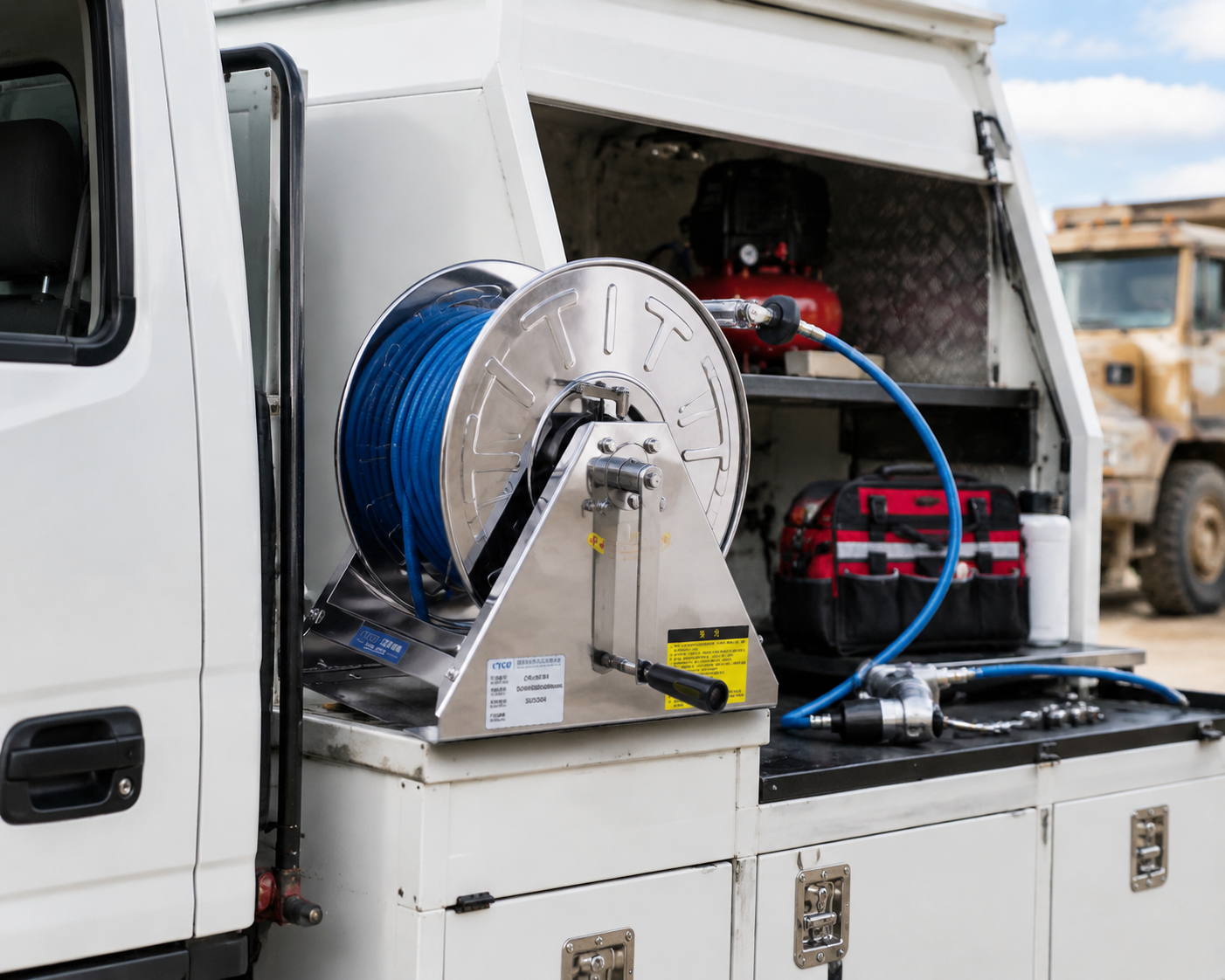
Service vehicles typically need to carry air compressors, pneumatic tools, spare parts, lubricants, electrical equipment, and other maintenance supplies. With limited onboard space, hose reels need to provide efficient hose management without taking up too much space.
2.1 Compact and Space-Saving Design
A suitable reel should fit naturally into the service vehicle’s cargo compartment, equipment bay, or side mounting area. A compact design ensures the reel won’t obstruct the use of other equipment after installation.
The installation location also needs to ensure smooth hose pull-out. If the reel is too close to the vehicle wall, storage compartment, or other equipment, the hose may rub against surrounding surfaces during use. Properly configured guide arms can improve the hose’s movement path and reduce unnecessary bends.
2.2 Appropriate Hose Length and Operating Pressure
The hose length should be selected based on the actual operating range around the vehicle. A hose that is too short will limit the operating range, while a hose that is too long will increase the size of the reel and storage space requirements.
Operating pressure is equally important. The hose, connectors, swivel joints, and the reel itself should all be compatible with the compressed air system used by the service vehicle. When selecting a reel, its rated operating pressure should meet or exceed the system’s maximum operating pressure, and should not be determined solely by the air compressor’s normal operating pressure.
The hose inner diameter also needs to be considered, as it affects airflow. For scenarios using pneumatic tools with high air consumption, a larger hose inner diameter helps reduce pressure loss during long-distance air delivery.
2.3 Durable Construction for Mobile Environments
Service vehicle air hose reels experience significantly more movement and vibration than stationary shop reels. Continuous vibrations from road travel, frequent pulling and releasing, temperature changes, dust, and occasional impacts all gradually affect the reel and hose.
A robust frame, reliable drive springs, durable rotary joints, and corrosion-resistant surface treatments help the reel adapt to these working conditions. If the vehicle frequently operates in humid or corrosive environments, a stainless steel construction can also be considered.
3.Important Structural Design
The reel’s structure directly affects the smoothness of hose pulling, releasing, and retraction.
3.1 Adjustable Guide Arm
The guide arm controls the direction in which the hose enters and leaves the reel. This is especially important for service vehicles, as the reel may be installed horizontally, vertically, or in an equipment compartment.
The adjustable guide arm adjusts the hose’s movement path according to the actual installation position, reducing lateral forces and minimizing the possibility of friction between the hose and the reel edge or vehicle structure.
3.2 Adjustable Hose Stop
The hose stop allows the operator to set the hose retraction stop position. This ensures that the handle remains easily accessible after the hose is fully retracted, eliminating the need to pull the entire hose out each time.
For service vehicles that require frequent hose use throughout the day, this seemingly simple design significantly improves operational convenience.
3.3 Enclosed Drive Spring
The drive spring is a crucial working component of the spring-driven reel. An enclosed spring structure reduces the ingress of dust, dirt, and moisture into the internal mechanism, while also reducing the risk of accidental contact with the spring.
Protecting the drive spring is particularly valuable for mobile service applications, as the reel may be exposed to road dust and constantly changing environmental conditions for extended periods. A protected spring mechanism helps maintain stable performance and extends the reel’s lifespan.
4.How to Choose the Right Air Hose Reel for a Service Vehicle?
The most suitable reel is not necessarily the largest or highest-capacity model, but rather should be selected based on the actual usage of the service vehicle.
4.1 Determine the Specific Application
First, it’s necessary to clarify the primary purpose of the compressed air. The requirements for tire inflation differ from those for pneumatic impact wrenches, air guns, or other high-air-consumption equipment.
Consider the following factors:
- Required hose length
- Maximum operating pressure
- Required airflow
- Hose inner diameter
- Frequency of use
- Available installation space
- Working environment
For service vehicles performing routine maintenance, a medium-length, spring-loaded, automatic retractable air hose reel usually provides a good user experience. If the application requires a longer hose, or the reel needs to frequently bear heavy hose loads, a larger-capacity industrial hose reel may be necessary.
4.2 Choosing the Right Hose
The hose needs to be matched to the operating pressure, temperature, environment, and expected movement, while also possessing sufficient flexibility to withstand repeated pulling and retraction.
If the hose is too stiff, it will increase the load on the reel’s drive spring and reduce operating comfort. Conversely, if the hose is not strong enough, it may wear out quickly when repeatedly dragged across rough surfaces.
The connection between the hose and the rotary joint also requires careful inspection. A suitable connection helps maintain a stable airflow and reduces the risk of leaks.
4.3 Choosing the Appropriate Drive Type
The drive type is also an important factor to consider when selecting an air hose reel for a service vehicle.
Spring-driven hose reels are generally a practical choice for general service vehicle applications. They automatically retract the hose, require no external power supply, are simple to operate, and are relatively easy to maintain.
Motor-driven hose reels are more suitable for applications with longer, heavier hoses or those requiring frequent deployment and retraction. The motor provides power for automatic hose deployment and retraction, reducing the physical burden on operators. However, motor-driven systems require additional electrical components and place greater demands on vehicle power supply and installation.
Manual hose reels are suitable for scenarios with lower usage frequency and no special requirements for automatic retraction. They have a simple structure, but require manual hose winding after each use.
For most mobile compressed air applications, the choice between spring-driven and motor-driven reels mainly depends on the hose size, length, frequency of use, and whether the vehicle has suitable power supply capabilities.
5.Installation and Maintenance Recommendations
Proper installation is just as important as selecting the right reel. The mounting structure should be strong enough to withstand the weight of the reel itself and the forces generated when pulling out the hose.
Use appropriate mounting hardware and ensure the reel is securely fastened to the service vehicle’s body or equipment structure. Avoid installing the reel in locations where the hose will be sharply bent immediately after exiting the reel.
After installation, perform a full operational test on the reel. Slowly pull out the hose, check the locking mechanism, and then retract the hose in a controlled manner. Ensure the hose winds evenly around the reel, rather than bunching on one side.
Routine maintenance should include checking the hose for cuts, abrasions, cracks, or deformation. Also check for leaks at connections and inspect swivel joints and other moving parts according to the manufacturer’s maintenance recommendations.
If the service vehicle frequently operates in dusty or muddy environments, clean the hose as needed. Avoid dragging the hose across sharp edges or hot surfaces for extended periods, as these conditions will significantly shorten the hose’s lifespan.
If the reel exhibits uneven reeling, abnormal locking, or unusual mechanical noise, it should be inspected before continuing high-frequency use. Addressing minor issues promptly can prevent further damage to other components.
6.Conclusion
Service vehicle air hose reels need to balance hose management, reliable operation, and durability within a compact space. The appropriate solution depends on the vehicle layout, hose specifications, operating pressure, specific application, and frequency of use.
For general mobile maintenance work, spring-driven air hose reels offer rapid hose deployment and automatic reeling without requiring an additional power source. When the vehicle uses longer or heavier hoses and requires frequent operation, motor-driven reels offer greater ease of use. Regardless of the drive method chosen, features such as adjustable guide arms, hose stops, robust frames, and protected drive mechanisms contribute to an improved overall user experience.
Optimizing the hose, reel capacity, drive method, and installation location based on actual maintenance needs creates a cleaner and more efficient mobile compressed air system. A suitable service vehicle air hose reel not only effectively manages hoses but also helps maintenance personnel reduce equipment operation and tidying time, allowing them to focus more on actual maintenance work.
Related Posts
DEF Compatible Hose Reels: What Specifications Can’t Be Ignored?
October 10, 2026
Fuel Hose Reel Selection Guide for Safe Fueling Systems
June 22, 2026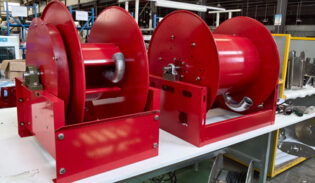
Primary Categories and Characteristics of Industrial Hose Reels
October 28, 2025