How to Clean Hose Reels: A Step-by-Step Cleaning Guide
September 8, 2026 | Industrial Hose Reels
Hose reels are often overlooked yet crucial pieces of equipment in the workplace—whether in industrial workshops, fire protection systems, or daily irrigation, they play a vital role in deploying and retracting hoses. However, the long-term accumulation of dust, dirt, oil, and chemical residues can gradually affect the reel’s operating efficiency and even shorten its lifespan. Regular cleaning not only maintains equipment performance but is also an important part of preventative maintenance.
This article will introduce when hose reels need cleaning, what tools and materials are needed, how to clean them step by step, the applicable scenarios for different cleaning methods, and what parts need to be inspected after cleaning.
1. Why Do Hose Reels Need Cleaning?
Hose reels are not only used to store hoses but also include multiple working components such as the spool, hose guide, swivel joint, mounting structure, and springs or drive components. These parts are affected during hose deployment and retrieval, and dust and other contaminants can accumulate on their surfaces, affecting the normal operation of the reel.
Regular cleaning helps to:
- Remove dust, oil, grease, and other contaminants.
- Reducing surface wear that may be caused by abrasive particles.
- Keeping the hose surface clean for easy inspection. Easier to observe hose unfolding and retraction.
- Help helps detect corrosion, leaks, or component damage early.
- Keeps the work area cleaner and more organized.
Cleanliness is especially important in industrial environments, as hose reels may be exposed to oil, grease, dirt, metal dust, cleaning chemicals, or frequent rinsing.
However, cleaning is not the same as complete hose reel maintenance. Lubrication, component replacement, pressure testing, and other maintenance should be performed according to the reel manufacturer’s instructions.
2. Signs a Hose Reel Needs Cleaning
There is no uniform cleaning schedule for all industrial hose reels. The condition of the reel itself and the actual working environment are usually better indicators.
Focus on observing the following signs:
Obvious dust or contaminants: If there is obvious dust, dirt, oil, grease, or other deposits on the hose, reel, support, or guide, it usually indicates that the reel needs cleaning.
Oil or grease buildup: Oil and grease easily attract dust, forming a thick residue around the hose reel. This not only affects the appearance but also increases the difficulty of inspecting the hose and related components.
Dirty areas in the hose guide area: Excessive dirt buildup around the guide can affect the proper movement of the hose during deployment and retrieval.
Water stains or chemical residues: Water stains, salt deposits, or chemical residues may indicate that the reel needs cleaning, especially outdoors, at sea, in washing areas, or in chemical environments.
The reel becomes increasingly difficult to inspect: When contaminants accumulate heavily, cracks, corrosion, loose connections, and other obvious problems can be obscured. Cleaning makes these conditions much easier to spot.
Hose reels don’t necessarily need immediate cleaning for every small amount of dust. Cleaning frequency should be determined based on the quantity and type of contaminants, as well as the actual frequency of reel use.
3. What tools and materials do you need?
Routine cleaning typically doesn’t require special equipment. Prepare the following items:
- Clean water
- · Mild detergent
- · Soft cloth or sponge
- · Soft-bristled brush
- · Low-pressure water flow
- · Dry cloth
- · Protective gloves
- · Safety goggles if necessary
- Cleaning products must be compatible with the reel material, hose material, and the residue to be removed.
Which cleaning products should be avoided?
Do not use a strong detergent directly on a hose reel. Strong acids, strong alkalis, harsh solvents, and abrasive cleaners may damage surface coatings, stainless steel surfaces, seals, or hose materials.
For stainless steel reels, avoid using cleaners that may cause discoloration or corrosion. For coated steel reels, strong chemicals or abrasive tools may damage the surface coating, exposing the underlying metal and increasing the risk of corrosion.
If the hose reel was previously used to transport chemicals, identify the previously transported medium before selecting a cleaning agent. The cleaning agent should not react hazardously with residue.
4. How to Clean a Hose Reel: A Step-by-Step Guide
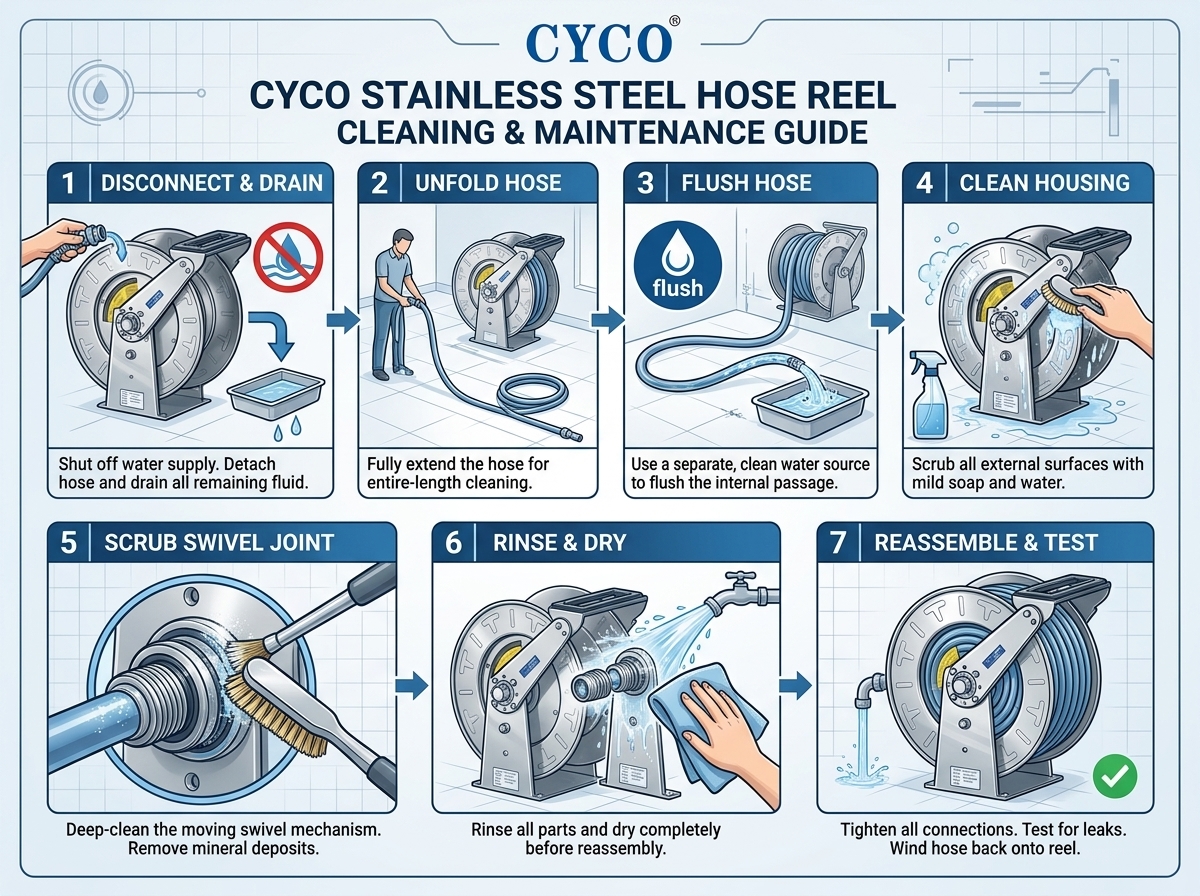
Step 1: Stop the device and relieve pressure
Before cleaning, equipment connected to the hose reel should be stopped and the supply of water, air, liquid or other media turned off. Before working on hoses or connections, relieve any residual pressure in the system.
Never start cleaning while the hose reel is under pressure, especially in high-pressure water, hydraulic, chemical or compressed air systems.
Step 2: Unfold the Hose
Pull out enough hose to gain access to the hose surface and reel. When conditions permit, the hose can be unrolled further to inspect for possible dirt hidden between the coiled layers.
If the reel is not operating properly, do not force the hose out. Jammed or damaged reels should be inspected first.
Step 3: Remove Loose Dust and Debris
Treat dry or loose contaminants before using water or detergents. Use a soft cloth or soft-bristled brush to remove: dust, sand, dirt, metal particles, loose sediment and other surface debris.
Removing these particles first reduces the likelihood of them being rubbed onto the hose or reel surface during the cleaning process.
Step 4: Clean the hose
Use clean water and, if necessary, a mild detergent suitable for the material of the hose.
Wipe with a rag or gently clean the hose surface with a soft-bristled brush to remove dust, oil, grease or other external contaminants. Special attention should be paid to areas where there is frequent contact with the ground or where hose guides are frequently passed.
Do not use cleaning products that may cause the hose material to deteriorate, discolor, or affect its performance.
Step 5: Clean the roll and holder
Use a soft rag, sponge, or soft-bristled brush to clean the accessible surfaces of the reel frame and reel.
If there is obvious soiling, use a mild detergent if the material is compatible. At the same time, be careful to avoid flushing large amounts of water or cleaning fluid directly into closed mechanical areas.
Focus on cleaning areas where dirt tends to accumulate, such as:
- Around the reel
- Accessible area inside the bracket
- Near the mounting bracket
- near hose outlet
- hose guide area
Step 6: Clean Hose Guides and Stops
Hose guides and stops come into direct contact with the hose during use, so dirt is also prone to accumulate in these areas.
Guide surfaces should be carefully cleaned and the guides checked for proper movement. Remove any dirt that may interfere with hose access and movement.
If the reel is equipped with an adjustable buffer stop, clean around the stop as well and make sure it remains securely in place.
Step 7: Rinse the Scroll
After cleaning is complete, use clean water and low-pressure water to flush away any remaining detergent and loose dirt.
Avoid using strong water jets directed at the internal parts of the reel. Moisture that gets into springs, bearings, rotary joints, motors, electrical connections, or other enclosed mechanisms can cause problems that are worse than the original contamination.
Step 8: Dry Hoses and Reels
Use a clean, dry cloth to wipe away excess moisture from the surface and allow the hose reel to dry completely.
Focus on connections, mounting brackets, drums, and other recessed areas where water can collect.
Adequate drying is particularly important for reels installed in humid environments, as prolonged moisture retention may increase the risk of corrosion in certain materials.
Step 9: Inspect the Scroll Before Returning to Service
After the reel is clean and dry, the hose and reel should be inspected before returning to normal operation.
Confirm:
- There is no visible surface damage to the hose.
- The connection parts are firm.
- The hose guides are clean and in the correct position.
- The reel can rotate normally.
- The hose can be recovered smoothly.
- No obvious leaks or damaged parts.
If an abnormality is found, the cause should be determined before continuing to use the scroll.
5. Hose reel cleaning methods and applicable scenarios
Different contaminants may require different cleaning methods. Typically, priority should be given to relatively gentle cleaning methods that effectively remove contaminants.
| Cleaning Method | Suitable For | Main Consideration |
|---|---|---|
| Wiping | Light dust and surface dirt | Use a soft cloth |
| Soft brushing | Dry deposits and loose dirt | Avoid abrasive brushes |
| Low-pressure water | Mud and general surface contamination | Protect internal components |
| Mild detergent | Oil, grease, and stubborn deposits | Check material compatibility |
| High-pressure water | Heavy external dirt | Avoid internal mechanisms and electrical parts |
Wipe and soft-bristle brush cleaning
For light contamination, wiping and using a soft-bristled brush is usually all that is needed. These methods provide greater control over where moisture comes into contact and are particularly suitable for areas near sensitive components.
Low pressure water cleaning
A low pressure stream of water can be used to remove dirt and other washable contaminants from the outside of the reel. Water flow should be directed primarily toward exposed surfaces and not directly toward internal mechanisms.
Clean with mild detergent
If oil, grease, or difficult-to-remove residue is present, you can use a mild detergent to help soften the contaminants, then rinse. Compatibility with reel surface treatment, hose material, seals and residue to be removed should be verified before use.
High pressure water cleaning
High-pressure water may have a better cleaning effect on heavier external soiling, but it needs to be used with extreme caution.
If high-pressure water is sprayed directly onto mechanical housings, bearings, seals, electrical components, or other sensitive areas, moisture or contaminants may be forced inside.
For most hose reels, high-pressure water cleaning is not necessary for routine maintenance. If high-pressure water is used, the manufacturer’s instructions should be followed and sensitive parts should be protected.
6. Cleaning Hose Reels by Material
Different materials require different precautions when cleaning hose reels.
6.1 Coated Steel Hose Reels
Coated steel hose reels can be cleaned with a mild detergent, a soft cloth, or a soft-bristled brush. Avoid using abrasive tools that may scratch the coating.
After cleaning, check the surface for coating peeling, deep scratches, or other coating damage. If the metal substrate is exposed, especially in humid or outdoor environments, corrosion may be more likely.
6.2 304 Stainless Steel Hose Reels
304 stainless steel hose reels are typically used in environments requiring higher corrosion resistance. Routine surface cleaning can be done with water, a mild detergent, and soft cleaning tools.
After cleaning, remove water stains, salt, and chemical residues; do not allow these substances to remain on the surface for extended periods.
6.3 316/316L Stainless Steel Hose Reels
316/316L stainless steel offers even higher corrosion resistance and is typically used in more complex corrosive environments. However, even stainless steel hose reels require regular cleaning.
Salt, chemical residues, and other contaminants should be removed promptly, depending on the actual working environment and the compatibility of the cleaning agent with the materials.
7. Which parts of the hose reel require special attention?
Some parts require extra care during cleaning:
Springs and Rewind Mechanisms: Spring driven hose reels contain a rewind mechanism and should not be directly rinsed with high-pressure water. Protect the springs and other internal components unless explicitly permitted by the manufacturer’s cleaning instructions.
Motors and Electrical Components: For electric hose reels, keep the motor, electrical connections, switches, and control components dry. Do not use cleaning methods that could allow moisture to enter the electrical housing or connections.
Swivel Joints and Sealing Components: Swivel joints allow the hose connection to rotate while maintaining media delivery. During cleaning, remove contaminants from externally accessible areas, but do not force water or cleaning agents into the sealing mechanism.
Hose Guides and Moving Parts: Remove contaminants around guide rollers, guide arms, and other moving parts. Excessive deposits can impede smooth hose movement.
Hose Connections: After cleaning the external surfaces of the joints and connections, check for signs of leaks, loosening, corrosion, or damage.
8. How often should hose reels be cleaned?
There is no uniform cleaning schedule for all industrial hose reels. The appropriate cleaning frequency depends on the working environment, the type of contaminants, the reel’s structure, and the frequency of use.
| Working Environment | Cleaning Approach |
|---|---|
| Clean indoor workshop | Clean as needed and during routine inspections |
| Dusty industrial environment | Clean more frequently as dirt accumulates |
| Oil and grease area | Clean when residue builds up |
| Outdoor environment | Clean regularly, especially after heavy exposure |
| Washdown area | Inspect and clean regularly |
| Chemical environment | Follow contamination and material-compatibility requirements |
For reels used frequently in dirtier environments, cleaning is usually necessary when visibly contaminated. In cleaner indoor environments, less frequent cleaning may be required.
The focus of cleaning is not on mechanically performing cleaning on fixed dates, but on preventing contaminants from accumulating to the point of affecting inspections, hose movement, or component condition.
9. What should be checked after cleaning?
After cleaning, take this opportunity to conduct a more thorough inspection of the hose reel.
Inspect the hose for cuts, abrasions, cracks, bulges, bends, or other obvious damage. Check connections and swivel joints for leaks or abnormal wear. Ensure the hose guides and limiters are securely installed and free of obstructions.
Then carefully operate the reel to observe whether the hose can be smoothly unwound and retracted.
Cleaning is only part of routine hose reel maintenance. For a more comprehensive overview of inspection, lubrication, component condition, and preventative maintenance, please refer to our Hose Reel Maintenance guide.
10. Common Mistakes When Cleaning Hose Reels
Avoid the following common mistakes when cleaning:
- Cleaning with the system still pressurized: Residual pressure in the system before handling or disassembling the hose can pose a safety risk.
- Using strong corrosive chemicals: Cleaning agents that quickly remove dirt can also damage coatings, seals, stainless steel surfaces, or hose materials.
- Using high-pressure water to directly rinse internal components: A strong water flow can force moisture and contaminants into internal mechanisms.
- Leaving the reel damp for extended periods after cleaning: Residual moisture at connections, installation areas, and vulnerable metal surfaces can increase the risk of corrosion.
- Failure to confirm material compatibility: The cleaning agent used should be compatible with the reel material, hose material, and the contaminants to be removed.
- Ignoring manufacturer instructions: Different hose reels have different structures and operating mechanisms. If the manufacturer provides specific cleaning and safety requirements, follow their instructions first.
Final Thoughts
Properly cleaning industrial hose reels is not complicated, but it requires the right approach. The basic cleaning process can be summarized as follows: Stop the equipment and release pressure → Unwind the hose → Remove loose contaminants → Clean the hose and reel → Rinse → Dry → Inspect. Specific cleaning methods should be adjusted based on the reel material, hose material, type of contaminants, and working environment. Regular cleaning helps keep reels and hoses easily inspectable and reduces the buildup of dust, oil, grease, and other contaminants.
More importantly, during cleaning, avoid exposing springs, electrical components, rotary joints, seals, and other sensitive parts to unnecessary moisture or strong cleaning agents. Combining regular cleaning with proper Hose Reel Maintenance helps maintain the reliable operation of industrial hose reel systems.
Related Posts
Primary Categories and Characteristics of Industrial Hose Reels
October 28, 2025
Hose Reel Solutions for Manufacturing Plants
July 22, 2026
Best Hose Reel Solutions for the Paper Industry
August 27, 2026