When Should You Choose a Stainless Steel Manual Hose Reel?
October 8, 2026 | Industrial Hose Reels, Manual Hose Reel, Stainless Steel Hose Reels
Choosing a hose reel is not simply a matter of deciding between manual or automatic operation, nor is it simply about choosing a corrosion-resistant material. A more reasonable approach is to match the hose reel with how the hose is actually used and the working environment in which the reel is installed.
When the working environment requires good durability while the application itself does not require automatic retraction, a stainless steel manual hose reel can be a practical choice. This combination is particularly meaningful when there is no convenient power supply on site, the hose is not used frequently, or operators need to directly control the deployment and retraction of the hose.
The key is to determine: when this configuration truly offers advantages, and when other types of hose reels would be more suitable.
1. When Is Stainless Steel Worth Choosing?
The core advantages of stainless steel are corrosion resistance, easy surface cleaning, and long service life. When your working environment meets any of the following conditions, a stainless steel hose reel is suitable.
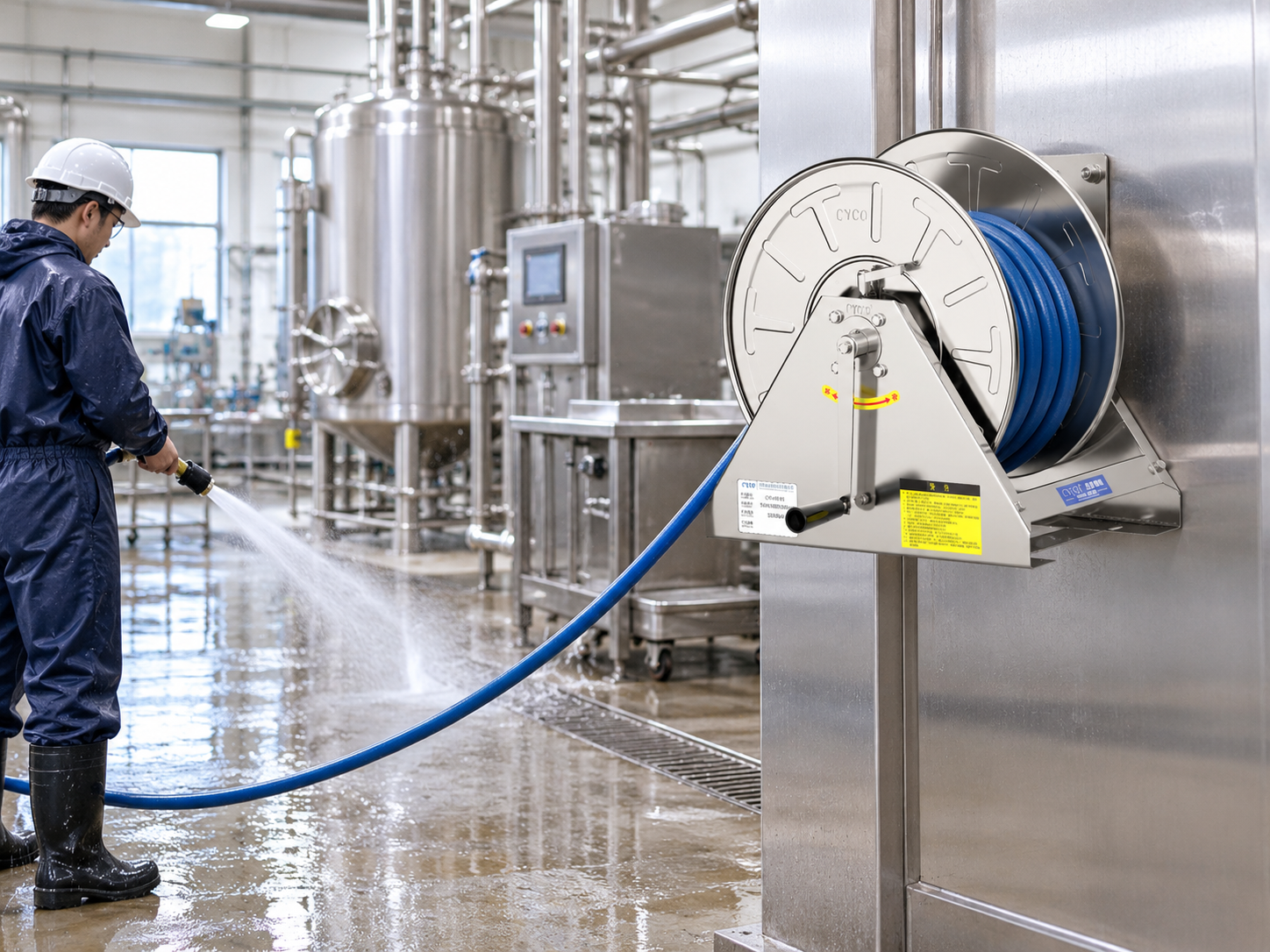
First, the working area is constantly wet, exposed to water splashes, or has high humidity. Wastewater treatment workshops, food and beverage processing plants, ports, and outdoor coastal locations are exposed to moisture for long periods. Ordinary carbon steel hose reels are prone to rust and paint peeling, which can lead to structural damage, while 304 or 316 stainless steel can resist oxidation and extend the service life of the equipment.
Second, the equipment frequently comes into contact with cleaning agents, mild chemical reagents, salt spray, or corrosive residues. A passive protective layer forms on the stainless steel surface, allowing it to withstand splashes from most detergents, disinfectants, and mild chemical liquids. In high-chloride environments, such as coastal plants, upgrading to 316 stainless steel is recommended to further improve corrosion resistance.
Third, there are strict hygiene standards and the equipment needs to be washed frequently. Food processing, pharmaceutical, and other production environments with stringent hygiene requirements require regular washing to maintain equipment cleanliness. Stainless steel has a smooth, non-porous surface that is less likely to accumulate contaminants and is easy to wipe and rinse. Compared with painted metal, it can reduce the risk of contamination.
If the working environment is dry, there is no chemical splash, and hygiene requirements are not high, a painted carbon steel hose reel can meet the requirements at a lower cost.
2. What Applications Are More Suitable for Manual Operation?
Manual hose reels rely on a hand crank to retract the hose and do not use spring-driven or motor-powered mechanisms. Manual models are preferred in the following actual working conditions.
The first suitable condition is low hose usage frequency. If the hose only needs to be extended and retracted several times a day, manual retraction will not significantly reduce work efficiency and can also avoid wear on spring and motor components. Typical applications include intermittent equipment maintenance, occasional tank cleaning, and non-continuous chemical transfer.
Second, the worksite prioritizes low failure risk and minimal maintenance. Manual hose reels have fewer moving components, with no spring components that are prone to fatigue and no motors, wiring, or other components that can be damaged by moisture. They can continue to operate reliably even where maintenance personnel are limited or in remote working conditions.
Third, safety regulations prohibit the use of electrical equipment or spring mechanisms. In certain explosion-proof or high-risk wet areas, powered equipment may introduce safety hazards. A simple hand-operated manual hose reel eliminates electrical risks and allows hoses to be stored and accessed safely.
Fourth, the hose is large-diameter and heavy, but used very infrequently. For heavy hoses that are only deployed and retracted occasionally, a manual crank can be used instead of purchasing a more expensive heavy-duty motor-driven hose reel.
3. Why Combine Stainless Steel Construction with Manual Operation?
Combining stainless steel construction with manual retraction creates a unique balance that can address practical problems that are difficult for other hose reel configurations to handle.
For working conditions that are humid and corrosive while the hose is not used frequently, a stainless steel manual hose reel avoids two common problems. The internal springs of spring-driven stainless steel hose reels can fatigue more easily in high-humidity environments, shortening their service life. Motor-driven stainless steel hose reels have higher purchasing costs, and their electrical components also require additional protection against moisture and chemical vapors. The manual version eliminates these vulnerable components while retaining the rust-resistant and easy-to-clean advantages of stainless steel, while also controlling purchasing costs.
At the same time, this combination can remain stable in environments with limited maintenance resources. Its internal mechanical structure is simple, and when the equipment is splashed with liquid, only the stainless steel exterior needs to be rinsed. There is no need to regularly check spring tension or motor wear, significantly reducing lifecycle operating costs.
It is also flexible to operate. The hand crank allows operators to control retraction speed and hose tension manually. Operators can retract the hose evenly and at a controlled speed, avoiding hose compression, tangling, and uneven stacking. This makes it particularly suitable for thick and rigid hoses used for chemical transfer and wastewater cleaning.
4. What Should Be Confirmed Before Choosing?
Once the material and operating method have been basically determined, the following five factors should also be considered.
Hose Capacity and Size Matching
Confirm that the reel can accommodate the actual hose length, inner diameter, and weight. Overloading the reel can cause disorganized winding, increase cranking resistance, and accelerate hose wear.
Installation Location and Operating Space
The installation location directly affects the convenience of operating a manual hose reel. Before selecting a hose reel, consider where the operator usually stands, the direction in which the hose is pulled out, and whether there is sufficient operating space around the crank.For vehicle-mounted installations, special attention should also be paid to whether surrounding equipment and vehicle components will interfere with operation.
In addition, a stable mounting structure is important because pulling out the hose generates tension, while the retraction process also places mechanical loads on the reel.
Stainless Steel Grade
Finally, the appropriate stainless steel grade should be selected according to the actual working environment.
For many general industrial and wet environments, 304 stainless steel provides a good balance between corrosion resistance and cost. If the reel is exposed to more severe conditions for extended periods, 316L can be considered.
Crank Usability and Structural Strength
Pay attention to the crank arm length and bearing quality. When the hose is relatively heavy, a crank that is too short will make manual operation more difficult. High-quality graphite-bronze bushings can reduce rotational friction and make hand-crank operation smoother.
Seal and Accessory Compatibility
Confirm that seals, gaskets, and fittings are compatible with the conveyed media, such as water, disinfectants, cleaning agents, and various chemical fluids. Even if the hose reel body is made of high-quality stainless steel, ordinary rubber seals in contact with chemicals can quickly age and fail.
Conclusion
When the working environment is humid, corrosive, or subject to strict hygiene requirements, while hose usage frequency is low and equipment maintenance resources are limited, a stainless steel manual hose reel is a suitable choice. It combines corrosion resistance, hygiene performance, and low maintenance requirements.
Before purchasing, confirm the stainless steel grade, hose capacity, pressure rating, and accessory compatibility. If frequent hose retraction is required, extremely heavy hoses need to be handled, or the application is a dry environment where cost is a major concern, spring-driven, motor-driven, or carbon steel hose reels may provide greater overall value. CYCO provides a full range of manual, spring-driven, and motor-driven stainless steel hose reels to meet the needs of various industrial applications.
Related Posts
How Do I Replace the Hose on My Reel?
June 30, 2026