How to Choose a Vacuum Hose Reel for Industrial Application
October 13, 2026 | Industrial Hose Reels
Vacuum hose reels are widely used in industrial cleaning, dust extraction, equipment maintenance, and other applications involving vacuum systems. However, choosing a suitable vacuum hose reel requires more than considering hose length or installation method. The hose must withstand the required vacuum level, the reel must accommodate the hose’s size and weight, and the connecting components must be suitable for actual operating conditions.
If the hose and reel are mismatched, the system may experience restricted airflow, hose deformation, difficulties during daily operation, or air leakage at connection points. Therefore, before purchasing a vacuum hose reel, buyers should evaluate the application requirements, hose specifications, installation environment, and connection structure.
1. Determine the Required Vacuum Level and Hose Specifications
First, identify the vacuum conditions under which the hose will operate. Unlike conventional pressure hoses that transport fluids or gases above atmospheric pressure, vacuum hoses operate at an internal pressure below atmospheric pressure. This pressure difference may cause an unsuitable hose to deform or collapse, restricting airflow and reducing system performance.
Therefore, a hose’s positive-pressure working rating does not prove that it is suitable for vacuum applications. Buyers should check the vacuum rating provided by the manufacturer and confirm that it meets the expected operating conditions. The hose’s reinforcement structure, wall thickness, material flexibility, and overall construction all affect its resistance to collapse.
It is also important to distinguish the vacuum generated by the system from the actual operating conditions experienced by the hose. These conditions may be affected by the vacuum source, piping, filters, hose length, and airflow requirements. Therefore, the hose and reel assembly should be suitable for the system’s expected operating range rather than being selected solely according to the vacuum pump’s maximum rating.
If the system operates at varying vacuum levels or requires frequent start-stop cycles, these operating characteristics should also be considered. Confirming the hose specifications before selecting a vacuum hose reel helps prevent compatibility problems later.
When comparing different types of industrial hose reels, buyers should consider the operating conditions of the entire system rather than focusing only on hose length or reel capacity.
2. Match the Hose Diameter and Length to the System
The hose’s inner diameter and length affect airflow resistance and determine how much hose the reel needs to accommodate. Both parameters should be selected according to the vacuum system’s requirements and the distance between the connection point and the actual work area.
A hose with an inner diameter that is too small may create excessive airflow resistance. Unnecessarily long hoses can also increase resistance and reduce airflow at the working end. These effects are particularly important in dust extraction and industrial cleaning applications, where sufficient airflow is needed to collect and transport materials effectively.
A larger hose diameter is not automatically the better choice. The required diameter depends on the system’s airflow requirements, the characteristics of the collected materials, and the specifications of the connected equipment. Buyers should follow the vacuum system manufacturer’s recommendations rather than selecting a size based solely on whether the hose fits the connection.
The hose should be long enough to cover the intended work area without leaving excessive unused length. Depending on the hose’s weight and construction, longer hoses may require a larger-capacity vacuum hose reel and a stronger supporting structure.
Before requesting a quotation, buyers should confirm the required hose’s inner diameter, total length, and operating conditions. This information helps determine whether the reel can accommodate the hose without excessive bending or interference with the winding mechanism.
3. Choose a Hose Material Suitable for the Application
The hose material should be selected according to the substances collected or transported by the system and the actual working environment. Different applications may require different levels of abrasion resistance, flexibility, temperature resistance, and chemical compatibility.
In general industrial cleaning applications, hoses may need to withstand frequent handling and contact with workshop floors and equipment surfaces. For dust extraction, the hose should be selected according to the type, particle size, and concentration of the dust. If the application involves oil, chemical vapors, high-temperature particles, or other specialized substances, buyers should confirm that the hose material is compatible with those conditions.
Flexibility is equally important. An overly rigid hose may be difficult to deploy and maneuver around equipment. However, a highly flexible hose that is not suitable for vacuum conditions may be more susceptible to deformation. The hose material and reinforcement structure must therefore balance ease of handling with resistance to vacuum-induced collapse.
Buyers should also consider how the hose performs under actual operating temperatures and repeated bending. Compatibility with the transported material alone does not guarantee that the hose can withstand the mechanical stresses encountered during daily use.
If the hose is purchased separately from the reel, its outer diameter, weight, minimum bending radius, and overall construction should be checked against the reel’s capacity and guide mechanism.
4. Choose the Appropriate Reel Structure and Retraction Method
After determining the hose specifications, the next step is to select a reel structure and operating method that suit daily use. Manual, spring-driven, and motor-driven hose reels differ in operating convenience and suitability for different working conditions.
When the hose is relatively short and lightweight, use is infrequent, and operators can wind it without difficulty, a manual hose reel may be suitable. Manual hose reels do not require a powered winding mechanism. However, buyers should consider the time and physical effort required to wind longer or heavier hoses when evaluating operating costs.
For applications involving moderate hose lengths and manageable hose weights, manual hose reels may be a practical option when powered retraction is unnecessary.
Spring-driven hose reels automatically retract the hose after it has been pulled out and released according to the manufacturer’s instructions. They are suitable for work areas where hoses need to be extended and retracted frequently. However, the spring mechanism must be compatible with the hose’s weight, length, and operating requirements. Not every vacuum hose is suitable for automatic retraction.
For longer or heavier hoses, frequent operation, or applications requiring powered winding, motor-driven hose reels may be worth considering. Buyers should evaluate the available power supply, control methods, maintenance requirements, and the suitability of the drive system for the working environment.
Regardless of the retraction method, the vacuum hose reel must have sufficient capacity for the specified hose. Capacity should be verified against the manufacturer’s specifications, taking the hose’s actual dimensions and construction into account. During winding, the hose should be distributed evenly to prevent excessively tight bends and interference between adjacent hose coils.
5. Evaluate the Installation Position and Hose Reach
The installation position affects hose reach, routing, and the time and effort required for daily operation. Wall-mounted hose reels may be suitable when workers repeatedly use hoses within a fixed area. If the hose needs to reach multiple workstations or wall space is limited, alternative mounting arrangements may be necessary.
The reel should be installed where the hose can extend smoothly to the work area without crossing sharp edges, moving machinery, or other obstacles. Poor hose routing may increase wear, create tripping hazards, and interfere with reliable retraction.
The hose should maintain its minimum bending radius throughout its entire movement path, including near the reel outlet and at equipment connections. Excessive bending may restrict airflow and place unnecessary stress on the hose. Sufficient clearance should also be provided to allow the reel to rotate, the hose to move freely, and maintenance personnel to access components that require inspection or repair.
Before installation, plan the area the hose needs to cover and identify where operators will connect, extend, and retract it. This helps determine the appropriate mounting height, reel orientation, and required hose length.
The installation position should not be chosen solely for convenient storage. It must also support the complete operating process, allowing the hose to reach the work area smoothly and be retracted safely after use.
6. Check Connections, Seals, and Vacuum Compatibility
Connections are an important part of a vacuum hose reel assembly because leakage may allow outside air to enter the system. Depending on the system configuration, this can affect the vacuum level or reduce the airflow available at the working end.
Buyers should confirm that the hose fittings, reel inlet and outlet, and connecting pipework have compatible connection types and dimensions. Before assembly, check the thread type, sealing method, material compatibility, and expected operating conditions.
If the reel uses a rotary joint, confirm that the joint and its seals are suitable for the intended vacuum conditions. Not all rotary joints are suitable for vacuum systems, so compatibility should be verified against the manufacturer’s specifications. The internal flow path of the joint and any potential restrictions to airflow should also be considered.
Installation quality is equally important. Loose connections, damaged seals, incompatible fittings, or incorrect assembly can affect overall system performance. Before putting the system into service, follow the manufacturer’s installation instructions and inspect all connection points.
If the vacuum system handles combustible dust, hazardous substances, or other regulated materials, additional requirements may apply, including grounding, static control, material selection, and equipment certification. These requirements should be assessed separately rather than assuming that general vacuum compatibility addresses every safety concern.
7. Use a Practical Checklist Before Purchasing
Before comparing quotations from different suppliers, prepare a consistent list of application requirements. This allows suppliers to recommend equipment based on the same conditions and reduces the risk of comparing reels that are not suitable for the same task.
Key information to confirm includes:
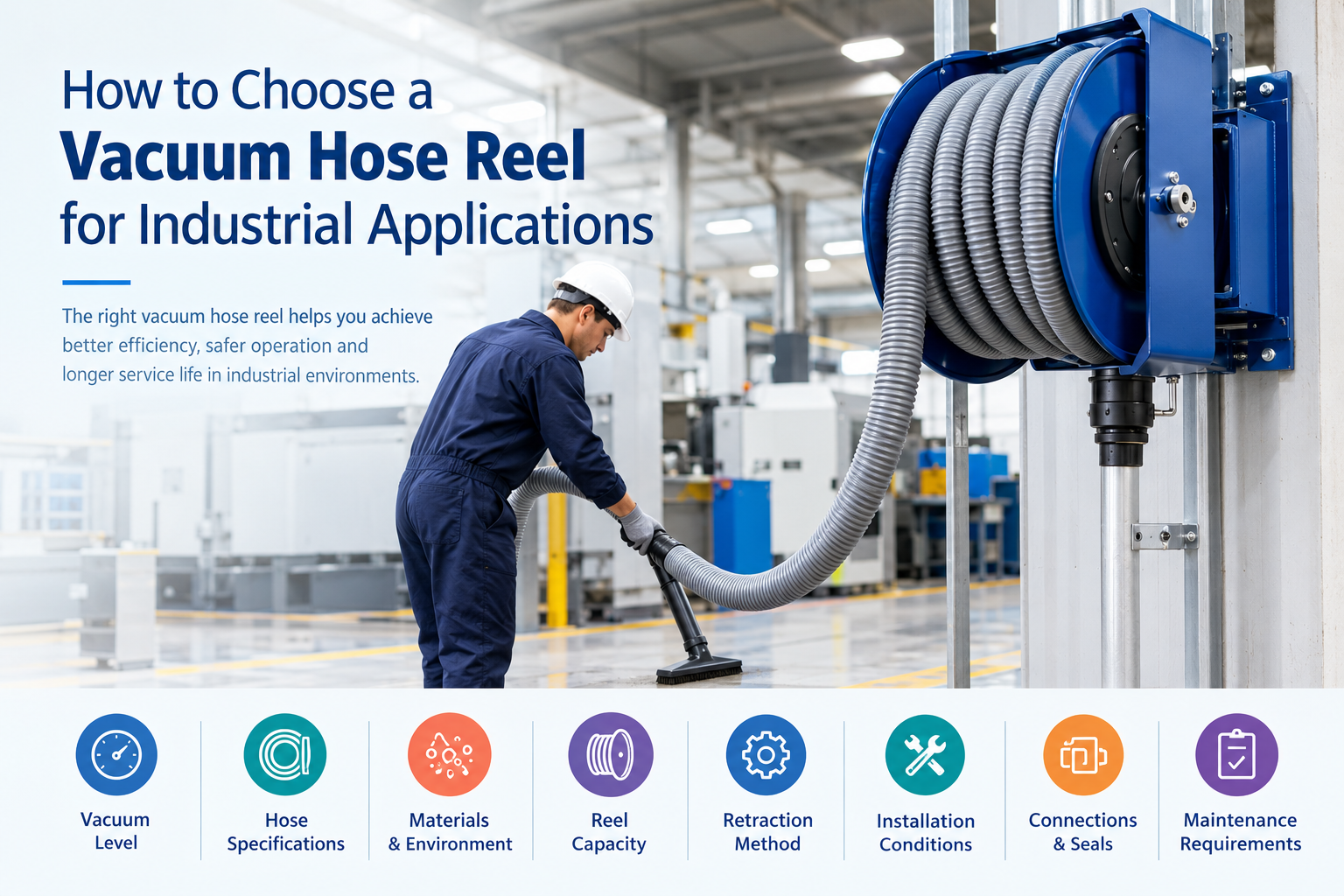
- Vacuum conditions: Expected operating vacuum level and relevant operating cycles.
- Hose specifications: Inner diameter, total length, outer diameter, weight, and minimum bending radius.
- Collected or transported materials: Dust, debris, liquids, or other media, along with relevant chemical exposure and temperature conditions.
- Reel capacity: Whether the reel can accommodate the specified hose.
- Retraction method: Manual, spring-driven, or motor-driven, depending on workload and operating requirements.
- Installation conditions: Mounting surface, available space, hose reach, and routing path.
- Connections and seals: Connection dimensions, fitting types, and suitability for the expected vacuum conditions.
- Maintenance requirements: Access to serviceable components, inspection needs, and spare parts availability.
When discussing specifications with hose reel manufacturers, provide the hose dimensions, vacuum requirements, connection details, and installation conditions. This helps the manufacturer assess whether the proposed reel is suitable for the application.
It is also advisable to ask the supplier to confirm that the recommended hose, reel, and connecting components are compatible as a complete assembly. Even if a reel can physically accommodate the hose, it may not function properly if the connections, winding mechanism, or operating specifications do not meet the application’s requirements.
Conclusion
Choosing a vacuum hose reel for industrial applications requires an evaluation of the vacuum system, hose specifications, reel structure, installation position, and connection design. Buyers should first establish the hose’s resistance to vacuum-induced collapse and the system’s airflow requirements, then determine the appropriate reel capacity, retraction method, and installation arrangement.
The most suitable vacuum hose reel is not necessarily the model with the largest capacity or the highest level of automation. It is the configuration that accommodates the specified hose, meets the expected operating conditions, and fits the actual workflow. Confirming these requirements before purchasing helps reduce equipment compatibility problems and supports better purchasing decisions.
Related Posts

How to Select Hose Reel Materials for Outdoor Use
May 28, 2026
Hose Reel Manufacturer vs Distributor: Which One Should You Choose?
September 30, 2026
How to Choose a Large Capacity Hose Reel for Heavy-Duty…
July 13, 2026