Exhaust Hose Reel Selection for Automotive Workshops
October 27, 2026 | Industrial Hose Reels
When the vehicle is inspected, repaired, diagnosed or tested indoors, the vehicle maintenance workshop needs to effectively exhaust the exhaust gas generated by the vehicle. If there is no proper source exhaust system, waste gas may spread to the whole work area and affect indoor air quality. The exhaust hose reel is used to manage the flexible hose in the exhaust pumping system, so that it can be conveniently taken when needed and stored when not in use.
However, the selection of exhaust hose reel is not only based on hose length or reel size. Vehicle type, exhaust temperature, exhaust air volume, installation location and frequency of use will all affect the operation performance of the system. Understanding these factors is helpful for the maintenance workshop to choose the appropriate configuration according to the actual working conditions.
What Is an Exhaust Hose Reel?
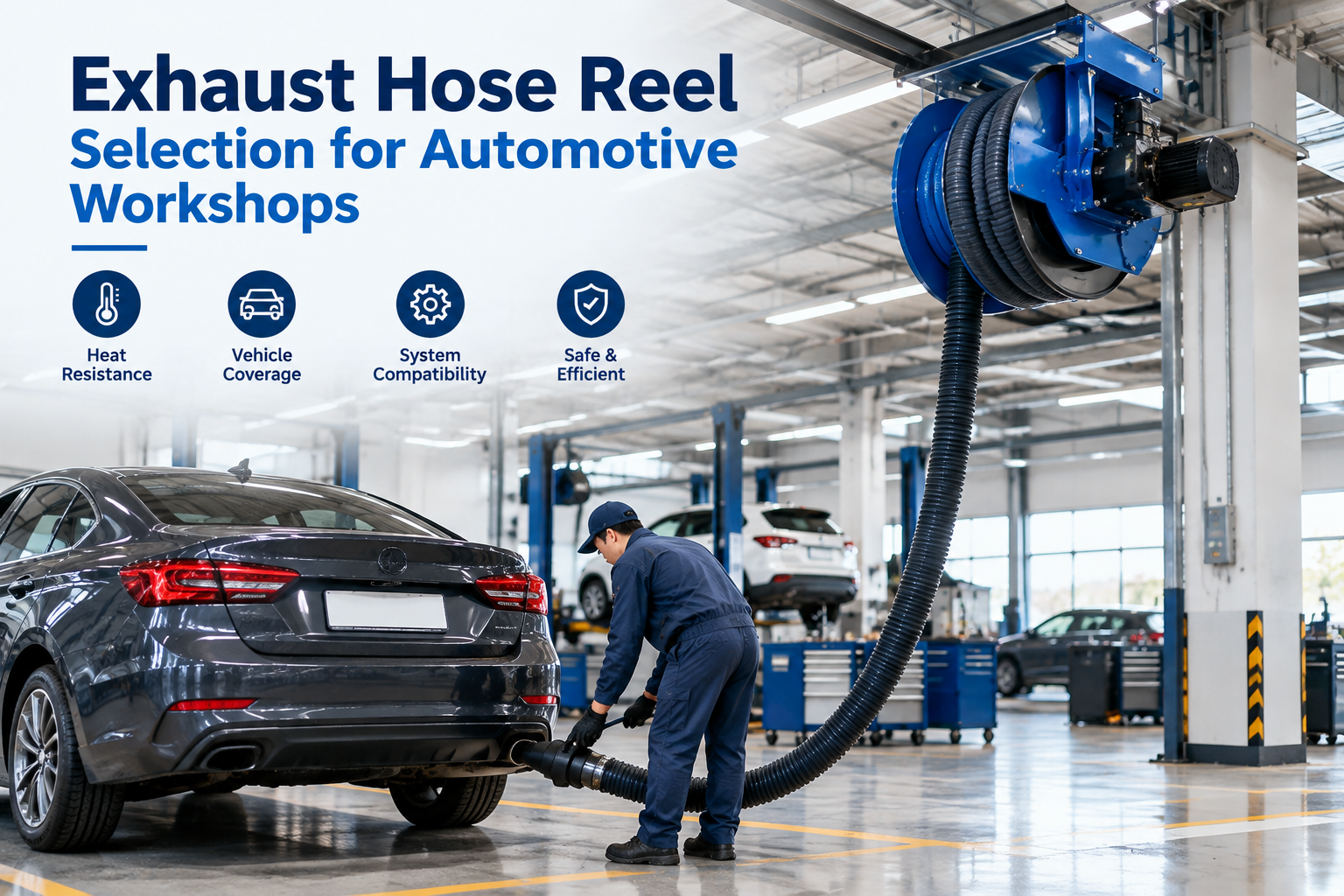
Exhaust hose reel is a kind of hose storage and deployment device in vehicle exhaust system. It is used for accommodating the heat-resistant flexible hose, one end of which is connected with the exhaust pipe or outlet of the vehicle, and the other end is used for conveying the exhaust gas to the exhaust fan and exhaust pipeline.
Different from ordinary air hose reel or water hose reel, the exhaust hose reel must be used in conjunction with the exhaust system that meets the requirements of corresponding exhaust conditions. Typical systems include reel assemblies, flexible exhaust hoses, tailpipe nozzles or adapters, and interfaces connected to the exhaust pumping system. According to the specific installation method, the fan can be directly installed on the reel or connected to the centralized pumping and drainage pipe network.
The exhaust hose reel can adopt a spring recovery mechanism or a motor drive system. The spring-driven hose reel allows the operator to manually pull out the hose and automatically retract it after use. The motor-driven hose reel can reduce the operation difficulty of unwinding and recovering the hose in the case of long, heavy or high installation position.
Common Application Scenarios of Exhaust Hose Reel
Automobile Maintenance Workshop
Automobile maintenance workshops often need to start the engine indoors for fault diagnosis, emission inspection or verification of maintenance effect. The exhaust hose reel allows technicians to connect the exhaust hose to the vehicle exhaust pipe, and at the same time, most hoses are kept off the ground when not in use.
For workshops with multiple maintenance stations, the number and location of pumping points should be planned according to the parking mode of vehicles and the number of stations that may run at the same time.
Heavy Vehicle Maintenance Facilities
Truck and bus repair shops may need longer hoses, larger hose diameters or different types of exhaust pipe adapters, because different vehicles have different exhaust outlet structures and operating conditions. In addition, compared with ordinary passenger car maintenance, when the engine is tested under load, it may also put forward different requirements for exhaust temperature and airflow. Therefore, when selecting the exhaust system, the specifications should be determined according to the type and working condition of the actual maintenance vehicle.
Vehicle Inspection and Engine Test Area
Vehicle inspection stations and engine test areas may need to repeatedly exhaust exhaust gas during regular inspection. In these scenarios, test duration, engine speed, load and the number of test stations running at the same time are all important selection factors.
If the tail gas with higher temperature is generated during the test, or it needs to be continuously pumped, it must be confirmed that the hose, reel configuration, fan and pipeline system meet the actual operation requirements.
How to Choose the Appropriate Exhaust Hose Reel?
1. Check the Temperature Resistance of the Exhaust Hose
Temperature compatibility is one of the most important selection factors. The exhaust gas temperature at the pumping position will be affected by the engine type, load, running time, exhaust pipe structure and the mixing degree of exhaust gas and cooling air, so the hose with suitable continuous working temperature and short-term peak temperature grade should be selected.
For the test of heavy vehicles or loaded engines, the actual operating conditions should be confirmed with the supplier of the exhaust system before the specifications are determined.
2. Determine the Hose Length According to the Operation Area
The hose must be able to reach the vehicle exhaust outlet while avoiding overstretching or being forced to bypass other equipment. Too short hose will limit the parking position of vehicles, while unnecessarily long hose may increase airflow resistance and increase operation difficulty.
The distance between the reel installation point and the farthest pumping position shall be measured, and the differences in vehicle length, exhaust pipe position, parking direction and reel installation height shall be considered.
If a single reel can’t cover the required area without unreasonable hose path, we can consider adjusting the installation position, or adopting other schemes such as pumping device with articulated arm and track pumping system.
3. Match the Hose Diameter and Pumping Capacity
The diameter of the hose will affect the airflow capacity and airflow resistance of the system. The suitable diameter depends on the vehicle exhaust volume, exhaust nozzle, hose length, fan performance and pipeline configuration.
In addition, the fan must be able to provide enough air volume under the actual system resistance, and the nozzle and connector should also be suitable for the vehicle exhaust outlet. Before selecting reels, confirm the required air volume and pressure loss with the system supplier. If multiple pumping points share a central fan, the number of pumping points that may run at the same time should also be made clear, and it should be confirmed that the system can still maintain the required air volume in this case.
4. Choose a Suitable Recycling Agency
Spring-retractable reel is usually suitable for daily maintenance scenes that need to pull out and retract hoses frequently. Its operation is relatively simple, but the spring mechanism must match the weight, length and installation height of the hose.
Motor-driven reels are suitable for large maintenance workshops, heavy vehicle maintenance areas, or installation scenes where it is difficult to manually operate hoses. Electric recycling can reduce the physical burden of operators, but it will also increase the requirements of electrical connection, control and maintenance.
When selecting, the actual use frequency, hose weight, power supply conditions and accessibility of operators should be comprehensively considered, and the correct recycling method should be selected.
5. Confirm the Compatibility of Nozzle and Vehicle Exhaust Pipe
The end of the hose must be reliably connected with the vehicle exhaust outlet. Passenger cars, trucks, buses and vehicles with dual exhaust outlets may need different nozzles or adapters.
Check the diameter, direction, shape and accessibility of the exhaust pipe. If the nozzle is not matched with the exhaust pipe, the tail gas collection effect may be reduced, or it may fall off during use.
For vehicles with dual exhaust outlets, it should be judged whether dual outlet adapters or other suitable connection methods are needed. The temperature resistance grade of the nozzle must also meet the actual working conditions.
How to Choose the Ceiling-Mounted and Wall-Mounted Exhaust Hose Reel?
The installation position will affect the coverage of the hose, the traffic space of the vehicle and the layout of the evacuation system.
| Comparative factors | Ceiling mounting | Wall mounting |
|---|---|---|
| The floor space | Reel and hose are located above, which can reduce the occupation of the working area. | The floor space can be reserved, but it may occupy the wall or column position. |
| The hose coverage | Can cover a large area of the maintenance workshop through the top layout. | Is suitable for the fixed workstation where the vehicle is parked near the installation point. |
| The installation requirements | Require reliable top structure support, and sufficient space is reserved. | Walls or columns that can bear the weight of the reel assembly are required. |
| Potential restrictions | May interfere with the top door, lighting, lifting equipment or other facilities. | If the vehicle exhaust outlet is far away from the installation point, the hose may not be covered. |
There is no absolute advantage or disadvantage between the two installation methods. Top installation is suitable for maintenance workshops that need a large range of top coverage, while wall installation may be more suitable for workstations with fixed parking positions. The final selection should comprehensively consider the bearing capacity of the structure, the moving range of the hose, the traffic space of the vehicle and the direction of the pumping pipeline.
Common Problems in Installation of Exhaust Hose Reel
Insufficient Hose Coverage
If the hose cannot reach the exhaust outlet, the technician has to adjust the position of the vehicle or pull the hose at an unreasonable angle. Before installation, measure the actual working area and check whether the hose can still be used normally at the farthest working position.
Excessive Bending of Hose
Too small bending radius, twisting and squeezing may restrict air flow and accelerate hose wear. When planning the hose path, the minimum bending radius specified by the hose manufacturer shall be observed, and the hose shall be ensured not to be caught by lighting equipment, vehicle body, lifting equipment or surrounding structures during deployment and recovery.
Insufficient Pumping and Drainage Effect
Even if the reel is installed correctly, it can’t make up for the problems such as too small fan selection, too large pipeline resistance, inappropriate hose diameter or incompatible nozzles. If the pumping effect is not satisfactory, the whole system should be checked, and the reel should not be replaced directly without finding out the reason.
Interference with Maintenance Workshop Equipment
The top door, vehicle hoist, lifting equipment, lighting facilities and electrical devices may affect the movement of the hose. Before fixing the reel, check the whole operating range, including the space for vehicle movement and the space required for hose recovery.
How to Maintain the Exhaust Hose Reel System?
Regular inspection is helpful to find hidden dangers in time before problems affect the pumping effect or operation safety.
Check the hose for cracks, abrasion, thermal damage, loose connection or extrusion deformation. Check whether the nozzle and adapter are firmly connected, and make sure that the hose can be unfolded and recovered smoothly. The reel mounting structure, spring or motor drive mechanism and locking parts should also be inspected according to the manufacturer’s maintenance instructions. Fans, pipes and airflow control devices also need to be checked. If the air volume of the system is insufficient or there is leakage at the joint, the whole pumping and exhaust system may still not work effectively.
Maintenance intervals specified by the equipment manufacturer and applicable workplace ventilation requirements shall be observed. If the hose has ever been exposed to a temperature exceeding its rated range, or has obvious damage, it should be stopped before it is confirmed that it is still suitable.
Frequently Asked Questions (FAQ)
Conclusion
When selecting the exhaust hose reel, it is necessary to comprehensively evaluate the vehicle type, exhaust gas temperature, hose length and diameter, system air volume, installation location and recovery method. Reasonable matching of these factors is helpful to ensure that the hose can reach the required exhaust outlet, and at the same time reduce unnecessary bending and interference with maintenance equipment.
Most importantly, the exhaust hose reel is only a part of the whole exhaust pumping system. Hose, nozzle, fan, pipeline and exhaust device must work together to effectively capture and exhaust vehicle exhaust. Through reasonable planning and regular inspection, it can help the system to maintain stable operation and adapt to the changing operation requirements of the maintenance workshop.
Related Posts
Static Discharge Reels for Fuel Transfer: Safety Basics
October 14, 2026