Classification of Industrial Hose Reels: 4 Classification Methods
September 29, 2026 | Industrial Hose Reels
There are many configurations of Industrial hose reels to choose from to adapt to different hoses, conveying media, operating conditions and installation requirements. Choosing the right hose reel is not just choosing the right hose length; The drive type, convey medium, structural materials and application environment of the hose reel will all affect its performance, durability and ease of use.
This guide classifies industrial hose reels from four practical angles: drive type, convey medium, structural materials and application scenarios. Understanding these main classifications will help users to determine the hose reel type that is most suitable for their equipment, working environment and fluid handling requirements.
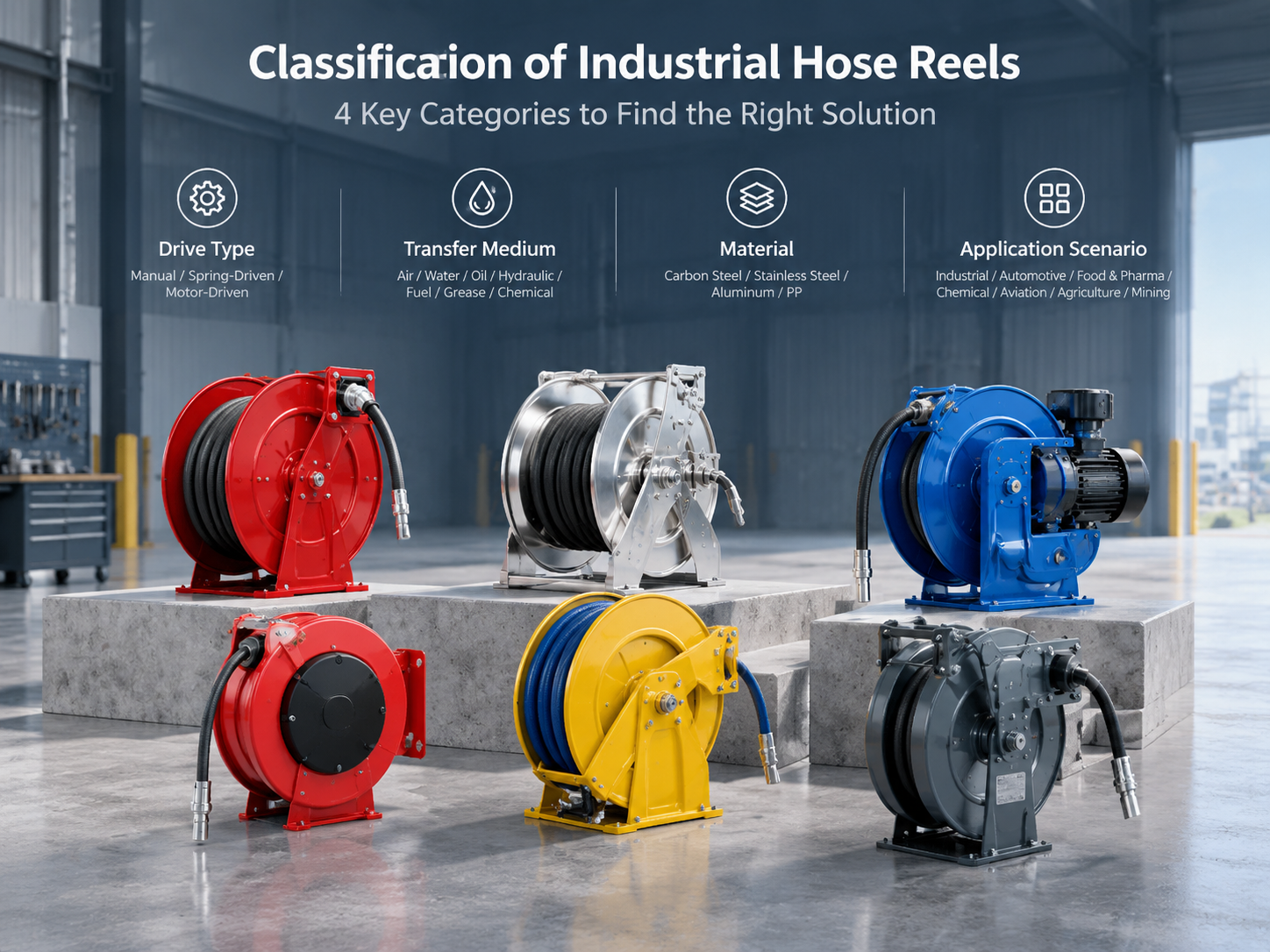
1. Classification of Industrial Hose Reels by Drive Type
1.1 Manual Hose Reel
Manual hose reel rotates the reel by hand crank or handwheel, and the operator manually expands and contracts the hose. Its structure is relatively simple, no power supply or external energy is needed, and it is flexible to install and use, and easy to maintain. Manual reels are suitable for applications where the frequency, length and weight of hoses are moderate; Commonly used in workshops, garages, maintenance areas and general industrial fluid transportation operations.
1.2 Spring-driven Hose Reel
Spring driven hose reel is the most common and widely used type of hose reel. They use internal springs to store energy: when the hose is pulled out, the spring generates tension, and after use, the stored energy is released, so that the hose automatically retracts. Operators do not need to manually shake the hose reel, which is more convenient to use. They are especially suitable for working environments that require frequent expansion and contraction of hoses, and are often used to transport air, water, oil and other liquids.
1.3 Electric Hose Reel
The electric hose reel is driven by a motor, which can automatically extend and retract the hose, reducing manual operation. Compared with manual hose reels, electric hose reels are more suitable for long and heavy hoses and installation scenes that require frequent operation or inconvenient manual handling. They are widely used in industrial production, equipment maintenance, vehicles and mobile devices.
| Drive Type | Operation | Hose Retraction | Power Requirement | Best Suited For |
|---|---|---|---|---|
| Manual | Hand crank or handwheel | Manual | None | Moderate use, workshops and maintenance |
| Spring-Driven | Internal spring | Automatic | None | Frequent hose extension and retraction |
| Motor-Driven | Electric motor | Automatic | Electricity | Long/heavy hoses and frequent operation |
2. Classification of Industrial Hose Reels by Conveying Media
2.1 Air Hose Reel
Air hose reel is used to transport compressed air from fixed air source to pneumatic tools, painting equipment or blowing station. Its rotary seal design ensures that air leakage will not occur during the rotation of the hose reel; They are common in automobile repair shops, production line workstations and general workshop environments.
2.2 Water Hose Reel
The water hose reel is used for conveying cold water, hot water or reclaimed water. They have corrosion resistance and efficient drainage performance, and are suitable for high-pressure cleaning, garden irrigation, vehicle cleaning and auxiliary fire water supply.
2.3 Oil Hose Reel
Oil hose reel is used to transport hydraulic oil or lubricating oil. Its rotary seal must be compatible with the specific oil type. These hose reels usually serve automobile repair shops, machinery processing factories and agricultural machinery repair shops, and adopt nitrile rubber or fluororubber (FKM) seals to ensure long-term leak-free performance.
2.4 Hydraulic Hose Reel
Hydraulic hose reels are specially designed to transmit high-pressure hydraulic power from fixed pumping stations to moving parts such as cranes, forklifts and container handling equipment. The main considerations include high working pressure, hose length and overall durability of the reel.
2.5 Fuel Hose Reel
The fuel hose reel is used to safely transport gasoline, diesel, aviation fuel and diesel exhaust treatment fluid (DEF). Both reels and hoses must be compatible with specific fuels and meet the safety requirements of the operating environment; Common applications include fleet gas stations, ground aviation refueling and fuel transport vehicles.
2.6 Grease Hose Reel
Grease hose reel is used for high-pressure grease transportation, and double-layer steel wire braided hose is used to withstand high pressure. Typical applications include chassis lubrication in automobile maintenance center, centralized lubrication system in fleet maintenance workshop and precise grease application in aircraft manufacturing.
2.7 Chemical Hose Reel
Chemical hose reels are specially designed for transporting corrosive liquids, such as acids, alkalis, bleaches, pesticides and fertilizers, and are widely used in chemical production, laboratories and industrial processing systems. Its most remarkable feature is that the fluid channel is completely isolated from the metal parts; CPVC rotary joint is adopted to ensure that the fluid only contacts with the hose material itself.
3.Classification of Industrial Hose Reels by Material
3.1 Carbon Steel Hose Reel
The carbon steel hose reel is made of cold-rolled or hot-rolled steel plate by stamping and welding. They have high structural strength and can withstand the mechanical stress caused by repeated winding and unfolding of large-diameter hoses. Powder coating or zinc plating process is usually used for surface treatment to improve corrosion resistance. Carbon steel hose reels are cost-effective, and are widely used in standard industrial places such as automobile maintenance, manufacturing plants and agricultural machinery maintenance. However, they are not suitable for strong acid, strong alkali or high humidity environment.
3.2 Stainless Steel Hose Reel
Stainless steel hose reel is mainly made of 304 or 316L stainless steel, which has excellent corrosion resistance and oxidation resistance. They will not rust even if they are used for a long time in an environment that is wet, needs washing or chemical splashing. Although the price is relatively high (sometimes three to five times that of carbon steel hose reels), they are widely used in applications that require high hygiene or corrosion resistance, such as chemical production, food and beverage processing, pharmaceuticals and offshore platforms.
3.3 Aluminum Hose Reel
Aluminum hose reel is cast or extruded by aluminum alloy. Its density is only one-third of that of steel, and it is light and easy to carry, so it is an ideal choice for moving winding cars or applications that need frequent relocation. Its surface is usually anodized to enhance corrosion resistance. Aluminum hose reel is often used in low-pressure to medium-pressure air, water or low-pressure oil medium, but it is not suitable for heavy-duty or high-pressure working environment.
3.4 polypropylene (PP) Hose Reel
Polypropylene (PP) hose reel is made by injection molding process, which has the advantages of chemical corrosion resistance, low cost, light weight, easy installation and movement. Although it is suitable for non-heavy applications (such as conveying water or low-pressure air), its structural strength is limited, and it is not suitable for large-diameter or heavy-duty hoses, nor for high-pressure or high-impact working environments.
| Material | Strength | Corrosion Resistance | Weight | Typical Applications |
|---|---|---|---|---|
| Carbon Steel | High | Moderate | Heavy | General industrial applications |
| Stainless Steel | High | Excellent | Heavy | Food, pharmaceutical, chemical, offshore |
| Aluminum | Moderate | Good | Lightweight | Mobile and low-to-medium pressure applications |
| PP | Low–Moderate | Good | Lightweight | Water and low-pressure air applications |
4. Industrial Hose Reels Classified by Application Scenario
4.1 General Industrial and Workshop Applications
The most basic and extensive application scenarios of hose reels are general industrial and workshop applications, covering production lines, maintenance workshops, assembly stations and material handling equipment. These hose reels are convenient for conveying compressed air, water and low-pressure oil, which helps to keep the work area clean, minimize the risk of tripping and improve the operation efficiency. They usually adopt powder-coated carbon steel structure and are mainly installed on walls or ceilings.
4.2 Automotive and Vehicle Service Applications
Automobile and vehicle service applications include automobile maintenance centers, dealers (4S shops), automobile beauty centers and mobile service vehicles. Hose reels are usually installed on walls or car bodies to supply air to pneumatic tools, apply grease or engine oil, or facilitate vehicle cleaning. They need to be easy to operate and quickly recovered; In particular, mobile hose reels must have excellent portability and seismic performance.
4.3 Food, Pharmaceutical and Healthcare Applications
These industries require extremely high hygiene standards. The hose reel is mainly made of 304 or 316L stainless steel, with smooth and seamless surface, which is convenient for cleaning and disinfection. They are suitable for the cleaning of equipment in food processing plants, the sanitation and disinfection of production lines and the delivery of clean liquids in pharmaceutical workshops, and meet the relevant hygiene certification requirements.
4.4 Chemical and Corrosive Environment applications
These applications involve the transportation of corrosive media (such as acid, alkali and solvent), and the operation in an environment vulnerable to salt fog, such as coastal areas or offshore platforms. The hose reel must be made of stainless steel or special corrosion-resistant materials, and equipped with rotary seals compatible with chemical media. The design of the fluid channel usually ensures that the fluid only contacts the hose, not the non-metallic parts, thus prolonging the service life.
4.5 Aviation and Special Fuel Applications
Aviation and special fuel applications include airport ground refueling and transportation of aviation fuel and urea solution (AdBlue). The hose reel must meet explosion-proof and anti-static standards, and be equipped with grounding device and explosion-proof motor. Some models adopt hose oil discharge design to ensure residual fuel backflow, while other models are suitable for emergency fire fighting operations.
4.6 Application of Agriculture and Landscaping
Agricultural and landscaping applications mainly use water hose reels for irrigation, pesticide spraying or fertilization. These hose reels must be able to withstand outdoor sun and rain, so they need to have certain weather resistance and corrosion resistance. Installation methods include trailer type, wall-mounted type and cart type, so as to facilitate movement in fields or garden areas.
4.7 Application in Mining and Construction Machinery
Mining and construction machinery applications rely on heavy duty hose reels to continuously supply hydraulic oil or compressed air to mobile equipment. In view of their high working pressure and large diameter hoses, these hose reels must be able to withstand strong vibration and erosion by dust and debris; They are usually driven by electric or hydraulic, and have sufficient structural strength to withstand frequent winding and unwinding operations under harsh working conditions.
In Conclusion
Industrial hose reels can be classified according to application requirements. The driving mode determines the expansion mode of the hose, and the conveying medium determines the requirements of the hose, seal and fluid channel. Structural materials affect the strength, weight, corrosion resistance and service life of the reel, while the application environment determines the required durability and protection level.
When selecting industrial hose reels, the following factors should be considered comprehensively, not individually. Matching the drive system, fluid compatibility, structural materials, hose specifications and operating environment of the reel is helpful to ensure the reliable operation and long-term stability of the hose. For special applications, other factors such as working pressure, hose length, temperature, installation method and safety requirements should be evaluated before selecting hose reels.
Related Posts
How to Operate a Fire Hose Reel System: A Best…
June 16, 2026
Welding Hose Reel Safety for Farms and Mobile Welding
October 12, 2026
How to Choose the Right Sewer Jetter Reel for Your…
July 14, 2026