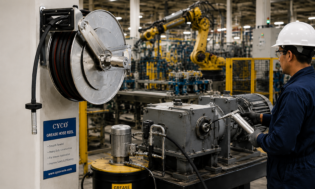
Welding Hose Reel Safety for Farms and Mobile Welding
October 12, 2026 | Industrial Hose Reels
Welding operations on farms and remote construction sites usually involve tractors, trailers, heavy equipment, steel structures, and service vehicles. In these environments, welding hoses need to be adjusted frequently according to the working position while being protected from sparks, high-temperature surfaces, sharp edges, and mechanical damage. A welding hose reel can help manage hose length and storage, but its installation and operation must meet the requirements of the gas delivery system and suit the actual working environment.
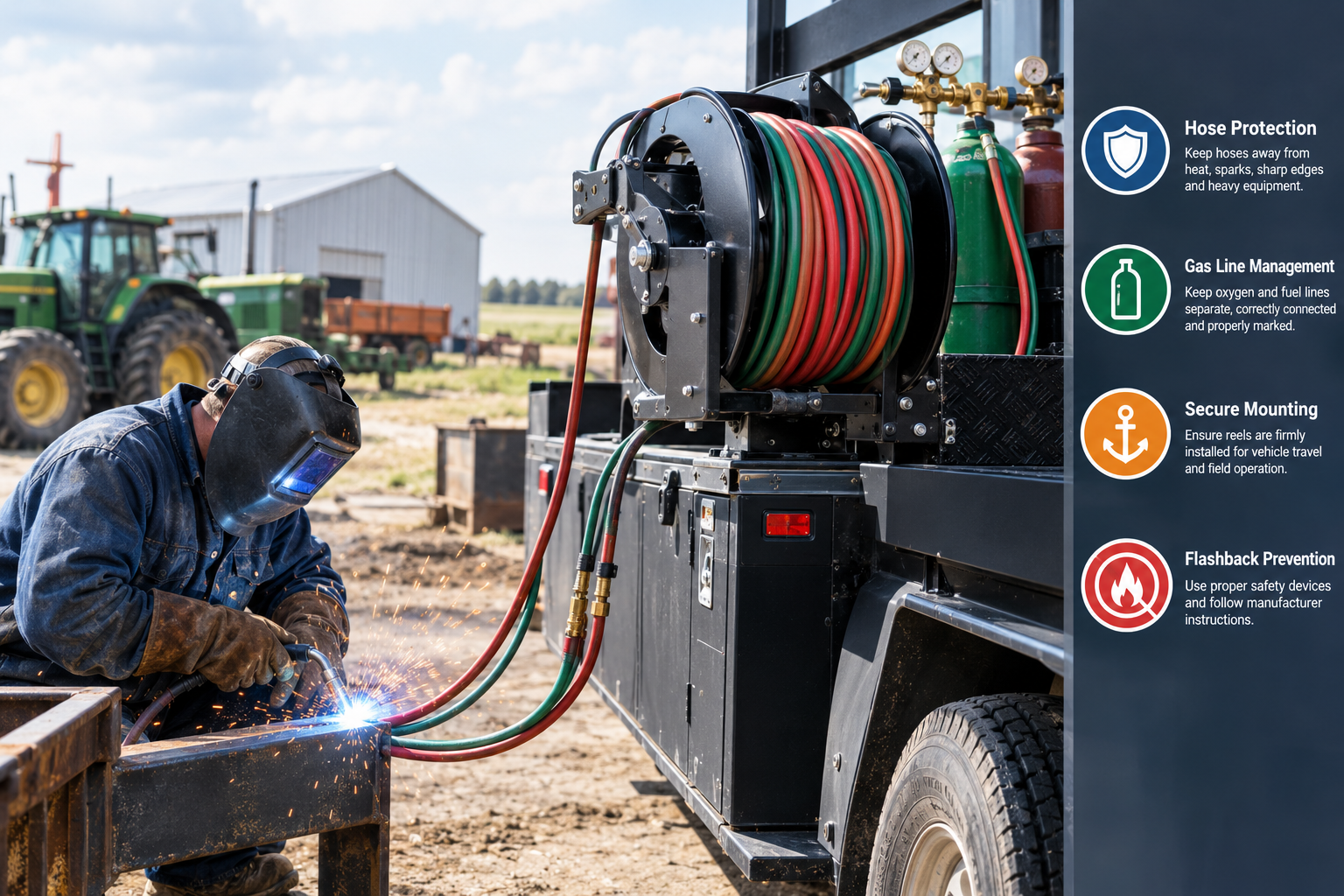
For mobile welding equipment, safety depends on more than the reel itself. The oxygen and fuel gas lines must be connected correctly, the gas delivery system must be equipped with appropriate flashback protection devices, and the reel must be securely mounted to withstand vehicle travel and field operations. Understanding these requirements helps operators identify risks that are easily overlooked in routine hose management.
Why Do Mobile Welding Operations Require Attention to Hose Reel Safety?
Unlike fixed welding stations, farm and field operations usually require equipment to move between different locations. Hoses may need to cross uneven ground, pass around machinery, or run near hot metal and vehicle exhaust components. Vibration and sudden vehicle movements during transportation may also place additional loads on reel brackets, hose connections, and locking mechanisms.
A suitable hose reel helps store unused hose and release the required length when needed. When choosing industrial hose reels suitable for farm maintenance and mobile welding equipment, buyers should also consider the installation location, hose protection, and actual working environment.
However, a reel cannot make an unsuitable hose safe, prevent gas leaks, or replace the protective devices required by an oxy-fuel system. A safety assessment must cover the entire system, including hoses, reels, connectors, gas control devices, mounting structures, and the surrounding work environment.
1. Check the Reel Mechanism Before Welding
Ratchet Locking and Controlled Retraction
A ratchet mechanism can hold the hose at the required extension length, reducing unintended hose movement during operation. Before use, check whether the reel locks securely, releases correctly, and retracts the hose smoothly under control. A damaged or unreliable locking mechanism may allow the hose to move unexpectedly, creating a tripping hazard or placing additional tension on connected equipment.
Operators should follow the hose reel manufacturer‘s instructions when extending, locking, releasing, and retracting the hose. Do not force a jammed mechanism or allow a spring-driven reel to retract the hose rapidly without control. If the reel cannot hold the hose securely or operates abnormally, stop using it until the problem has been inspected and corrected.
When Should You Consider Spark-Resistant Components?
Welding produces sparks, hot particles, and molten spatter that may ignite nearby combustible materials or damage surrounding equipment. Therefore, reel components located near welding operations should be evaluated for their material properties, temperature limits, and suitability for the actual working environment.
A product label claiming spark resistance does not establish that the entire reel is suitable for every hazardous location. Suitability should be confirmed through the material properties of the relevant components and applicable product test documentation. Even when suitable components are used, the reel should be installed as far as practical from direct welding spatter and other heat sources.
In addition, spark resistance does not mean that a reel is explosion-proof or approved for use in every flammable gas environment. If the workplace involves classified hazardous areas, the equipment must meet the requirements applicable to that specific area.
2. Manage Oxygen and Fuel Gas Lines Correctly
Oxy-fuel welding and cutting systems use separate oxygen and fuel gas lines. A dual-hose arrangement helps organize the hoses and reduce tangling, but both lines must remain correctly identified and connected throughout the operation.
Hoses, connectors, regulators, and other components must be suitable for the corresponding gas and meet the system’s rated operating conditions. Oxygen systems require particular attention to cleanliness because oil, grease, and other incompatible contaminants can create serious fire hazards in oxygen-enriched conditions.
Before welding, inspect the hoses for cuts, cracks, burns, crushing, deformation, or damaged connections. Make sure the connectors are correctly matched and that the lines are neither cross-connected nor attached to the wrong gas source. Do not modify connectors without authorization or use temporary adapters to force incompatible components together.
A dual-hose reel is intended to manage the hoses, not replace correct gas identification, compatible components, or leak testing. If the reel is used only for hose storage and does not incorporate a suitably designed gas passage, the gas must continue to flow through the specified hoses and connection system.
3. Understand Flashback Risks and the Safety Limits of welding Hose Reels
Flashback occurs when a flame travels back into the welding torch or gas delivery system. Incorrect operating conditions, problems with the torch or nozzle, improper gas settings, and other equipment faults may contribute to flashback. A backfire generally refers to a brief, abnormal combustion event at the torch, often accompanied by a popping sound. Repeated or unusual events require investigation rather than continued operation.
The oxy-fuel system must be equipped with appropriate safety devices in the locations and configurations specified by the equipment manufacturer and applicable requirements. Depending on the system, flashback arrestors and check valves may be required. These devices serve different purposes and should not be assumed to be interchangeable.
A welding hose reel cannot prevent flashback. Its function is to manage hose extension and storage. Operators must not treat the reel’s locking mechanism, hose arrangement, or connectors as protective measures against flame propagation.
If flashback or an abnormal backfire occurs, follow the shutdown and inspection procedures specified by the torch and equipment manufacturers. Do not resume work until the cause has been identified and the system has been confirmed safe. Never disconnect a pressurized gas line or attempt repairs while the system is in an unsafe condition.
4. Install Welding Hose Reels on Service Vehicles and Mobile Welding Machines
Choose a Mounting Position That Protects the Hose
When installing reels on service vehicles or mobile welding equipment, ensure that hoses can reach the work area without being scraped by sharp edges, trapped by machinery, or routed close to exhaust outlets and hot surfaces. The hose outlet should also allow smooth extension without sharp bends or excessive lateral force on the reel.
When evaluating the mounting position, consider the entire hose travel path rather than just the reel’s mounting point. A fully extended hose may clear the vehicle body but still contact tires, hinges, toolboxes, or other moving parts during use. Where practical, suitable guides or protective structures can help reduce abrasion and snagging.
Ensure Secure Mounting During Transport and Field Operations
A vehicle-mounted reel must withstand not only the forces generated when the hose is extended or retracted but also the vibration and movement associated with driving. The mounting structure, fasteners, and supporting surfaces must be capable of carrying the reel’s weight and expected operating loads.
Follow the reel manufacturer’s installation instructions and use the specified mounting hardware. A bracket suitable for fixed wall mounting should not automatically be assumed suitable for a moving vehicle.
Before driving, secure the reel and all extended hoses according to the manufacturer’s instructions. Check whether the assembly could shift, release unexpectedly, obstruct access, or interfere with other equipment. After driving over rough terrain or experiencing a significant impact, inspect the mounting points and hose connections before putting the equipment back into service.
5. Protect Hoses from Heat, Abrasion, and Field Damage
Farm maintenance and outdoor construction expose hoses to risks that may be less common in controlled workshop environments, including hot metal, welding spatter, sharp steel edges, muddy water, oil contamination, and heavy machinery. These factors can damage hoses or compromise their safe operation.
Keep hoses away from the direct path of sparks and molten metal particles. Do not place a hose on a freshly welded workpiece, hot exhaust components, or other surfaces exceeding its rated temperature limits. If a hose has been exposed to excessive heat or shows visible spatter damage, do not return it to service before an appropriate inspection.
When routing hoses, prevent vehicles and machinery from running over them. Avoid dragging hoses across sharp corners or pulling them beyond their intended operating range. Excessive bending near the reel outlet can also cause damage, particularly when the hose is under tension.
Outdoor storage conditions are equally important. Observe the hose and reel manufacturers’ specified limits for sunlight, moisture, oil, chemicals, and temperature. After completing the work, inspect and store the hose properly to prevent crushing, contamination, or unnecessary contact with welding equipment.
6. Safety Checks Before Farm and Field Welding Operations
A brief inspection before each operation helps identify potential problems before the gas supply is activated or welding begins.
- Reel operation: Confirm that the locking and release mechanisms work correctly and that the hose retracts under control.
- Hose condition: Check for cuts, cracks, burns, crushing, kinks, or other signs of damage.
- Gas connections: Ensure that the oxygen and fuel gas lines are clearly identified and correctly connected to compatible fittings.
- Leak testing: Use an approved method suitable for the gas system to inspect connections. Never use an open flame to locate a leak.
- Safety devices: Confirm that the required flashback protection devices and other gas control components are correctly installed and maintained according to the equipment manufacturer’s instructions.
- Vehicle mounting: Check that the reel, brackets, and fasteners are secure and that the hoses do not interfere with moving parts.
- Work area: Remove combustible materials where practical and protect hoses from sparks, hot surfaces, vehicle traffic, and mechanical damage.
If a leak, damaged hose, faulty safety device, or abnormal reel operation is detected, stop work and resume only after the problem has been resolved. Maintenance and component replacement must follow the relevant manufacturers’ procedures and applicable safety requirements.
When selecting reels for mobile welding equipment, buyers should confirm mounting requirements, hose compatibility, and operating conditions with experienced hose reel manufacturers. Providing detailed information about the welding equipment and installation environment helps determine whether the proposed reel configuration is suitable for the application.
Conclusion
Safe use of welding hose reels on farms and mobile construction sites requires attention to hose management, gas system protection, reel operation, and vehicle mounting. Ratchet mechanisms help control hose movement, while suitable dual-hose arrangements help organize oxygen and fuel gas lines. However, neither feature replaces compatible gas system components, leak testing, or the flashback protection required by the welding system.
For mobile welding equipment, reels must also be securely mounted, and hoses must be routed to avoid heat, abrasion, and mechanical damage. Evaluating these factors together helps operators maintain a safer and more reliable welding equipment setup when working across workshops, farms, and remote construction sites.
Related Posts
How to Choose the Right Hose Reel Cart with Wheels
June 29, 2026
Hose Reel Manufacturer vs Distributor: Which One Should You Choose?
September 30, 2026