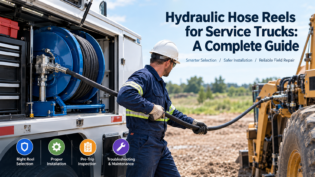
Common Hydraulic Hose Reel Failures and Troubleshooting
August 12, 2026 | Hydraulic hose reels
Introduction
Hydraulic hose reels are an indispensable component in mobile equipment, construction machinery, service trucks, and industrial applications. They provide a safe and orderly way to manage hydraulic hoses, preventing tangling and protecting them from environmental damage. However, like other mechanical components, hydraulic hose reels can experience various problems during long-term use, such as incomplete hose retraction, fluid leakage, and hose damage. These problems not only affect normal operation but, if ignored, can further damage the hoses or internal components of the reel.
Understanding these common failure modes and mastering troubleshooting methods is crucial for minimizing downtime and extending equipment life. This article introduces common hydraulic hose reel failures, possible causes, and practical troubleshooting methods.
1. Retraction Failure: Spring and Tangling Issues
Failure Symptom: Hose fails to retract fully or not at all
One of the most common failures of spring-retractable hydraulic hose reels is incomplete or no retraction. The reel’s helical spring provides the tension needed to retract the hose. When this mechanism fails, the hose may sag loosely, creating slack that can be caught or damaged.
1.1 Check the Spring Condition
Spring breakage or fatigue is a common cause of retraction failure. Spring damage is usually caused by overload. Exceeding the reel’s rated hose weight or length capacity can subject the spring to stresses beyond its design limits.
For a broken spring, replacement is often the only remedy. Extreme caution should be exercised during replacement because the spring remains under tension.
1.2 Check the Spring Preload
Insufficient preload during installation can cause the hose to jump off the reel or fail to retract properly.
Consult the manufacturer’s specifications to determine the required number of preload turns based on the hose diameter and length, and adjust accordingly.
1.3 Check for Mechanical Jamming
If the spring is intact but retracts slowly, inspect the guide mechanism for debris or damage.
The hose may be overwound or unevenly wound on the reel, which can cause jamming and hinder smooth retraction. Pulling the hose out completely and carefully rewinding it with even tension can usually solve this problem.
1.4 Lubricate Moving Parts
The spring housing requires regular lubrication. Some manufacturers recommend adding machine oil to the spring through the access hole at specified service intervals.
A dry or poorly lubricated spring can result in stiff and unstable performance. Grease fittings on the rotary joint and brake handle assembly should also be maintained regularly to ensure smooth operation.
2. Fluid Leakage: Rotary Joint and Connection Failure
Symptom: Oil leakage at the reel hub or joint
Hydraulic leakage is both a performance issue and a safety hazard. It reduces system pressure, creates slippery working surfaces, and can lead to environmental pollution.
The most common leakage points are the rotary joint, where the fixed inlet connects to the rotating reel, and the adapter at the hose connection.
2.1 Inspect the Rotary Joint Seals
The rotary joint contains seals that maintain pressure while allowing rotation. Over time, continuous rotation and pressure cycles can wear down the seals, leading to leakage around the reel hub.
Replacing the seals or installing a rotary joint repair kit is a standard repair method.
2.2 Tighten Loose Adapters
Leaks at adapters are often caused by vibration and loosening. Before determining that the seals have failed, check and tighten the adapter to the manufacturer’s specified torque.
2.3 Inspect the Hoses and Connections
If insufficient hydraulic pressure or flow is observed, immediately check for collapsed, damaged, or loose hydraulic lines connected to the reel.
Collapsed hoses can restrict flow, while loose connections can leak under pressure.
2.4 Release Pressure Before Maintenance
Always shut down the hydraulic supply and release residual system pressure before performing any leak repairs.
High-pressure hydraulic oil can cause serious injury if it penetrates the skin or contacts the body.
3. Hose Damage: Wear, Kinking, and Premature Aging
Symptoms: Excessive wear, cuts, or kinking on the hose surface
Hydraulic hoses on reels are subjected to repeated bending, dragging across surfaces, and exposure to UV rays, chemicals, and abrasive materials.
This cumulative wear can lead to surface degradation, leakage, and ultimately hose failure.
3.1 Assess Hose Routing and Alignment
Poor alignment between the hose reel outlet and the equipment connection point can cause the hose to rub against surfaces or bend at sharp angles.
Reposition the reel and connection points to ensure a straight and smooth hose path. For complex installations, guide rollers can help prevent contact with sharp edges.
3.2 Inspect Guide Arms and Rollers
Bent, misaligned, or missing rollers on the guide arms can force the hose off the reel at the wrong angle, causing friction and uneven wear.
Ensure the guide arms are correctly installed and adjusted according to the installation configuration.
3.3 Correct Uneven Winding
When the hose piles up on one side of the reel, interlayer compression stress increases significantly, accelerating fatigue of the inner reinforcing layers.
Fully pull out the hose and rewind it with uniform tension. For reels equipped with winders, check for smooth reciprocating motion. For reels without winders, manually guide the hose for even winding.
3.4 Use Protective Sleeves
In harsh environments, especially where the hose is dragged across concrete, gravel, or metal surfaces, abrasion-resistant sleeves or protective covers can significantly extend hose life.
This is particularly useful for service vehicles operating on uneven terrain.
3.5 Check Preload and Tension
Excessive spring tension can cause the hose to be overstretched during retraction, increasing stress on the reel structure and accelerating wear at contact points.
Verify that the spring preload matches the manufacturer’s recommendation for the specific hose length and diameter.
4. Jamming and Mechanical Seizure
Symptoms: Reel cannot rotate or winding motion is abnormal
Reel jamming can completely interrupt operations. The reel may not rotate in either direction, or the winding motion may feel rough, uneven, or restricted.
4.1 Remove Foreign Objects
Debris, dust, or slurry can accumulate in the reel mechanism, especially on equipment operating in dusty or muddy environments.
Thoroughly clean the guide rails, drum, and spring housing. Material buildup can also prevent the hose or drum from moving freely.
4.2 Check Internal Alignment
Bent components, such as the drum shaft or guide arm, can cause jamming.
If the reel has been subjected to impact loads or collisions, inspect these components for visible damage or deformation.
4.3 Check the Drive Motor if Applicable
For motor-driven reels, abnormal operation may originate from the hydraulic motor.
Check the motor temperature and inspect the seals for oil leakage, which may indicate internal failure. Damaged sprockets, broken chains, or missing key pins can also prevent the reel from rotating properly.
4.4 Confirm System Pressure
Insufficient hydraulic power can sometimes appear as mechanical jamming.
Ensure the main hydraulic switch is on and check the supply line for disconnections or damage. If the system is not properly pressurized, the reel may not receive sufficient driving force.
5. Corrosion and Environmental Degradation
Symptoms: Rust, corrosion, or surface degradation
Hydraulic reels installed outdoors, on service vehicles, or in corrosive environments such as saltwater areas and chemical plants are more likely to experience rust and corrosion.
Corrosion can affect appearance, reduce structural strength, and cause premature failure of internal components.
5.1 Inspect for Signs of Rust
Pay particular attention to spring housings, rotary joints, fasteners, and exposed metal surfaces.
Corrosion can cause springs to seize and seals to fail prematurely. Replace severely corroded components before they cause secondary damage.
5.2 Use Protective Coatings and Lubricants
Regularly applying a suitable rust-preventive coating or lubricant to exposed metal surfaces can help extend service life, especially for equipment operating in salt spray environments.
For highly corrosive conditions, consider stainless steel construction or enhanced powder-coated finishes.
5.3 Use Protective Covers
Covering the reel when the vehicle is parked or the equipment is not in use can reduce exposure to UV radiation, rain, and moisture.
Even a simple protective cover can provide additional environmental protection.
6. Preventive Maintenance: The Cornerstone of Reliability
Troubleshooting is reactive, while preventive maintenance focuses on avoiding failures before they occur.
A structured maintenance plan can prevent many of the problems mentioned above and help extend the service life of hydraulic hose reels.
Lubricate the Grease Fittings
Lubricate the rotary joints, handle assemblies, and other designated grease points according to the manufacturer’s recommended schedule.
Inspect the Hose Regularly
Check the hose for cuts, abrasions, cracks, bulges, kinks, and other signs of damage.
Maintain the Spring Housing
Check spring lubrication at the recommended service intervals and use the lubricant specified by the manufacturer.
Test Reel Operation
During routine maintenance, pull out, lock, and retract the hose to verify smooth operation and proper locking performance.
Record the Preload Setting
Record the spring preload setting so that it can be restored to the correct position after maintenance or hose replacement.
Conclusion
Hydraulic hose reel failures can generally be categorized into several predictable types: retraction failures caused by spring wear or incorrect preload; fluid leaks caused by worn rotary joint seals or loose connections; hose damage caused by wear and misalignment; jamming caused by debris or mechanical obstruction; and corrosion caused by environmental exposure.
Each failure mode has identifiable symptoms and practical troubleshooting methods.
However, the most effective strategy is preventive maintenance. Regular lubrication, inspection, and adherence to the manufacturer’s specifications regarding hose weight, length, and operating pressure can help ensure reliable and safe reel operation.
When a failure occurs, using a systematic troubleshooting approach and starting with the most likely cause can minimize downtime and avoid unnecessary parts replacement.
For any operation relying on hydraulic equipment, understanding these common failures is essential for maintaining productivity, safety, and long-term equipment reliability.
Related Posts
How Forklift Attachments Alter Hydraulic Hose Requirements
September 15, 2026
Hydraulic Hose Reel Safety Operating Procedures
August 5, 2026
Hose Reels for Paper Mills: Applications in Paper Production
September 17, 2026