Hose Reel Swivel Joints Guide: Working Principles, Construction, and Selection
September 30, 2026 | Industrial Hose Reels
A hose reel has to do two things at once: spin freely as the hose pays out or winds back in, and stay connected to a fluid supply that never moves. The swivel joint is what makes this possible. It separates the stationary side from the rotating side, so the reel can turn while air, water, oil, or hydraulic fluid keeps flowing without interruption.
This guide walks through how these swivel joints work, what they are made of, the problems they tend to develop, and what to look for when choosing one.
1. What Is a Hose Reel Swivel Joint?
A hose reel swivel joint sits between the fixed supply line and the rotating reel. Its job is simple to describe: let the reel turn, keep the fluid path sealed.
Think about what would happen without one. The supply line would have to twist every time the reel moved. Eventually the hose would kink, the connection would fail, or fluid would start leaking. The swivel joint avoids all of that by giving the stationary and rotating sections their own independent movement.
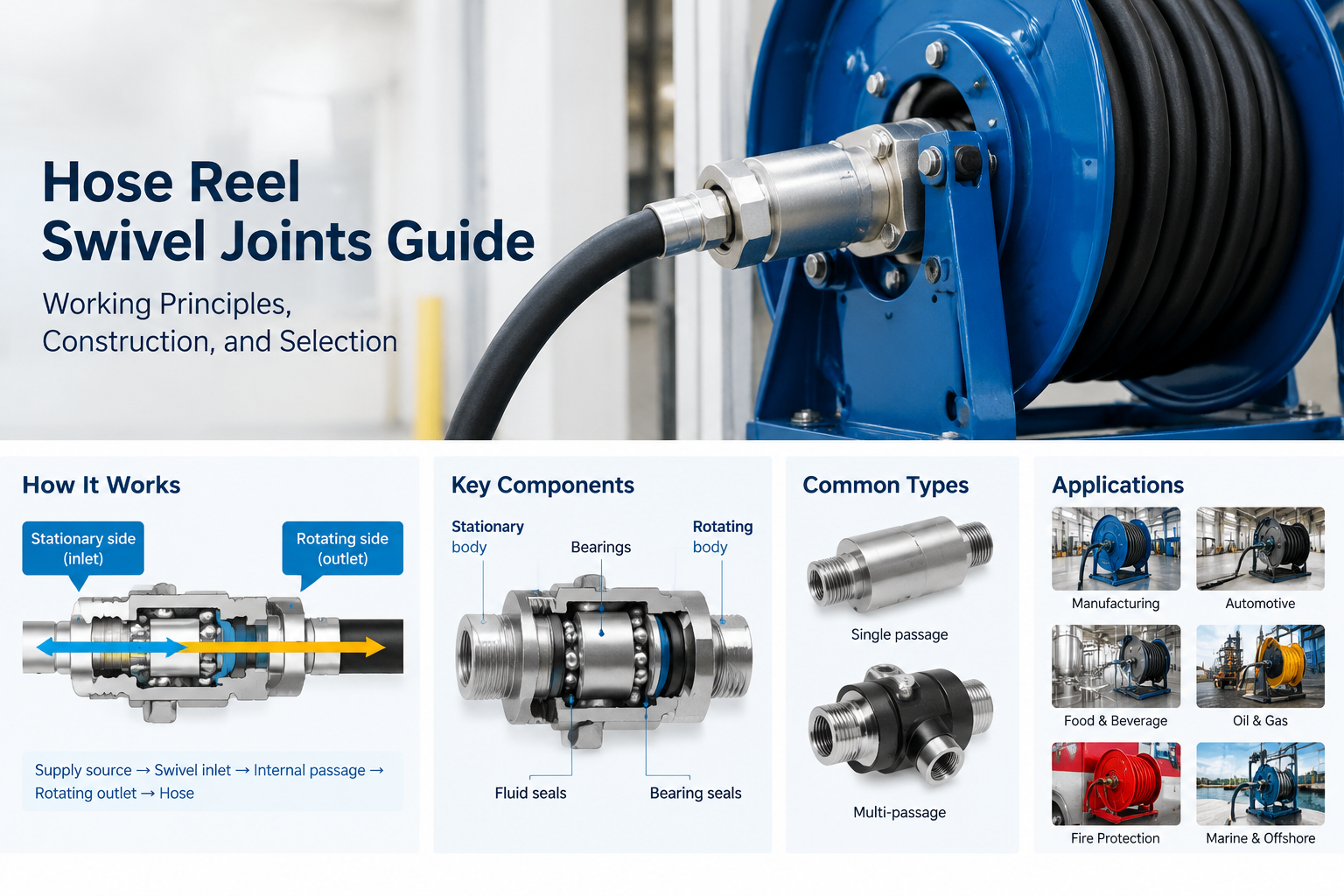
The inlet stays fixed to the supply source; the outlet turns with the reel. Flow continues either way.
In short, a swivel joint does three things:
- Keeps fluid moving while the reel rotates
- Takes torsional stress off the hose and fittings
- Holds a reliable seal between the moving and non-moving parts
Because pressure, temperature, and media vary so much across applications, these joints come in a wide range of materials and seal configurations.
2. How Does a Hose Reel Swivel Joint Work?
The principle is straightforward: two sections move independently while sharing one continuous internal passage. One section is fixed to the supply system. The other rotates with the reel.
Pull the hose out, and the reel starts turning. The rotating half of the swivel joint turns with it. The inlet side stays put, still connected to the supply line, and fluid keeps moving through the internal passage into the hose.
The flow path looks like this:
Supply source → Swivel inlet → Internal passage → Rotating outlet → Hose
Retraction works the same way, just in reverse. The reel spins the other direction, but the joint keeps the two sides connected, so the cycle can repeat indefinitely.
A good swivel joint has to rotate smoothly, hold pressure, seal properly, and tolerate the media being conveyed. Those four things together determine how reliable the reel will be over years of industrial use.
3. Structure of a Hose Reel Swivel Joint
3.1 Rotating and Stationary Components
Every swivel joint has two main structural parts.
The stationary part mounts to the reel’s frame or base. The rotating part attaches to the drum that carries the hose. Fluid enters through the inlet on the stationary side, travels through a hollow channel, and exits through the outlet on the rotating side into the hose.
Many designs use a hollow shaft running through the center of the assembly. That shaft does two jobs: it guides fluid along the axis of rotation, and it gives the bearings a surface to run on.
3.2 Bearings: Handling Load and Rotation
The bearing system is what allows smooth rotation under load.
Most hose reel swivel joints use ball bearings set between inner and outer races. Those races are machined to handle two different kinds of force:
- Axial loads — forces along the axis of rotation, created by fluid pressure pushing against internal surfaces
- Radial loads — forces perpendicular to the axis, created by the weight of the hose and reel
Better swivel joints use specific race geometries to handle these loads separately. Some use curved surfaces for axial loads and cylindrical surfaces for radial loads. Keeping the two apart prevents the bearings from being crushed or knocked out of alignment when pressure and weight act together. Bearings themselves can be made from hardened steel, stainless steel, or engineering plastics like acetal, depending on the application and how fast the joint needs to spin.
3.3 Seals: Keeping Fluid Where It Belongs
Seals are what stop leaks. Most swivel joints use two kinds:
Fluid seals sit between the rotating and stationary passages. These are usually O-rings, sometimes paired with backup rings for higher pressures. The O-ring gets compressed between two surfaces, forming a barrier the fluid cannot get past. Some designs add a plastic sealing element alongside the elastomeric O-ring for extra durability.
Bearing seals (also called dust seals) keep contaminants like dust and water out of the bearing cavity, and keep grease in. Without them, debris would damage the bearings quickly, and the joint would seize or start leaking. Seal material matters a great deal. Nitrile (Buna-N) covers most general-purpose applications. Viton and EPDM are used when the fluid or temperature range calls for them.
4. Types of Hose Reel Swivel Joints
Swivel joints generally fall into two categories: single-channel and multi-channel. Which one you need depends on how many media you are handling, the working pressure, and the equipment layout.
4.1 Single-Channel Swivel Joints
These have one internal passage and handle one medium.
They cover most standard hose reel applications:
- Compressed air
- Water
- Lubricating oil
- General industrial fluids
The simple construction makes them reliable and low-maintenance, which is why they are the most common type found on industrial hose reels.
An air hose reel in an auto repair shop is a typical example — it connects to the shop air supply and feeds pneumatic tools. Water and oil reels in maintenance areas usually use the same single-channel design.
For most standard industrial settings, a single-channel joint delivers stable performance and stands up to frequent extension and retraction.
4.2 Multi-Channel Swivel Joints
Multi-channel joints have several independent passages, so they can carry different media at the same time or connect multiple fluid lines through one rotating connection.
These handle more complex setups:
- Multiple hoses connected at once
- Multiple media transferred simultaneously
- Rotary connections inside complex equipment
You will find them in automation equipment, specialized machinery, and custom hose reel systems.
A machine that needs hydraulic oil, coolant, and compressed air all at once, for example, can route all three through a single multi-channel joint instead of three separate rotary connections. That cuts down on connection complexity considerably.
5. Common Issues with Hose Reel Swivel Joints
Swivel joints are built for long-term rotation, but problems still show up — usually from wrong model selection, poor installation, or skipped maintenance. Knowing the common failure causes helps you catch issues early and avoid downtime.
5.1 Leakage
Since the joint has to seal while moving, the sealing system’s condition directly determines reliability.
Typical causes:
- Seal wear
- Seal material incompatible with the medium
- Operating pressure above the rated limit
- Aging from prolonged, high-frequency use
- Seal damage during installation
A chemical transfer reel needs corrosion-resistant materials and the right seals. An oil reel needs seals with good oil resistance. Inspecting the joint regularly and matching specifications to actual operating conditions goes a long way toward preventing leaks.
5.2 Increased Rotational Resistance or Rough Operation
If rotational resistance increases, it will not only affect the hose retraction speed but may also increase the load on the reel drive mechanism.
Common causes:
- Bearing wear
- Contaminants inside the joint
- Insufficient lubrication
- Extended operation under overload
- Damage to internal mechanical parts
Smooth rotation matters most in high-frequency settings — production lines, maintenance bays, mobile equipment. Catching and fixing small issues early keeps them from taking down the whole reel system.
5.3 Shortened Service Life from Incorrect Model Selection
If a rotary joint operates for an extended period under conditions exceeding its design specifications, its service life will be significantly reduced.
For instance, a standard rotary joint designed for low-pressure air transmission is not necessarily suitable for high-pressure hydraulic systems. If pressure, temperature, or fluid requirements exceed design standards, it may lead to rapid seal failure or leakage.
When choosing a joint, weigh all of these together:
- Operating pressure
- Conveyed medium
- Operating temperature
- Rotation frequency
- Installation environment
Picking a joint based on connection size alone is not enough. You need a full picture of the reel’s operating conditions to get long, stable service.
6. How to Select the Right Swivel Joint for a Hose Reel
Choosing correctly means evaluating the actual application — the medium, the operating conditions, and the environment. A suitable joint has to meet connection requirements, obviously, but it also has to seal properly, last, and rotate well over the long haul.
6.1 Medium Compatibility
The joint’s materials and sealing system must be fully compatible with what is being conveyed.
- Air and water: standard sealing materials usually work
- Oil: requires oil-resistant seals
- Chemicals: requires corrosion-resistant materials
Get this wrong and you will see seals swell, harden, or wear out fast. When selecting, look at both the connection size and the range of media the joint can handle.
6.2 Operating Pressure
The rated pressure must meet or exceed what the system actually runs. Standard air and water reels work with conventional pressure ratings. Hydraulic or fuel reels need higher ratings and sturdier sealing structures. Running a joint above its rating for extended periods causes internal seal failure and raises the risk of leaks. The selected joint’s maximum operating pressure should be at least equal to the system’s actual working pressure.
6.3 Material Selection
Match the material to the operating environment:
| Operating Environment | Recommended Material |
|---|---|
| General industrial | Steel or brass |
| Humid or corrosive | Stainless steel |
| Food and pharmaceutical | 304/316L stainless steel |
Stainless steel joints hold up better in high humidity, high salt spray, or where chemical corrosion is a concern.
In food processing, pharmaceuticals, and other hygiene-sensitive industries, 304 or 316L stainless steel offers both corrosion resistance and easier compliance with cleaning and disinfection requirements.
6.4 Usage Frequency
How often the reel gets used drives how durable the joint needs to be. Standard designs are fine for low-frequency use. Industrial settings with daily, frequent extension and retraction need joints built for extra wear resistance.
For high-frequency applications, pay attention to:
- How smoothly it rotates
- How long the seals last
- Stability during prolonged operation
- Ease of maintenance
Production line maintenance, auto service centers, and mobile equipment repair are all examples of high-cycle operations that demand a joint built for the workload.
7. Maintenance of Hose Reel Swivel Joints
Good maintenance lowers the risk of leaks and extends the life of the whole reel system.
Regular checks should include:
- Inspecting the swivel connection for leaks
- Keeping the area around the joint clean
- Avoiding operation above rated pressure
- Checking seals and rotating components for wear
- Replacing damaged parts promptly
In industrial settings, a failed swivel joint interrupts fluid supply and disrupts equipment operation.
A regular inspection schedule matters. Catching seal aging and connection problems early — especially in high-pressure hydraulic, fuel transfer, or chemical handling applications — significantly reduces the chance of unplanned downtime.
Conclusion
The swivel joint is a small component with a large role in industrial hose reel systems. It keeps fluid moving while the reel rotates and reduces the twisting and mechanical stress that would otherwise hit the hose and connection points.
By decoupling the stationary supply inlet from the rotating reel, it makes the whole system run more smoothly and reliably. When selecting one, consider the conveyed medium, operating pressure, materials, usage frequency, and installation environment. Choose well, and you reduce leak risk, extend the reel’s service life, and improve overall operational efficiency.
FAQs
Related Posts
Best Hose Reel Solutions for the Paper Industry
August 27, 2026
How to Choose the Right Hose Reel Cart with Wheels
June 29, 2026
Negative vs. Positive Pressure: Hose Reel Design
October 15, 2026