Best Hose Reel Solutions for the Paper Industry
August 27, 2026 | Industrial Hose Reels
I. Industry Background and Pain Point Analysis
Paper mill workshops typically have high humidity, highly corrosive environments, large amounts of dust, and continuous vibration, placing extremely high demands on equipment durability.
Hose plays a crucial role in all stages of pulping, papermaking, and finished product processing, but it has long been neglected. Common problems include: hoses being carelessly discarded on the ground, suffering wear and tear from being run over and corroded by water containing chemicals; damage to the outer layer caused by friction with sharp edges; and damage to the internal structure due to excessive bending.
The consequences of mismanagement are severe. Paper production is continuous, and any unplanned downtime can result in huge losses. In one real-world example, a burst high-pressure cleaning hose caused a three-hour shutdown, resulting in approximately $150,000 in losses—not including emergency repair labor costs, spare parts costs, and customer claims. The safety hazards of burst hoses, such as injuries and tripping risks, are equally significant. The cumulative costs of frequent hose replacements are also staggering.
Therefore, the paper industry must shift from a passive “replace when it breaks” model to a systematic hose management approach—and high-quality hose reels are a core solution in this process.
The requirements vary at each stage: pulping requires wear-resistant and anti-clogging design; papermaking requires resistance to high-temperature steam and high-pressure cleaning; and finished product processing has higher requirements for cleanliness and corrosion resistance.
II. Core Selection Factors
To select the right hose reel for papermaking operations, the following four key factors need to be considered.
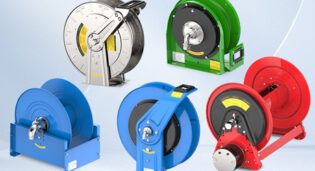
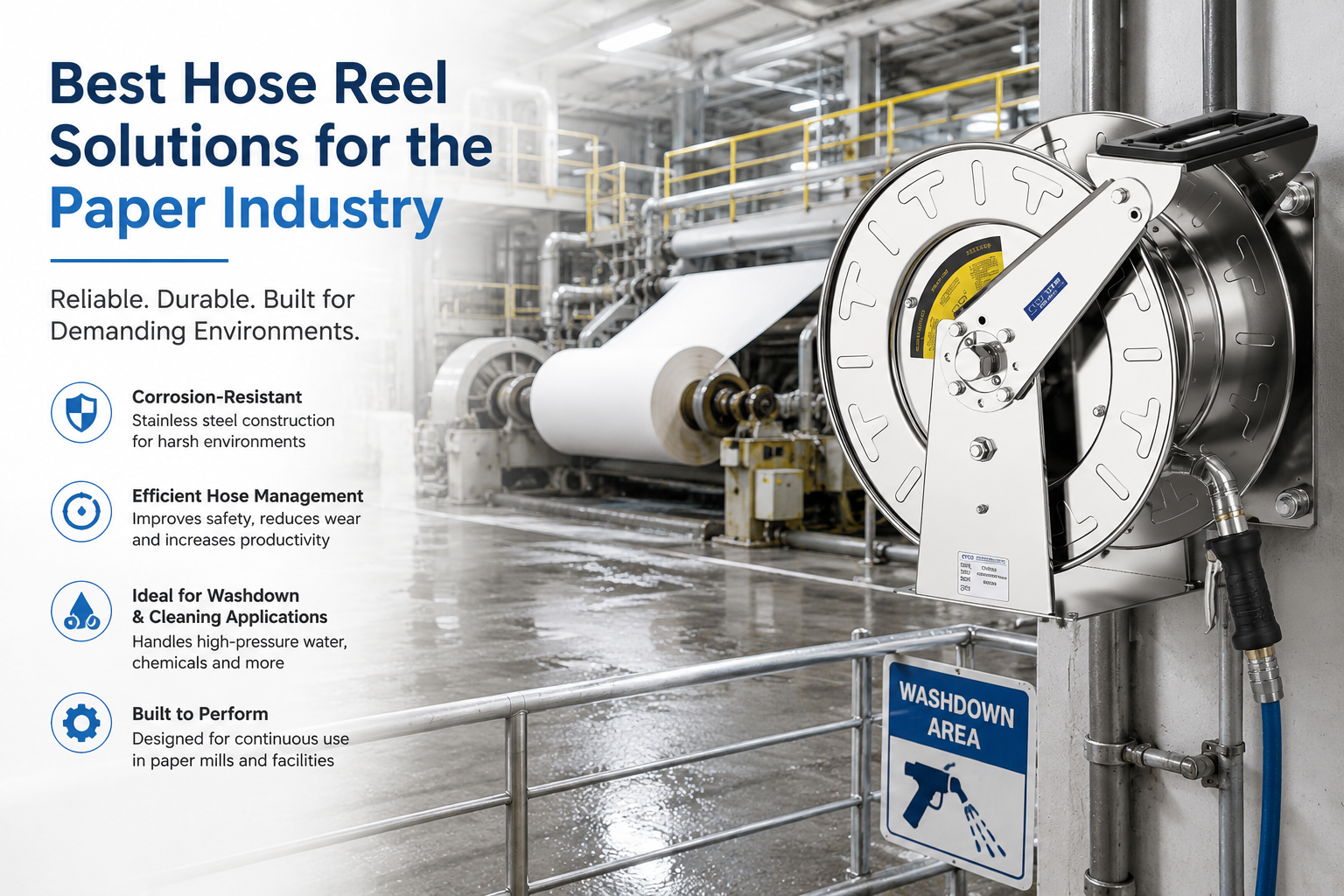
Corrosion Resistance and Durability: The air in the workshop contains highly corrosive volatile substances from chemicals such as bleaching agents, sizing agents, and fillers. In some high-grade paper production areas, iron and copper are strictly prohibited to prevent rust contamination of the pulp. Stainless steel hose reels are the preferred choice, as their chromium oxide protective film offers excellent corrosion resistance. For budget constraints, galvanized or CPC powder-coated carbon steel can be used, but these have shorter service lives and higher maintenance costs.
Medium and Operating Conditions Matching: High-concentration and abrasive pulp necessitates a clog-resistant and wear-resistant design. Chemical agents (bleaching agents, sizing agents, dyes) have varying pH levels and oxidizing properties, requiring corrosion-resistant seals. Steam and hot water are used for drying and cleaning, requiring seals that can withstand temperatures from -60°C to +180°C. High-pressure cleaning guns operate at pressures of hundreds or even thousands of psi, requiring the hose reel structure to withstand frequent pressure shocks.
Structural Design: Heavy-duty welded steel frames are preferred, and the discs are spun rather than stamped to prevent deformation. A low-profile outlet riser reduces bending stress, and an open drum groove facilitates inspection of hose winding. Permanently sealed, pre-lubricated bearings ensure smooth rotation and extend maintenance intervals.
Swivel Joint Reliability: This critical component is responsible for delivering the medium from the stationary conduit to the rotating drum. Industrial-grade brass or stainless steel is recommended, and the seals should be NBR, EPDM, or FKM depending on the medium type. High-quality joints must have low friction, reliable sealing, and long service life—because even small leaks can quickly deteriorate into severe corrosion in humid workshop environments.
III. Drive Method Selection
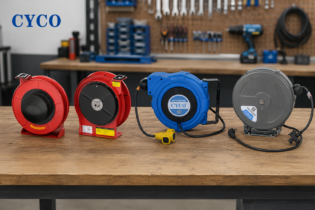
Spring-Driven Hose Reel (Automatic Rewind): The most widely used type, suitable for frequently used cleaning hoses and air hoses. The spring tensions when pulled out and automatically rewinds upon release—eliminating the tripping hazard of tangled hoses. High-end models are equipped with a safety rewind control system (such as EZ-Coil®) that reduces rewind speed by 80%, preventing injury from swaying. Suitable for light to medium-duty applications with an inner diameter not exceeding 3/4 inch and a length not exceeding 50 feet.
Manual Hose Reel: Simple structure, low cost, and high reliability. The operator simply turns the handle to extend or retract the hose. Particularly suitable for conveying large-diameter hoses (1 inch or more inner diameter), long hoses (over 100 feet), and heavy media such as pulp. Also suitable for stationary workstations with infrequent operation. Extremely low maintenance requirements—no spring fatigue or electrical failure issues, and extremely reliable in harsh environments.
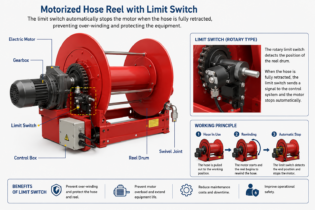
Electric Hose Reel: Designed for ultra-large and automated applications. When the length of a single hose exceeds 200 meters or fully automated control is required, electric drive becomes the necessary choice. High-quality products use spur gear drives (not chain drives), ensuring quiet, smooth operation and requiring no maintenance. Pneumatic drives are suitable for explosion-proof areas or workstations without power. They are typically equipped with limit switches and control systems to achieve timed or distance-based automatic operation.
Selection Guide:
High-frequency use → Spring drive; Low-frequency use → Hand-cranked drive. Small-diameter short pipes → Spring drive; Large-diameter long pipes → Hand-cranked or motor drive. Limited manpower → Prioritize automatic drive; Ample manpower → Hand-cranked drive to save costs.
IV. Key Configuration Recommendations
Fluid Path Material
Standard brass is suitable for water, air, and mild chemicals. However, for papermaking processes involving bleach, strong acids and alkalis, or chlorine-containing compounds, all stainless steel fluid paths are required (swivel joints, central shaft, and all interfaces made of 304 or 316 stainless steel). Initial investment is higher, but the incremental cost can typically be recovered within 12 to 18 months due to longer lifespan, less leakage downtime, and lower replacement frequency.
Installation Methods
Wall mounting is the most common—simple and space-saving. Floor mounting is suitable for mobile operations or scenarios where the wall cannot bear weight, using a column or trolley for fixation. Inverted mounting (ceiling-suspended) is valuable in compact workshops—saving floor and wall space and utilizing gravity to assist in pulling out the hose, especially suitable for narrow passages around paper machines. Regardless of the method used, the mounting base must be strong enough to withstand the weight of the hose reel, the hose, and dynamic tensile loads.
Capacity and Hose Matching
The hose reel capacity must be determined based on the actual distance from the installation point to the farthest point of use, with a 10%–15% margin. A hose with an outer diameter that is too large will not wind properly; one that is too small will result in loose winding and jamming. Common inner diameter ranges are from 1/2 inch to 4 inches—be sure to refer to the supplier’s capacity chart for precise matching. For compatibility with multiple hoses, a universal hose reel with replaceable guides is available.
Auxiliary Configurations
Guide rollers guide the hose to enter the hose reel at the correct angle, reducing uneven wear; locking devices prevent accidental rewinding; limit switches control the maximum pull-out length; and dust and splash guards protect the internal structure from pulp and dust intrusion. These details often determine the actual user experience and failure rate.
V. Full Lifecycle Management
Procurement and installation are only the first steps. To achieve long-term stable operation, a complete management system covering assessment, maintenance, tracking, and spare parts is needed.
System Assessment: This should be conducted by a professional consultant or the supplier’s technical team. A typical plant-wide assessment requires approximately 80 hours to complete inspections of all workstations, recording the purpose, hose specifications and condition, connector type, pressure/temperature parameters, and risk factors for each point. An independent file should be created for each hose. Problems are categorized into four levels of severity: Category 1 requires immediate shutdown (e.g., braided layer breakage exceeding 50%); Category 2 requires handling during the next planned shutdown; Category 3 is included in the annual plan; and Category 4 requires observation only. This categorization ensures that limited resources are prioritized for the highest-risk areas.
Preventative Maintenance: A common industry misconception is waiting until a leak or burst occurs before inspecting—this “firefighting” approach is the root cause of unplanned downtime. The correct approach is to establish inspection cycles and mandatory replacement schedules based on media type, pressure, usage frequency, and manufacturer recommendations. Routine inspections include visually checking for cracks, wear, bulges, corrosion, and leaks at joints. Periodic inspections encompass wall thickness measurements, pressure tests, and conductivity tests—systematically scheduled during planned downtime.
Asset Management System: A digital platform (such as EXARO®) assigns a unique identifier (RFID or QR code) to each hose, tracking purchase date, installation history, inspection results, and replacement records—achieving end-to-end traceability. The system automatically triggers inspection and replacement alerts. Accumulated data can identify failure modes, supporting future selection and inventory management decisions.
Spare Parts Inventory Management: Based on the assessment results, the plant should establish safety stock for commonly used specifications and critical workstations. The spare parts strategy should differentiate between routine spare parts (standard cleaning hoses and fittings), strategic spare parts (large-diameter pulp hoses, custom hose reels), and emergency spare parts (complete spare assemblies for critical workstations), setting different inventory levels for each. Establishing long-term partnerships with hose reel suppliers can also secure priority support in spare parts supply, technical consultation, and emergency response.
In summary, full lifecycle management is a systematic project encompassing assessment, maintenance, and spare parts. Only by elevating hose management to a strategic level of equal importance to the papermaking machine can enterprises truly achieve the goals of “zero unplanned downtime, safer operation, and lower total maintenance costs.”
VI. Conclusion
While hose reels may seem like insignificant auxiliary equipment in a paper mill, in actual production, they directly affect the continuous operation of the production line, the personal safety of operators, and the company’s maintenance costs. Choosing a high-quality hose reel solution suitable for its own operating conditions and establishing a systematic full life-cycle management system are crucial steps for paper companies to achieve cost reduction, efficiency improvement, and safe operation.
It is hoped that the ideas provided in this article from five dimensions—industry pain points, selection factors, drive methods, configuration suggestions, and full life cycle management—can bring practical reference value to equipment managers and procurement decision-makers in the paper industry.
Related Posts
Best Hose Reel Materials for Harsh Environments
May 25, 2026