Hydraulic Hose Reels for Service Trucks: A Complete Guide
October 13, 2026 | Hydraulic hose reels
In agricultural machinery emergency repair, construction machinery maintenance, and field equipment servicing, service trucks need to carry hydraulic hoses, maintenance tools, and related equipment to different locations. Unlike fixed maintenance workshops, mobile repair environments present several challenges: vehicles experience vibration and impact during transportation, reels must fit into limited installation spaces, and technicians frequently unwind and retract hoses according to the location of the equipment being repaired.
Hydraulic hose reels must meet the operating requirements of the hydraulic system while also accommodating vehicle transportation and field working conditions. If the reel’s mounting structure, rotary joint, retraction mechanism, or hose configuration does not match the actual operating conditions, problems such as loose connections, hose wear, hydraulic fluid leaks, or abnormal retraction may occur. Properly configuring a truck-mounted hydraulic hose reel requires consideration of the transportation environment, repair tasks, and compatibility of the entire hydraulic system.
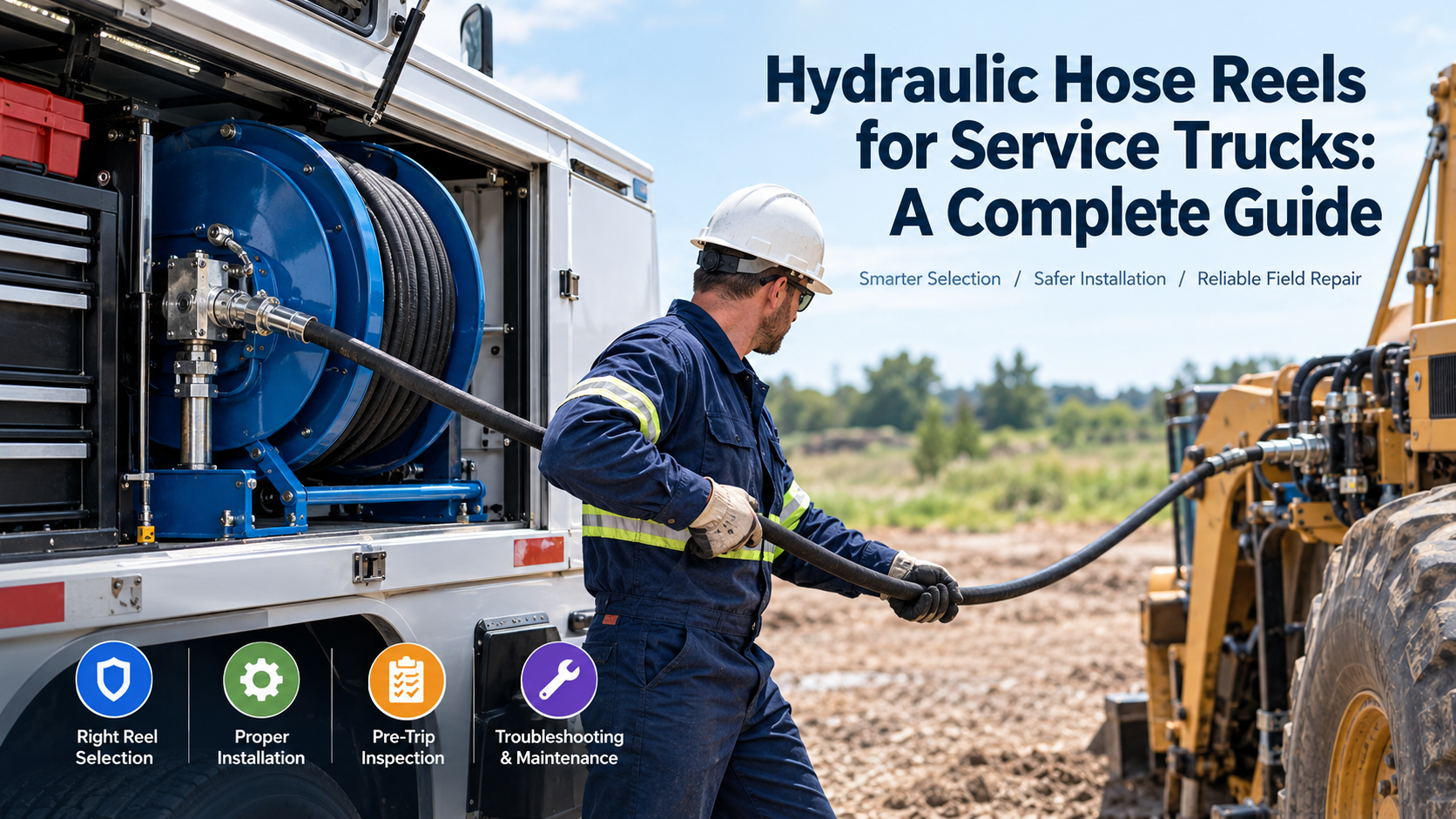
1. Special Operating Challenges for Truck-Mounted Hydraulic Hose Reels
1.1 Continuous Vibration and Mechanical Impact During Transportation
Truck-mounted reels operate under different conditions from reels installed in fixed workshops. When service trucks travel on roads, farmland, construction sites, and unpaved surfaces, their bodies experience continuous vibration and varying degrees of impact. These loads can be transferred to the reel frame, mounting bolts, pipe connections, and other fixed components.
If the mounting structure is not sufficiently stable or the reel is not properly supported on the vehicle frame, prolonged use may lead to loose fasteners, deformation of support structures, or additional stress on connection points. For hose reels equipped with spring-driven retraction mechanisms, unexpected impacts during transportation may also affect the reliability of locking mechanisms and other moving components, depending on the product design.
When selecting a truck-mounted hydraulic hose reel, buyers should consider not only hose capacity and working pressure but also whether the reel structure and mounting method are suitable for vehicle transportation. For service trucks that frequently travel over rough terrain, particular attention should be paid to mounting support, fastening methods, and hose restraint during transit.
1.2 Dust, Rain, and Temperature Changes
Field maintenance environments generally lack the protective conditions of fixed workshops. Reels may be exposed to dust, mud, rain, direct sunlight, and temperature fluctuations for extended periods. These environmental factors can affect the reel’s external structure and increase maintenance requirements for seals, bearings, retraction mechanisms, and connection components.
The appropriate surface treatment, materials, and protective structure should be selected according to the vehicle’s operating environment. For equipment frequently used outdoors or in humid conditions, corrosion resistance is an important consideration. Where dust and mud are common, buyers should also evaluate the protection of moving components and the ease of cleaning and maintenance.
Truck-mounted hose reels should also be positioned away from engine exhaust components and other high-temperature sources whenever possible. Ambient temperatures and radiant heat can affect hoses, seals, and lubricated components. Suitability for a particular vehicle should therefore be assessed against the manufacturer’s temperature and environmental specifications rather than appearance or material alone.
1.3 Limited Installation Space and Frequent Hose Deployment
Service trucks must accommodate toolboxes, hydraulic power units, pipelines, lighting equipment, and other maintenance tools within a limited space. The reel’s mounting position affects both space utilization and the ability to route the hose to the equipment being serviced.
If the hydraulic hose reel is mounted too far inside a compartment, its outlet faces the wrong direction, or the hose path is obstructed by the vehicle body, technicians may need to repeatedly adjust the hose or route it around the frame, toolbox edges, or other equipment. These conditions increase the risk of bending, abrasion, and pulling forces.
Vehicles that perform multiple service calls each day also subject their hydraulic hose reels to frequent deployment and retraction cycles. The mounting position should therefore provide adequate hose reach, convenient operation, and safe routing rather than simply minimizing the space occupied by the reel.
2. Key Selection Factors for Hydraulic Hose Reels Used in Mobile Repair
2.1 Frame Strength and Secure Mounting
Truck-mounted hydraulic hose reels must support their own weight, the hose load, and dynamic loads generated during transportation. The reel frame, mounting base, and attachment points should be suitable for the equipment’s weight and expected operating conditions.
Before purchasing, confirm that the mounting structure can be securely attached to an appropriate load-bearing part of the vehicle. The manufacturer’s requirements for mounting orientation, fastening methods, and allowable loads should also be checked. A hydraulic hose reel’s suitability for vehicle use cannot be determined solely by whether it accommodates the required hose length.
For hydraulic hose reels installed inside tool compartments, on vehicle frames, or on dedicated brackets, ensure that the mounting location provides adequate structural support. When necessary, have a qualified vehicle modification or equipment installation professional assess the brackets and attachment points. Avoid mounting a hydraulic hose reel on thin panels that lack sufficient strength or are prone to deformation.
2.2 Pressure and Flow Compatibility of the Rotary Joint
The rotary joint is an important connection between the stationary hydraulic supply line and the rotating reel drum. It must maintain hydraulic fluid transfer while the reel rotates and the hose is deployed or retracted, while also meeting the system’s operating requirements.
When selecting a rotary joint, check its rated working pressure, flow capacity, hydraulic fluid compatibility, operating temperature, and connection specifications. The hydraulic hose reel’s ratings must match the actual hydraulic system. The hose’s pressure rating alone is not sufficient to determine whether the complete assembly is suitable.
Hoses, fittings, rotary joints, and other components must all be suitable for the expected operating conditions. The allowable working pressure of the complete system must account for the limitations of all components and the manufacturer’s specifications.
The installation of the rotary joint and its connected piping also requires attention. External piping that is pulled, bent, misaligned, or subjected to unnecessary lateral loads may place additional stress on the connection. The inlet line should be supported and routed according to the manufacturer’s instructions to prevent pipe weight or vehicle movement from transferring excessive loads directly to the rotary joint.
2.3 Matching Retraction Torque to Hose Weight
Hose length, inner and outer diameters, material, and construction all affect its weight and bending characteristics. Longer, larger-diameter, or heavier hydraulic hoses place greater demands on the hydraulic hose reel’s load capacity and retraction mechanism.
For spring-driven hose reels, confirm that the retraction mechanism is suitable for the specified hose length, weight, and operating conditions. Insufficient retraction capacity may prevent the hose from returning fully. Excessive retraction speed or an unsuitable locking and release mechanism may also create operational risks.
Hydraulic Hose Reel selection should therefore be based on the complete hose specifications rather than the maximum hose length alone. For heavy hoses or frequent service operations, manual and powered hose reels can also be evaluated according to workload and operating requirements. The appropriate drive method depends on the specific product ratings and application rather than a single solution being suitable for every service vehicle.
2.4 Protective Housing and Environmental Suitability
The hydraulic hose reel’s protective structure should match its working environment. An enclosed housing or protective cover can reduce direct exposure of internal components to certain contaminants, but the actual level of protection depends on the product’s construction and specified protection rating.
For vehicles frequently operating in muddy, dusty, or humid conditions, consider the hydraulic hose reel’s surface treatment, housing construction, protection of moving parts, and cleaning requirements. Where corrosive substances may be present, material compatibility with the relevant media should also be verified.
Protection should not come at the expense of maintainability. Connections, fasteners, and components requiring regular inspection should remain reasonably accessible so that routine maintenance can be performed without unnecessary difficulty.
3. Best Practices for Installing Truck-Mounted Hydraulic Hose Reels
3.1 Choose a Mounting Location Away from High-Temperature Components
Before installation, identify the engine, exhaust system, hydraulic power unit, and other components that may generate heat. Hoses, seals, and reel components must remain within their specified temperature limits. The mounting position should therefore be selected with consideration for heat sources, airflow, and the arrangement of surrounding equipment.
The hydraulic hose reel should also be positioned so that it does not obstruct toolbox doors, vehicle maintenance access, personnel entry and exit, or the operation of other equipment. After installation, check that the reel and hose do not interfere with doors, support equipment, or other moving components.
3.2 Control Vibration and Provide Reliable Structural Support
The hydraulic hose reel should be secured according to the manufacturer’s installation instructions using fasteners suitable for the expected loads and mounting structure. For vehicles subject to substantial vibration, carefully evaluate the support structure, attachment points, and fastening methods against actual transportation conditions.
Vibration-control measures may be appropriate depending on the vehicle and equipment design, but flexible materials should not simply be inserted between the reel and vehicle frame without considering structural stability. An overly flexible mounting arrangement may allow excessive movement, create abnormal loads on attachment points, or affect hose connections.
After installation, verify that the frame is stable, the hose reel rotates properly, and the hose can be deployed and retracted without abnormal friction or interference.
3.3 Allow Adequate Hose Movement and Maintain the Required Bend Radius
The hose should be long enough to reach common service locations without selecting unnecessary extra length. Excessive hose length can increase hydraulic hose reel load, complicate routing, and make field hose management more difficult.
When planning the hose path, follow the manufacturer’s specified minimum bend radius. Avoid sharp bends at the hydraulic hose reel outlet, vehicle body edges, or equipment corners. The hose should also be routed away from sharp edges, moving vehicle components, and locations where it could be crushed.
During installation planning, consider the technician’s typical route from the service truck to the equipment being repaired. Confirm that the hose can reach common working positions without continuous pulling or routing around obstacles. If the serviced equipment may move during the task, allow sufficient working slack to prevent sudden tension from being applied to the hose.
3.4 Prevent Additional Stress on the Inlet Connection and Rotary Joint
The hydraulic hose reel’s inlet pipeline should be installed using the connection method specified by the manufacturer and supported appropriately. If rigid piping is misaligned with the rotary joint or cannot accommodate relative movement between vehicle structures, additional stress may be transferred to the connection.
Do not force the pipeline into position simply to make installation easier, or tighten fittings to compensate for incorrect alignment. Ensure that connection dimensions are correct and that the piping is positioned appropriately. Where relative movement between the vehicle and reel is possible, evaluate a suitable piping arrangement that meets the hydraulic system’s requirements.
After installation, inspect the connections according to the equipment manufacturer’s procedures and verify that there are no abnormal leaks under the specified operating conditions.
4. Pre-Trip Inspection Checklist for Truck-Mounted Hydraulic Hose Reels
For service trucks that regularly travel to different repair locations, pre-trip inspections should focus on transportation security, hydraulic connections, and reel operating condition. A consistent inspection routine helps identify problems that may have developed during previous operations or road travel.
4.1 Inspect Mounting Fasteners and Structural Components
Check the hydraulic hose reel base, mounting brackets, fastening bolts, and visible structural components for looseness, cracks, deformation, or other abnormalities. If an attachment point is damaged or the reel structure is unstable, do not continue using the equipment until it has been returned to a safe condition and inspected or repaired according to the manufacturer’s requirements.
4.2 Check Hoses, Fittings, and Rotary Joints
Inspect the hose surface for cuts, bulges, obvious abrasion, kinks, or other damage. Check visible fittings and rotary joints for signs of hydraulic fluid leakage. Do not attempt to conceal problems with damaged hoses or connections simply by wiping away fluid or repeatedly tightening fittings. Hydraulic system inspection and maintenance must follow the manufacturer’s pressure-release and safety-isolation procedures, high-pressure hydraulic fluid leaks can cause serious injuries. Pay attention to that never use your hands to locate a pinhole leak.
4.3 Test the Retraction Mechanism and Locking Device
Following the product’s operating instructions, check hose deployment, locking, release, and retraction functions. For hydraulic hose reels with automatic retraction, confirm that the hose can be retracted normally without obvious binding, abnormal impact, or failure of the locking mechanism. If retraction speed, locking behavior, or operating resistance changes noticeably, inspect the hose load, reel mechanism, and related components before returning the equipment to service.
4.4 Confirm Hose Routing and Operating Clearance
Check that the hose is properly arranged and free from tangling, crushing, or contact with sharp edges. Ensure that vehicle doors, tool compartments, support equipment, and other moving components cannot trap the hose. After inspection, secure the hose and reel in the manufacturer’s recommended transport position to prevent unnecessary movement or impact while the vehicle is traveling.
5. Common Field Failures and Their Possible Causes
5.1 Hydraulic Fluid Leaks Around Connections or Rotary Joints
Leaks may result from worn seals, incompatible fittings, installation misalignment, loose connections, or a damaged rotary joint. On vehicle-mounted equipment, also check whether external piping is continuously pulling on the connection or whether vehicle vibration is creating additional stress.
Before investigating the cause, stop the system and safely release hydraulic pressure according to the required procedures. Then inspect the relevant components. Not every leak originates in the rotary joint itself, and repeatedly tightening a fitting without confirming the connection specifications and installation requirements may not solve the problem.
5.2 Slow, Incomplete, or Abnormal Hose Retraction
Retraction problems may occur when the hose exceeds the mechanism’s intended load capacity, the hose is unevenly wound, the hydraulic hose reel is obstructed, or the retraction mechanism is worn. For spring-driven reels, the condition of the spring mechanism and locking and release components should also be checked.
First, confirm that the hose specifications are compatible with the reel, that rotation is not obstructed, and that the hose is not forming a sharp bend near the outlet. Maintenance of internal spring mechanisms must follow the manufacturer’s procedures. Do not disassemble these components without the appropriate precautions and technical guidance.
5.3 Hose Abrasion, Kinking, or Premature Deterioration
Hose wear is often closely related to routing and handling. Repeated contact with vehicle body edges, insufficient bend radius, crushing by nearby equipment, or excessive pulling during deployment can accelerate damage.
If wear repeatedly appears in the same location, inspect the hose route, reel outlet direction, and available space inside the vehicle rather than simply replacing the damaged hose. Hoses showing deterioration, cracking, or other significant damage should be replaced according to the manufacturer’s requirements.
5.4 Loose Mounting Fasteners and Structural Damage
Repeated loosening of hydraulic hose reel fasteners may indicate insufficient mounting-point strength, unsuitable fastening methods, deformation of the support structure, or transportation vibration. Simply tightening the bolts again may not address the underlying cause.
Inspect the hydraulic hose reel base, brackets, attachment points, and associated fasteners to confirm that the mounting structure is appropriate for the equipment’s weight and operating conditions. If cracks, deformation, or other structural damage are found, stop using the hose reel until the necessary inspection and repairs have been completed.
Conclusion
Configuring a truck-mounted hydraulic hose reel requires consideration of hydraulic system requirements, vehicle transportation conditions, and field maintenance procedures. The frame and mounting structure must accommodate expected loads, the rotary joint and hose must meet the required operating parameters, and the retraction mechanism must be compatible with the hose specifications and frequency of use.
Installation position, pipeline support, hose routing, and pre-trip inspections are equally important. For agricultural machinery repairs, construction equipment maintenance, and other mobile service tasks, treating the reel, vehicle layout, hydraulic equipment, and actual operating requirements as an integrated system helps reduce avoidable wear and failure risks and supports more reliable field maintenance.
Related Posts
Hydraulic Hose Reel Safety Operating Procedures
August 5, 2026
How Forklift Attachments Alter Hydraulic Hose Requirements
September 15, 2026