Power vs. Signal Transmission in Spring Cable Reels
October 21, 2026 | Cable Reels
Introduction
Spring cable reel is used to manage cables that need to be pulled out and recycled repeatedly. In addition to keeping cables neatly stored, it can also maintain electrical connection between fixed power supply or control system and mobile equipment. Depending on the specific application, the spring cable reel can transmit power, control signals, communication data, or multiple types of signals at the same time.
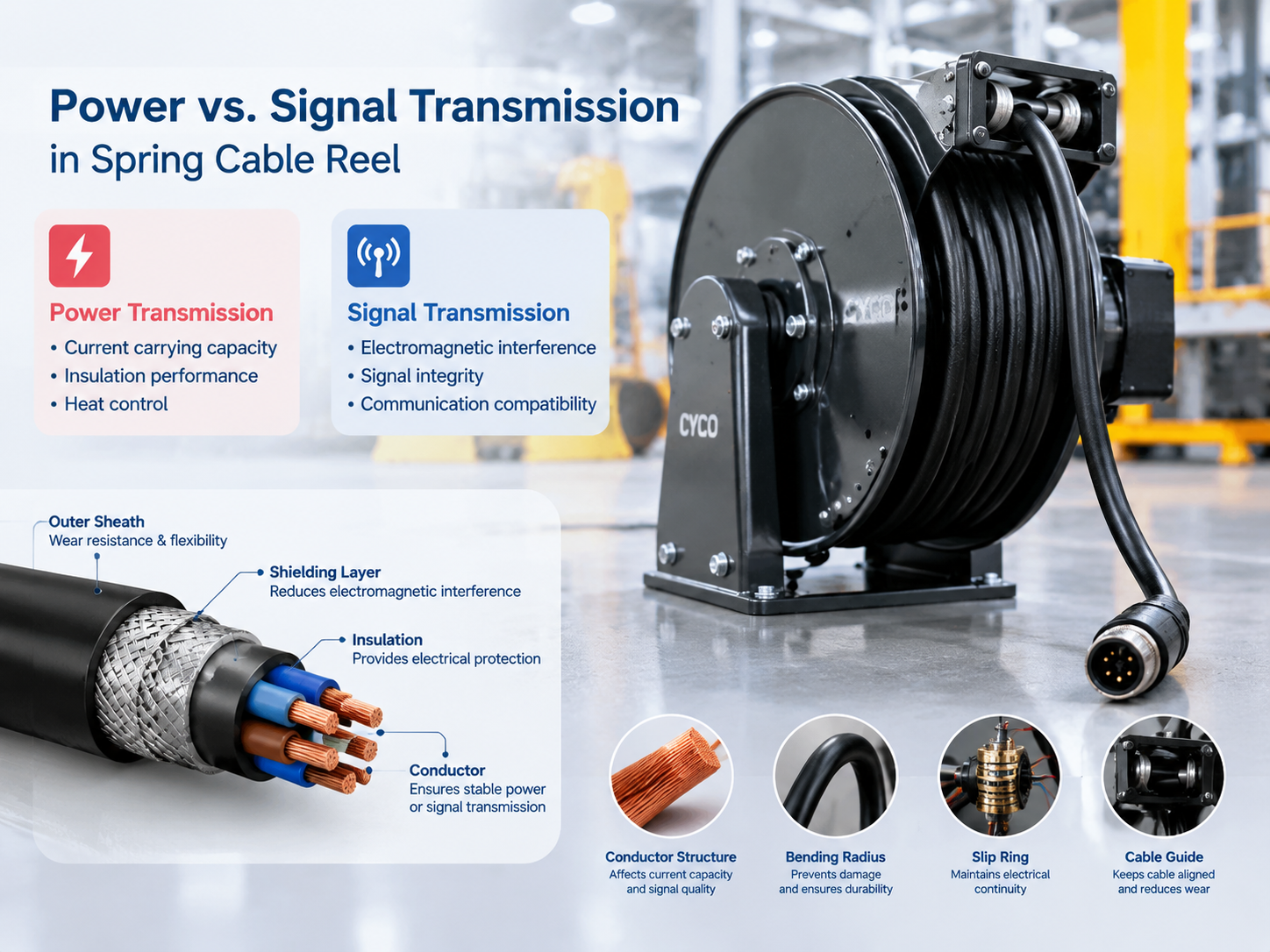
Although cable reels with similar structures can be used for power transmission and signal transmission, their electrical requirements are not the same. Power transmission mainly focuses on current carrying capacity, insulation performance and heat control, while signal transmission needs to pay special attention to electromagnetic interference, signal integrity and communication compatibility. Understanding these differences is helpful for engineers to reasonably match the configuration of cables, slip rings and reels according to the actual operation requirements of equipment.
1. What Is the Difference Between Power Transmission and Signal Transmission?
1.1 Power Transmission in Spring Cable Reels
Power transmission is used to supply power for motors, actuators and mobile machinery. The cable and its electrical connection parts must be able to carry the required current and ensure that the rated working limit is not exceeded during continuous or intermittent operation.
Many factors determine whether cables are suitable for power transmission. The cross-sectional area of the conductor will affect the current carrying capacity and resistance. The insulation layer must meet the requirements of working voltage and environmental conditions, while the cable structure needs to be able to withstand the bending during repeated pull-out and recovery.
The problem of fever is also worthy of attention. When current passes through a conductor, the resistance will cause the conductor to generate heat. If the current exceeds the carrying capacity of the cable, or the heat cannot be fully dissipated, the conductor temperature may exceed the allowable range. Therefore, it is necessary to comprehensively consider the rated current, ambient temperature, working period and installation conditions of the cable.
The electrical components of spr reel must also be able to withstand the expected load. If slip rings are used to transmit power between fixed parts and rotating parts, slip rings must have appropriate rated current and rated voltage. Even if the cable itself has enough bearing capacity, if the rated load of the supporting electrical connection parts is low, the whole system still cannot meet the requirements.
1.2 Signal Transmission in Spring Cable Reels
Signal transmission is mainly used to transmit information, not to provide main operating power for equipment. Depending on the system type, the transmission content may include sensor readings, control instructions, communication data, encoder feedback or video signals.
Compared with power loop, signal loop may be more sensitive to less electrical interference. Electromagnetic interference, unnecessary signal coupling between conductors and poor electrical connection may introduce noise or distort transmission information. In digital systems, interference may lead to communication errors or data loss; In the analog system, it may cause inaccurate reading or unnecessary fluctuation of the signal.
The cable structure must match the signal type. In the applicable differential signal system, twisted pair is helpful to reduce interference; Shielded cables may be needed in an environment with high electrical noise. For specific video or high-frequency signals, coaxial cables or other cables with specific impedance structures may be needed.
However, shielding alone cannot guarantee reliable transmission. Cable impedance, connector quality, grounding mode, transmission distance and communication protocol will all affect transmission performance. Therefore, these requirements should be made clear before selecting cables for spring cable reels.
1.3 Why Do the Two Transmission Modes Have Different Requirements?
The main difference between the two transmission modes lies in the different criteria for judging whether the transmission is successful or not. The power circuit needs to provide the required power safely, and at the same time control the voltage drop and temperature rise within the allowable range. The signal loop needs to keep the information carried by the electrical waveform as accurately as possible within the limits specified by the relevant system.
Cables suitable for power transmission are not necessarily suitable for data communication. Conversely, cables designed for low-level signals may not meet the requirements of power load for conductor size or insulation grade.
2. How Do Cable and Reel Components Affect Transmission Performance?
2.1 Cable Structure and Repeated Bending
The spring cable reel will make the cable move repeatedly. In the process of drawing and recycling, the cable will bend around the drum and may pass through the guide device or other mechanical parts. With the increase of use times, if the cable structure is not suitable for this movement mode, conductor fatigue, insulation damage or outer sheath aging may occur.
For power cables, conductor structure, conductor size, flexibility of insulation layer and sheath will all affect their ability to withstand repeated movements when energized. Damage to conductors may increase resistance or cause disconnection, while damage to insulation may bring electrical safety risks.
There are additional considerations for signal cables. Excessive bending or squeezing may change the geometry of twisted pair, affect the impedance, or damage the shielding layer. Even if the cable appearance is not obviously damaged, these changes may reduce the signal quality.
Therefore, the dynamic bending grade of cables is very important, and the minimum bending radius and bending life specifications of cables should be checked according to the actual operating conditions of reels.
2.2 Slip Rings and Electrical Continuity
Some spring cable reels use slip rings to maintain electrical connection between the fixed equipment and the rotating reel. Slip rings are usually composed of conductive rings and corresponding contact parts, which can transmit power or signals during relative rotation. The number of circuits and electrical structure depend on the specific application requirements.
For power transmission, the slip ring must meet the required current and voltage requirements. Contact resistance and heat generated from it should be kept within the rated limit of the module, and appropriate insulation performance and circuit isolation should be provided at the same time.
Signal transmission may put forward different requirements for slip rings. Low-level control signals, communication data and video signals do not have exactly the same electrical requirements. Contact stability, circuit configuration, shielding mode, and compatibility with signal frequency or communication protocol may all determine whether a certain slip ring is suitable.
If the reel needs to transmit power and signals at the same time, it is necessary to comprehensively evaluate the two functions of the whole set of components.
2.3 Electrical Noise and Signal Integrity
When the power circuit runs adjacent to the signal circuit, electrical noise is particularly worthy of attention. When current flows through the power conductor, it will produce electromagnetic field, and switching equipment and motor drivers may also introduce additional electrical interference. These interferences may be coupled into the nearby signal loop.
Interference risk depends on signal type, circuit layout, switching characteristics, shielding mode and grounding conditions. Low-speed control signals may be able to tolerate some interference environments, and high-speed communication links may be affected. Therefore, the measures to reduce noise should be formulated according to the actual transmission requirements.
The measures that can be taken include using proper shielded cable, keeping proper distance between power circuit and signal circuit, adopting correct grounding mode, and selecting compatible connectors and slip rings. If the communication system supports differential signal transmission, the twisted pair structure is also helpful to improve the anti-interference ability.
If a reel needs to transmit power and data at the same time, the electrical design should consider them as a complete system to ensure sufficient isolation between circuits and ensure signal quality.
2.4 Cable Movement and Connection Reliability
Reliable transmission depends not only on the rated parameters of cables and slip rings. The mechanical force generated by cable movement will also affect the electrical connection.
If the cable is subjected to excessive tension, sharp bending, or repeated friction with inappropriate surfaces, the stress may be concentrated near the cable entrance, terminal or connector. In the long run, this may lead to loose connections or damage to conductors and insulation.
The reel shall guide the cable to be wound along an appropriate path to avoid that the bending radius of the cable is less than the minimum value specified by the manufacturer. The cable length, reel capacity, guiding structure and the movement mode of connecting equipment will all affect the mechanical load borne by the cable.
For the application of transmitting sensitive signals, even intermittent connection problems may cause communication interruption or inaccurate feedback data. For power applications, poor connections may cause excessive resistance and local overheating. Therefore, proper mechanical support and compatible termination methods are helpful to improve electrical and operational reliability at the same time.
3. How to Match the Spring Cable Reel According to the Transmission Requirements?
3.1 Clear Transmission Requirements
First of all, it is necessary to know exactly what the reel needs to transmit. For power applications, the working voltage, current, load characteristics, working cycle and environmental conditions should be confirmed. For signal application, it is necessary to determine the signal type, the number of circuits, the applicable data transmission rate, shielding requirements and communication protocol.
If the application involves both power and signal transmission, a comprehensive evaluation is needed. Designers should determine whether the circuits need electrical isolation, whether the same cable assembly can be shared, and whether the electrical components of the reel support all the required transmission functions.
3.2 Check the Compatibility Between Cable and Slip Ring
After defining the transmission requirements, the cables and electrical components should be inspected as a complete system.
For cables, it is necessary to confirm the conductor size, insulation grade, flexibility, minimum bending radius and whether it is suitable for repeated winding. For slip rings, it is necessary to confirm the rated voltage, rated current, number of circuits and their compatibility with target signals. Special data or video applications may require additional technical parameters or manufacturer verification.
Mechanical capacity is equally important. The reel must be able to accommodate the actual outer diameter and length of the cable, so as to avoid the cable from being wound in an inappropriate way. The weight and rigidity of the cable should also match the spring mechanism and guide structure.
Even if the reel has enough physical storage space, if the cable or electrical connection component can’t meet the transmission specifications, it may not be applicable.
3.3 Considering the Combined Transmission of Power and Signal
Some mobile devices need to get power at the same time and receive control or communication signals. In this case, as long as the cable structure and electrical components are designed for the corresponding tasks, the spring cable reel can be configured to transmit a variety of circuits.
The key is compatibility. The power circuit may cause interference and affect the nearby signal circuit; Different signal types may also put forward specific requirements for impedance, shielding or contact structure. Reasonable circuit isolation, cable selection and slip ring design are helpful to deal with these problems.
The specific configuration depends on the equipment and transmission system. Before determining the reel scheme for transmitting power and signals at the same time, it should be confirmed that cables, slip rings, connectors and grounding methods can meet the requirements of expected electrical loads and communication protocols. For demanding applications, it may be necessary to test under representative actual operating conditions.
Conclusion
Power transmission and signal transmission put forward different requirements for spring cable reels. The power circuit needs sufficient current carrying capacity, reliable insulation and effective heat management; The signal loop relies on stable electrical connection, noise control, and components that match the transmitted information. At the same time, both of them need cable structures that can withstand repeated pulling and recycling.
Reliable operation performance comes from the reasonable matching between cable, slip ring and reel mechanism and actual electrical and mechanical requirements. Through comprehensive evaluation of these components, engineers can choose a spring cable reel that is more suitable for specific applications, thus supporting stable power supply, reliable signal transmission and continuous operation in long-term repeated use.
Related Posts
Retractable Cable Reel: Problems & Solutions
November 2, 2026
Static Discharge Reels for Fuel Transfer: Safety Basics
October 14, 2026