Retractable Cable Reel: Problems & Solutions
November 2, 2026 | Cable Reels
Introduction
Retractable cable reels are widely used in workshops, industrial facilities, garages and equipment maintenance areas. It can pull out the power cord when necessary and take it back after use, which is convenient for cable storage and management. According to different models, the retractable cable reel may adopt spring drive mechanism, locking system, rotating electrical connection device and internal cable guiding structure to control the extension and recovery of cables.
With the increase of service time, repeated pulling and recycling, improper operation, excessive electrical load and environmental factors may affect the running performance of the reel. Common problems include abnormal recycling, failure of locking mechanism, cable damage, unstable electrical connection and overheating during operation.
Understanding these problems helps operators to identify potential faults and judge whether simple adjustment, professional inspection or overall replacement is needed. This guide will introduce common problems of retractable cable reels, practical troubleshooting methods and routine maintenance precautions.
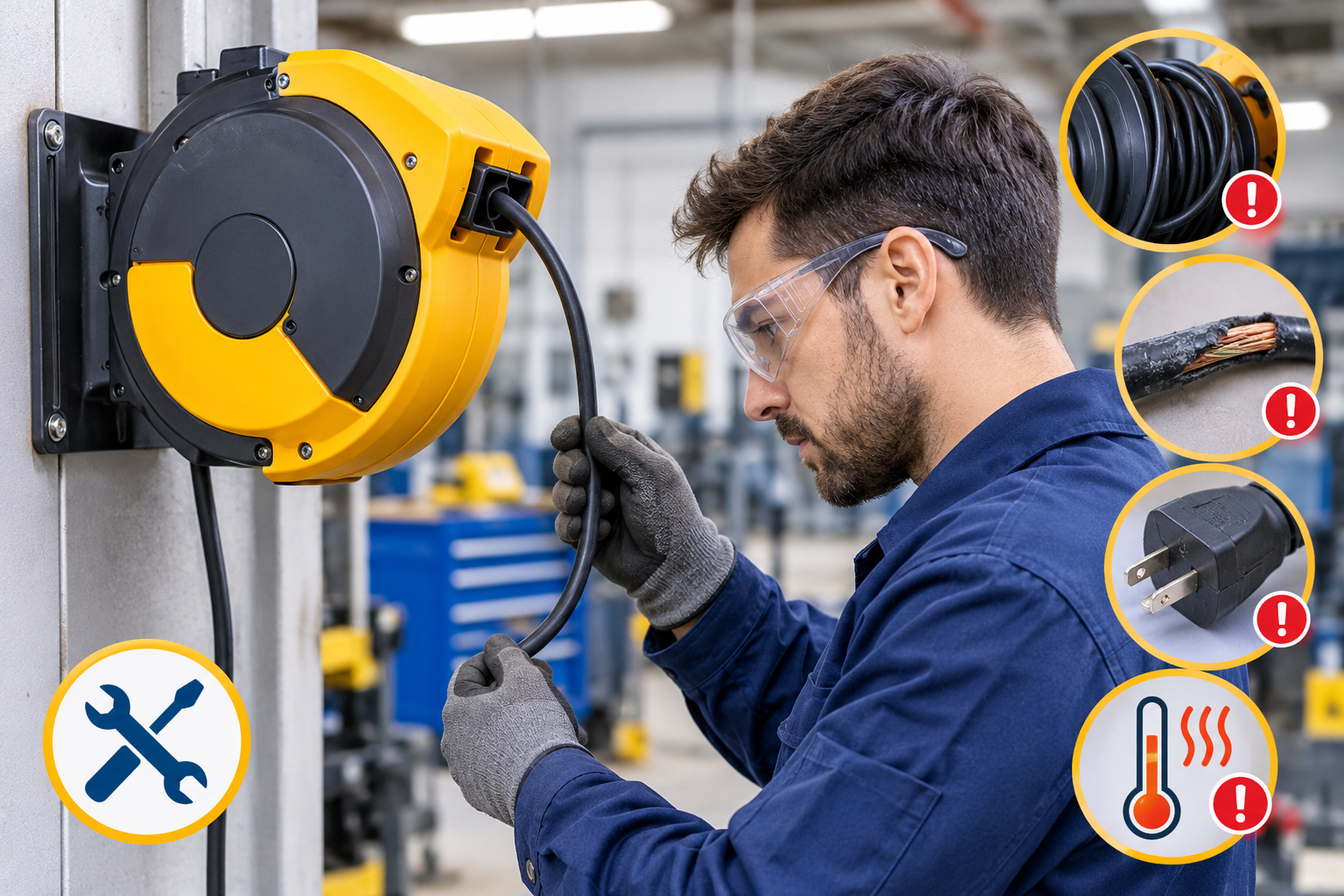
Retractable Cable Reel Cannot Be Recovered Normally
The retractable cable reel should be able to retract the cable smoothly after unlocking. If the cable stays in the extended state all the time, the recovery speed is slow, or the inside of the reel cannot be completely recovered, the problem may be related to the spring mechanism, cable guide device or cable winding state.
Probable Cause
The most common reason is that the performance of recovery spring is weakened or damaged. Spring-driven cable reels rely on stored mechanical energy to pull back cables. Repeated use for a long time, excessive pulling or improper operation may affect the ability of the spring to provide stable recovery force.
Cable entanglement is also a possible cause. If the cables overlap, twist, or get stuck between the drum and the shell, additional resistance may be generated during the recovery process. Dust, sundries or damage in the cable guide area will also affect the normal movement of the cable.
How to Check and Solve Problems
First, disconnect the power supply before checking the cable reel. Check the exposed cables for twisting, knotting or obvious obstacles. If the cable is wound, it should be carefully unwound according to the manufacturer’s instructions and release unnecessary tension.
Next, check the cable outlet and guide area for sundries or damage. Make sure that the cable can move freely without rubbing against sharp edges or getting stuck.
If the cable is still difficult to recover after the above inspection, it may be necessary to carry out professional inspection on the internal spring mechanism. Do not open the spring-loaded housing without proper maintenance procedures, because the spring tension stored inside may cause injury. If the spring is damaged, it should be repaired or replaced according to the manufacturer’s suggestion.
The Cable Reel Locking Mechanism Cannot Work Normally
Many retractable cable reels are equipped with locking mechanisms, which can fix the cable at a selected extension length. This enables the operator to place the cable near the equipment or workbench without having to keep the tension by hand all the time.
When the locking mechanism fails, the cable may be recovered immediately after being pulled out, unable to maintain the required length, or difficult to unlock.
Probable Cause
Failure of the locking mechanism may be caused by abrasion of internal engaging parts, dust accumulation, damage of internal parts or incorrect cable operation. In some spring-driven cable reels, the locking system will only engage when the cable extends to a specific position. Pulling the cable too fast or using the wrong release method may cause the locking mechanism to fail to work normally.
How to Check and Solve Problems
First of all, check the product operating instructions to confirm the correct way to extend and lock the cable. Some models need to pull the cable out a little distance before the locking mechanism can be engaged or unlocked.
Check the external visible shell and cable outlet area to confirm whether there is obvious damage or sundries. If the mechanism feels stuck, do not forcibly pull the cable, because excessive pulling force may damage the locking part or spring assembly.
If the cable reel cannot be locked or accidentally released repeatedly, it should be stopped until the locking mechanism is checked. Worn or damaged internal components may need professional repair or replacement.
Worn, Cracked or Damaged Cables
Cable damage is one of the problems that retractable cable reels need to find in time, because it may cause electric shock, short circuit or fire risk.
After repeated extension and recovery, contact with rough surfaces, excessive bending or exposure to inappropriate environmental conditions, cables may gradually wear out.
Common Signs of Cable Damage
- Cracks or cuts appear in the external insulation layer.
- Flat or deformed areas due to repeated extrusion.
- The internal insulation or conductor is exposed.
- Discoloration or melting signs appear near the cable or plug.
- Worn, cracked or damaged near the plug or at the cable entrance.
Probable Cause
Repeated movement will gradually wear the cable, especially where the cable passes through the guide or enters the reel housing. Sharp edges, excessive pulling and incorrect cable storage methods may increase the degree of wear.
If the bending radius of the cable is less than its allowable range, it may also damage the internal structure. In addition, if the cable material is not suitable for the actual working environment, contact with oil, chemicals, moisture, ultraviolet rays or high temperature may accelerate aging.
How to Deal with This Problem?
Check the whole visible cable regularly, paying special attention to the plug, cable outlet and the frequently operated area.
If the insulation layer is cracked, cut, melted or otherwise damaged, the power supply should be immediately disconnected and stopped. Do not wrap ordinary adhesive tape around the damaged parts and use it as a permanent maintenance method. Cables should be replaced or repaired by qualified personnel according to the requirements and maintenance procedures approved by the manufacturer.
Choosing cables with proper insulation performance, flexibility and environmental tolerance according to practical application is also helpful to reduce premature wear.
Unstable Electrical Connection
Unstable electrical connection means that the power supply is still interrupted intermittently when the power supply and connected equipment seem to be normal. This kind of problem may cause the equipment to stop unexpectedly, restart or run unsteadily.
Probable Cause
Loose plugs, damaged sockets, worn electrical contacts and internal wiring failures are all common causes. In the retractable cable reel, repeated rotation and cable movement may also affect the electrical connection over time.
Some models use slip ring components to maintain electrical continuity between the rotating reel and the fixed power supply connection. If the slip ring contacts are worn, polluted or damaged, the electrical connection may become unstable.
How to Check and Solve Problems
First, disconnect the power of the reel. Check the plug, socket and accessible cable connection position to confirm whether there are signs of discoloration, cracks, loose parts or overheating.
If the connecting equipment loses power when moving the cable, do not continue to operate the reel, and do not repeatedly adjust the cable position to restore power supply. This may mean that the conductor has been damaged or the internal contact connection is unstable.
Internal wiring and slip ring components should be inspected by qualified technicians. Damaged electrical contacts or connecting parts must be repaired or replaced according to the manufacturer’s technical requirements.
Overheating Occurred During the Operation of the Cable Reel
The cable reel generates too much heat during operation, which may mean that its use exceeds the rated electrical load, or the heat cannot be effectively dissipated.
A particularly important factor is whether the cable is fully unfolded. When the cable is still wound on the drum, the resistance heat generated by the current passing through the cable may accumulate between the multi-layer cables. This will lead to an increase in the temperature of the cable and increase the risk of damage to the insulation.
Other Possible Reasons
- The current of the connected equipment exceeds the rated bearing capacity of the reel.
- The specification of cable conductor is not enough to meet the actual electrical load.
- The cable has been damaged or the electrical connection is poor.
- The environment in which the reel is used is poorly ventilated or the environment temperature is high.
- The connected electrical equipment exceeds the rated capacity of the reel.
How to Prevent Overheating
Before connecting the equipment, be sure to check the rated voltage, current and power capacity of the reel. The actual electrical load must be kept within the range specified by the manufacturer.
According to the manufacturer’s instructions, when connecting high-power equipment, if required, the cable should be fully unfolded. Avoid covering the reel or placing it near the heat source, and ensure that there is enough ventilation space around it.
If the cable, plug, socket or reel shell is abnormally heated, disconnect the power supply and stop using it under the condition of ensuring safety. Discoloration, burning smell or melting insulation may indicate serious electrical damage. Before putting it back into use, professional inspection should be arranged.
How to Maintain Retractable Cable Reel
Regular inspection and correct operation are helpful to reduce mechanical wear, find electrical problems early and keep cables moving smoothly.
Check Cables and Electrical Components
Check cable insulation, plug, socket and accessible connection parts to confirm whether there are cracks, cuts, deformation, discoloration or overheating. Damaged electrical components must be repaired or replaced before the reel is put into use again.
Keep the Cable Guide and Housing Clean
Dust and debris around the cable outlet may increase friction and affect cable recovery. The accessible area shall be cleaned according to the method recommended by the manufacturer. Avoid letting water or cleaning chemicals enter the inside of electrical components.
Check the Recovery and Locking Function
Pull out and recover the cable under controlled conditions, and confirm whether the operation is smooth and whether the locking mechanism can be locked and released normally. Abnormal noise, unstable tension or sudden change in recovery speed may indicate that internal components are worn.
Avoid Excessive Pulling and Incorrect Winding
Do not exceed the recommended cable extension length, and do not pull the cable beyond its designed working range. Avoid twisting, knotting or getting stuck in the recycling process. The mechanism should be allowed to recover the cable at the normal design speed, and it should not be violently stuffed back into the shell.
Follow the Manufacturer’s Inspection Plan
Spring mechanism, slip ring and internal electrical components may need professional inspection. The manufacturer’s maintenance instructions should be followed, and the internal maintenance work should be handled by qualified maintenance personnel.
When Should the Cable Reel Be Replaced?
Not all cable reel failures need to be replaced as a whole. Some problems, such as external dust or slight obstacles in the cable guide area, can be solved by basic maintenance. However, some cases show that there may be potential safety hazards in continuous use, or maintenance is no longer of practical value.
Consider Replacing the Cable Reel When:
- Cracking, deformation or serious damage to the shell, drum or installation structure.
- The internal spring or locking mechanism has failed and cannot be repaired.
- Serious damage to electrical contacts, internal wiring or slip ring components.
- Cable insulation failure occurs repeatedly, or the required replacement parts cannot be obtained.
- After professional maintenance, the cable reel still appears overheating or electrical failure repeatedly.
- The maintenance cost required to restore safe operation has approached or exceeded the cost of purchasing a suitable new reel.
When selecting replacement products, the required cable length, conductor specification, rated voltage and current, recovery mechanism, installation method and working environment should be considered. When selecting a reel, priority should be given to ensuring that it meets the electrical requirements of the connected equipment, rather than just depending on the cable length.
Conclusion
Problems with retractable cable reels may involve recovery springs, locking mechanisms, cable conditions, electrical connections or operating loads. It is very important to accurately identify the source of the problem, because mechanical failure and electrical failure require different inspection and maintenance methods.
Regular inspection, correct operation of cables and use of reels within the rated load range are helpful to reduce premature wear and accidental failures. For cable damage, unstable electrical connection, overheating or internal mechanism failure, stop using it and arrange professional inspection. When the reel can no longer run safely, timely replacement is very important to ensure reliable power supply in industrial and commercial environments.
Related Posts
Power vs. Signal Transmission in Spring Cable Reels
October 21, 2026
Static Discharge Reels for Fuel Transfer: Safety Basics
October 14, 2026