How Do Cable Reels Serve Different Industrial Workstations?
November 17, 2026 | Cable Reels
Introduction
Industrial workstations usually need to use a variety of devices in a relatively limited space. Assembly personnel need to operate power tools, inspection personnel need to use test instruments, and maintenance technicians need to connect various portable electrical equipment. Although these jobs are different, they all have a common demand: to easily obtain stable power supply where needed.
Fixed wall outlets do not always meet the power supply requirements of every operating position. In some factories, the equipment may need to move between different stations, and the working position may change with the production task, and some jobs also need temporary power connection. If the cables are laid on the ground at will or arranged around the machine, it may affect the normal operation and increase the management difficulty of the work area.
Cable reel provides a practical way for cable storage and power supply in industrial workstations. The factory can incorporate the cable reel into the overall layout of the workstation according to the location of the equipment, the activity range of the operator and the daily workflow, instead of treating it as an independent auxiliary accessory. This way helps to establish a more orderly power connection, so that the power supply can be more convenient to access the equipment that needs to be used.
1. Cable Reel Application in Assembly Workstation
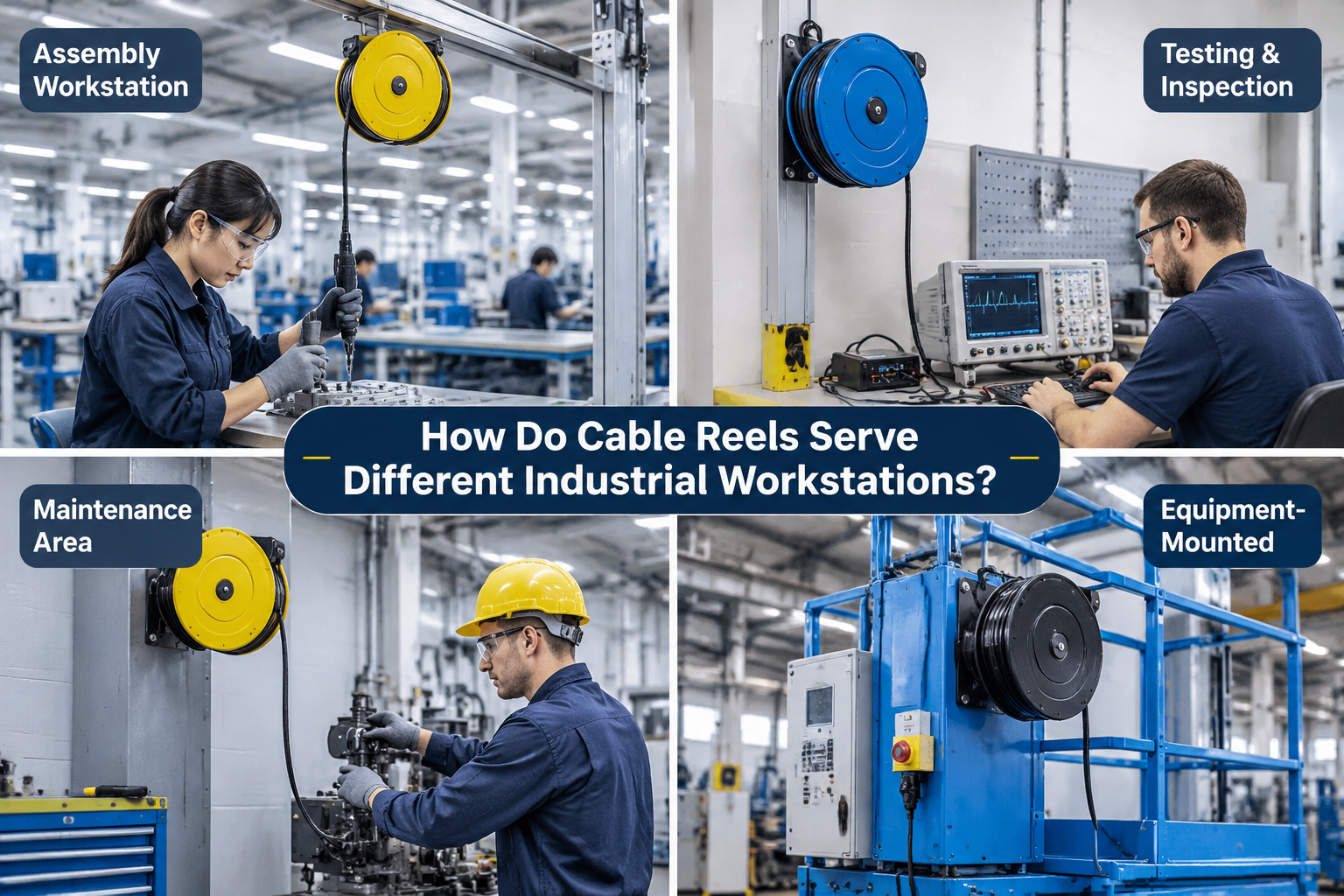
Assembly workstations often use electric screwdrivers, electric drills, test equipment and other electric tools. In the production environment where operators need to perform similar tasks repeatedly throughout the shift, whether they can easily obtain power will directly affect the daily workflow.
The fixed power socket may only meet the power demand of a certain part of the workstation, but it may not be close to every tool or assembly position. Operators may need to use equipment in different positions of the workbench, and may also need to adjust the working area according to the size and position of parts. If the cable layout is unreasonable, the extended power cord will easily accumulate in the work area and even limit the movement of tools.
Cable reels can provide controllable cable connections for the equipment used in these workstations. For example, the reel installed on the top or side of the assembly platform allows the operator to pull out the cable when the equipment is needed and take it back after the task is completed.
2. Cable Reel for Equipment Testing and Inspection
Compared with the general assembly station, the test and detection workstation has different requirements for cable management. These areas may need to use electrical test instruments, diagnostic equipment, measuring devices, computers and other instruments that need temporary or continuous power supply.
During the inspection process, technicians may need to connect the instrument to different parts of the product or move the inspection equipment between multiple locations. The required cable length will vary with the size of the product to be tested and the location of the test point. If the equipment is not in use, the cable will still be fully unfolded, which will take up unnecessary space.
Cable reels can manage these connections by providing clear cable connection paths. When testing equipment needs to be used, the operator can pull the cable to the required position; After the inspection is completed, the excess cable is taken back to the reel, so that the workstation can leave more operation space for the next task.
Some test environments also need to use both power lines and signal lines or communication lines. For example, an automated inspection station may not only need to provide power for devices, but also need to transmit control signals or inspection data between connected devices. In this case, the cable reel must match the actual transmission requirements.
3. Cable Reels in Industrial Maintenance Area
Industrial maintenance areas usually need to handle more types of tasks than dedicated production stations. Technicians may need to inspect machines, replace parts, troubleshoot electrical systems, operate portable power tools, or perform regular maintenance. The equipment and working location used in different tasks may be quite different.
Therefore, the maintenance area needs flexible power supply access. Technicians may use a portable electric drill next to one machine, connect diagnostic instruments next to another device, and may also need to use temporary lighting equipment in areas with poor light. If the maintenance area only depends on fixed sockets, these tasks may become inconvenient in the workshop where maintenance equipment is widely distributed.
Cable reels can provide convenient cable connections at designated maintenance locations to support these operations. For example, the reel installed near the maintenance workbench can supply power to the tools used for parts maintenance. In a large maintenance area, multiple reels can be distributed in different working areas, avoiding the need for technicians to pull a long extended power cord from a remote socket.
Temporary lighting is also a possible application. When the machine or parts need to be inspected in a place with insufficient light, a suitable cable reel can provide power connection for compatible portable lighting equipment. It should be noted that the reel itself is not necessarily equipped with working lights, and the connected lighting equipment and reel must meet the actual use environment and electrical requirements.
By arranging the reels near the equipment that often needs maintenance and planning the cable path in advance, the maintenance team can manage the power connection more conveniently. For large factories, maintenance areas with high daily use frequency can be identified, and appropriate cable access points can be set in each area.
4. Layout Planning of Cable Reels Around Industrial Workstations
The installation position of cable reel should be determined according to the layout of workstation and the use of electrical equipment in daily work. Different installation methods are suitable for different needs. Some reels can provide power for the work area from above, while others are more suitable for fixed worktable or mechanical equipment that needs to change its position during operation.
4.1 Overhead Installation
Overhead installation is usually suitable for workstations where operators need to use power tools at different positions on the workbench or production area. Installing the reel above the operation area can make the cable extend downward, and provide power without occupying valuable workbench or floor space.
This installation method is especially suitable for assembly lines, maintenance workshops and inspection workstations, because these areas often need to connect and disconnect various power tools. For example, the cable reel installed above the assembly platform can provide power for multiple operating positions nearby according to the length and extension range of the cable.
When planning, it is important to consider how much coverage a reel can cover. In a long production area, instead of relying on one reel to connect all positions, it is better to install multiple top reels according to the actual situation. The position of the reel should correspond to the actual use point of the tool and the layout of the production line.
4.2 Wall-Mounted Installation
Wall-mounted cable reels are suitable for workstations arranged along workshop walls or work areas around fixed equipment. It can rely on the existing wall structure to set a fixed power access point, while reducing the occupation of other space by the reel.
This installation method is suitable for maintenance workbench, equipment inspection area and workshop maintenance workshop. For example, the reel installed next to the maintenance workbench can provide power for electric drills, test instruments and other portable tools used in this area.
For a workshop with multiple workstations arranged along the same wall, the reel position can be arranged as a whole according to the distance between workstations and the power demand. Managers do not necessarily need to install a reel next to each workbench, but can judge whether a reel can meet the power demand of adjacent workstations within its effective working range. This can not only reduce unnecessary equipment installation, but also ensure the convenience of power use.
4.3 Equipment-Mounted Installation
Some industrial applications need to extend and retract cables synchronously when mechanical equipment or mobile equipment changes position. In this case, the cable reel can be installed directly on the equipment or on the supporting structure matched with the equipment.
Common applications include mobile working platforms, mobile mechanical equipment and equipment running along fixed tracks. As the equipment moves, the reel can manage the required cable length according to the position change of the equipment, thus maintaining the electrical connection between the equipment and the fixed power supply or control system.
Different from the reels used in fixed workstations, the equipment-mounted reels need to be matched according to the motion characteristics of mechanical equipment. The equipment moving distance, running speed, cable tension, winding capacity and moving frequency will all affect the reel configuration.
For applications that require continuous movement, cables and reels must also be able to meet the working requirements of repeated retraction. The selected system should be able to cover the complete operating range of the equipment, while avoiding excessive tension on cables or electrical connections.
5. Summary
Cable reels play an important role in the electrical connection management of industrial workstations. Their purpose is not only to store redundant cables, but also to provide power for power tools on the assembly table, to provide convenient connection for test equipment, and to help maintenance teams obtain power at different maintenance locations.
Whether the cable reel can play a role depends on whether it is reasonably integrated into the actual working environment. When determining the reel installation position, it is necessary to comprehensively consider the workstation type, equipment movement, personnel operation requirements, cable routing path and other media connections.
For factories that use a variety of industrial equipment, cable reels can also be used in conjunction with air hose reels, hydraulic hose reels and water hose reels to form a more orderly media supply layout. By planning these connections according to the actual workflow, manufacturing enterprises can make workstations easier to operate and maintain, and can flexibly adjust with the changes of production requirements.
Related Posts
Power vs. Signal Transmission in Spring Cable Reels
October 21, 2026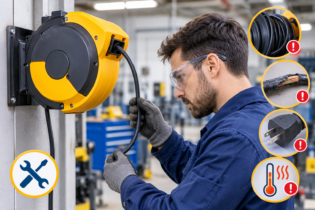
Retractable Cable Reel: Problems & Solutions
November 2, 2026