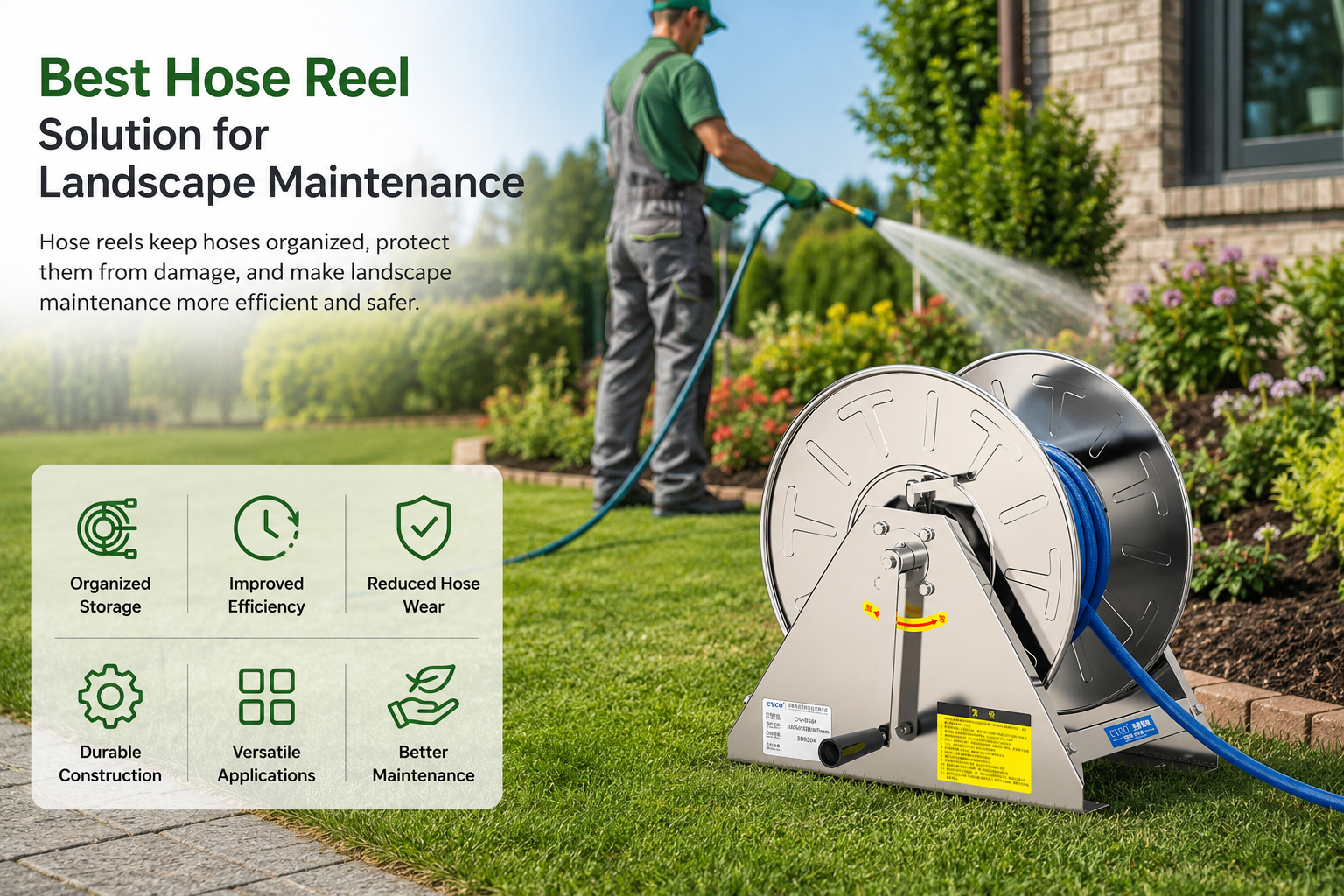
Best Hose Reel Solution for Landscape Maintenance
August 25, 2026 | Industrial Hose Reels
1. Introduction
Landscape maintenance is more than just mowing lawns and trimming hedges. Landscaping contractors often use hoses to water, spray lawns, fertilize, control pests and disease, pressure wash, clean equipment and for other outdoor maintenance jobs. Many of these tasks require hoses to extend over large distances and be repeatedly paid out, retracted and stored.
If not for an efficient hose management, even a few meters of long hose can get entangled, knotted, dragged on rough ground or rub against a highly abrasive surface.These problems not only reduce daily work efficiency but can also increase the risk of hose damage and tripping accidents on site. Hose reels help keep hoses neatly stored while making hose deployment and retraction faster.
There is no single type of hose reel suitable for all situations in landscape maintenance. The right choice depends on the specific application, hose size, working environment, and frequency of use. Small spring-driven hose reels may be suitable for daily watering, while heavy-duty or motorized hose reels may be needed for long hoses, pressure cleaning, or commercial garden maintenance.
2. Common Applications of Hose Reels in Landscape Maintenance
2.1 Lawn and Landscape Irrigation
Watering is one of the most common applications of hoses in landscape maintenance. Workers may need to water lawns, planting areas, trees, sports fields, and other green areas.
For these applications, hose length and water flow rate are key considerations. The hose reel should have sufficient capacity to accommodate the required hose length while preventing the hose from becoming overly tight or unevenly wound on the reel. The hose and reel also need to be compatible with the operating pressure and flow rate requirements of the irrigation system.
For larger green areas, mobile hose reel systems offer greater flexibility, allowing staff to move water supply equipment between different areas without relying entirely on fixed connections. Hose reel irrigation systems can also be used in landscaped areas and sports fields requiring portable irrigation coverage.
2.2 Lawn Spraying and Fertilization
Landscape contractors spray fertilizers, herbicides, and other lawn chemicals with hoses. Since these types of products are delivered through the hoses, there are even greater considerations given to the hose reels.
Therefore, when selecting a spray hose reel, the entire system should be considered, not just the reel capacity. The hose, swivel joint, connectors, and seals should all be compatible with the chemical medium being used.
For equipment mounted on trucks or trailers, compact hose reels can also help workers make more efficient use of limited vehicle space while keeping spray hoses neatly stored between operations.
2.3 Pest and disease control
Pest and disease control in gardens may require repeated spraying in lawns, gardens, commercial properties, and other landscaped areas. These operations typically require long hoses so that workers can cover the treated area without having to frequently move service vehicles.
A suitable hose reel should allow for smooth hose deployment and retraction, reducing manual handling. If pesticides or other chemicals are involved, chemical compatibility must be considered when selecting hose, seal, swivel joint, and reel materials.
2.4 High-pressure cleaning and equipment cleaning
The landscape maintenance crew utilizes hosing for cleaning off lawnmowers, servicing vehicles, walkways, outside fixtures and other items. High-pressure cleaning requires extreme variations in the hose reels versus normal watering.
The reel must be matched to the hose’s operating pressure and temperature, while ensuring that the fittings and connections are suitable for high-pressure cleaning systems. Heavy-duty or motorized hose reels are particularly useful when the hose is long, stiff, or requires frequent unwinding.
3. Best type of hose reel for landscape maintenance
The choice of landscape maintenance hose reel depends on hose size, length, working pressure, installation location, and frequency of use.
3.1 Spring-driven hose reel
Spring-driven hose reels are a practical option when workers need to frequently unwind and rewind hoses. The spring mechanism automatically retracts the hose after use, reducing the time and effort required for manual handling and rewinding.
It is particularly suitable for service vehicles, watering operations, light to medium-sized spraying, and other jobs that require quick access to the hose.
Its main advantage lies in improving work efficiency: workers can pull out the hose of the required length, and after completing the work, the reel can retract the hose.
3.2 Manual hose reel
Manual hose reels are suitable for scenarios where hoses are used less frequently, or where a simple operation method is preferred.
It can be used for portable garden equipment, minor maintenance work, and applications where the hose is lightweight. Because the winding process is operator-controlled, the manual reel is also suitable for situations requiring precise control over the hose’s arrangement on the reel.
However, for operations that use hoses frequently every day or involve long, heavy hoses, spring-driven or electric hose reels are more helpful in reducing the workload of operators.
3.3 Electric Hose Reel
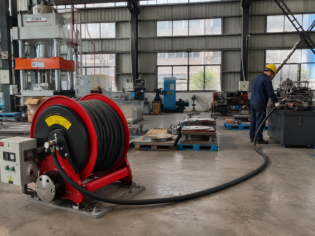
Electric hose reels retract hoses using a motor, making them suitable for situations where the hoses are long, heavy, or require frequent daily operation.
For commercial garden maintenance service vehicles, electric reels can reduce manual reeling time and improve daily work efficiency. When selecting an electric reel, the available power supply, hose weight, reel capacity, and installation space should be considered.
Electric retractors are particularly advantageous when a significant amount of manual effort is required to retract the hose after each use.
3.4 Heavy-duty hose reels
Heavy-duty hose reels are suitable for high-frequency use, large-gauge hoses, and applications that require frequent field operations.
It is typically suitable for commercial garden maintenance, municipal greening maintenance, high-pressure cleaning, and other scenarios where the hose needs to be extended and retracted multiple times a day.
When selecting heavy-duty reels, one should not only focus on the frame structure. The drive system, reel capacity, rotary joints, hose compatibility, and installation method all need to be matched to the actual application.
3.5 Stainless Steel Flexible Hose Reel
Stainless steel hose reels are suitable for humid or corrosive environments. Landscape maintenance equipment is frequently exposed to water, fertilizers, cleaning solutions, soil, and outdoor weather conditions.
The main advantage of stainless steel is its corrosion resistance, but the choice of material should still be determined based on the actual working environment and the medium being transported. In chemical media applications, the compatibility of seals, fittings, and the hoses themselves is equally important.
4. How to choose the right hose reel for landscape maintenance
4.1 Hose Length and Diameter
When selecting a hose reel, the actual usage requirements of the hose should be determined first. It is necessary to consider how far the operator will be from the reel during operation, and to select a hose length that can cover the working area, while avoiding the use of excessively long hoses that will be left idle for extended periods.
Hose diameter also affects reel capacity and overall system performance. Larger diameter hoses can typically deliver more water or media, but they also take up more reel space and may increase overall weight.
Therefore, the specifications of the reel should match the size and length of the selected hose.
4.2 Work pressure
The hose reel must be matched to the system’s operating pressure. This is especially important for high-pressure cleaning, spraying, and other applications with high operating pressures.
The reel should not be selected solely based on the maximum pressure specified on the hose. The reel, rotary joint, couplings, and other components must all be suitable for the actual working conditions.
For irrigation systems, both pressure and flow rate need to be considered, as both affect whether water can be effectively delivered to the target area.
4.3 Compatibility of hoses and conveyed media
Water, fertilizer solutions, pesticides, cleaning agents, and other media may have different compatibility requirements.
Before purchasing hose reels, ensure that the hose and all components that come into contact with the media are suitable for the target media. This includes the inner hose, outer hose, seals, swivel joints, and fittings.
For chemical spraying applications, simply selecting corrosion-resistant reels is insufficient. The entire media flow path needs to be evaluated.
4.4 Installation Location
The installation location directly affects the choice of hose reel.
Common installation methods include:
- Service trucks
- trailer
- garage or workshop walls
- Portable stroller
- Fixed maintenance equipment
For garden maintenance teams that need to move between multiple properties, hose reels mounted on trucks or trailers are highly practical. They secure and protect the hose during transport and can be quickly deployed upon arrival at the work site. Truck, trailer, trolley, and portable hose reel configurations are also frequently used for garden maintenance operations in industry applications.
At the same time, sufficient space should be left at the installation location to allow the hose to be extended and retracted, and to avoid excessive friction or bending of the hose with sharp edges or surrounding equipment.
4.5 Rewinding Method
The method of winding up should be matched with the actual workload.
For hoses used only occasionally, a manual reel is usually sufficient. For applications requiring frequent unwinding and rewinding, a spring-driven hose reel can increase winding speed. For longer or heavier hoses, an electric reel can reduce manual operation.
At the same time, the available power supply and the installation space on the vehicle or equipment also need to be considered.
5. Hose reel solutions for various landscape maintenance applications
Different landscape maintenance tasks require different reel configurations. Instead of selecting reels based solely on general parameters, it’s better to match them to the specific work requirements.
5.1 Irrigation hose reels
For routine lawn and landscape watering, a hose reel with appropriate capacity and easy deployment is often a practical choice.
Spring-driven hose reels offer a convenient operating experience when hoses require frequent daily use. For larger areas or specialized irrigation systems, portable or motorized hose reels may be considered.
Key factors include hose length, water flow rate, pressure, movement method, and reel capacity.
5.2 Lawn Sprayer Hose Reel
Lawn spraying requires special attention to the compatibility of the hoses with the medium being sprayed. The reel should provide sufficient hose length to cover the area to be treated, while keeping the hoses neatly stored when not in use.
For service vehicles, compact spring-driven or electric hose reels can help workers move more efficiently between different properties. If fertilizers, herbicides, or pesticides are used, the chemical compatibility of the materials should be confirmed before determining the reel configuration.
5.3 High-pressure cleaning hose reel
High-pressure cleaning requires the reel to be matched with the cleaning system in terms of pressure, temperature, hose diameter, and hose length.
For scenarios involving frequent commercial cleaning, heavy-duty or motorized hose reels can reduce manual labor and help keep long, high-pressure hoses neatly stored. At the same time, the reel’s position should be appropriately positioned to prevent excessive bending or wear during hose unwinding.
5.4 Service Truck Hose Reels
For mobile garden maintenance teams, hose reels mounted on vehicles can improve both work efficiency and equipment storage.
Properly installed hose reels allow workers to unroll only the required hose length and quickly retract them after work. This reduces hose tangling around the vehicle and helps keep the work area tidy.
For maintenance teams that need to visit multiple properties every day, the time saved in the preparation and closing of tasks can gradually translate into a significant improvement in operational efficiency.
5.5 Hose reels for commercial landscape maintenance
Large commercial properties, municipal areas, parks, and professional landscaping contractors typically require more durable hose management solutions because the equipment is used frequently and needs to operate continuously in different locations.
Heavy-duty, spring-driven, electric, or other power-driven hose reels can be selected based on hose size, application type, and daily workload. For outdoor or humid environments, the corrosion resistance of the reel should also be considered.
The most effective solution is not necessarily the largest reel, but rather a reel that can match the hose, application, installation method, and working environment, while making daily hose handling easier.
Conclusion
Choosing the best hose reel for landscape maintenance begins with understanding how the hose will actually be used. Irrigation, lawn spraying, pest control, pressure cleaning, and mobile service operations all have different requirements for hose management equipment.
For frequent daily use, spring-driven hose reels offer rapid unwinding and automatic winding; manual reels are suitable for simpler applications; and for longer or heavier hoses, electric and heavy-duty hose reels reduce manual operation. Stainless steel construction may also be a more suitable choice when the working environment poses a risk of corrosion.
Ultimately, a comprehensive evaluation should be conducted on hose length, diameter, operating pressure, media compatibility, installation location, and reeling method. Properly matched hose reels help landscape maintenance teams keep hoses organized, reduce unnecessary manual labor, and improve efficiency across different maintenance tasks.
Related Posts
How to Choose the Right Hose Reel Cart with Wheels
June 29, 2026
How to Choose a Large Capacity Hose Reel for Heavy-Duty…
July 13, 2026