Why Spring Fatigue Happens in Retractable Hose Reels

June 10, 2026 | Industrial Hose Reels, Spring-Driven Hose Reel

1. Introduction: Understanding Spring Fatigue

Spring-driven hose reels are widely used in workshops, factories, and maintenance environments because they provide fast, automatic hose retraction and help keep workspaces clean and organized. In many industrial settings, an industrial hose reel is an essential part of daily fluid and air management systems. At the core of every system is a flat coil spring that stores mechanical energy during hose extension and releases it during retraction.

Over time, the performance of a retractable hose reel can gradually decline. This is known as spring fatigue, a condition where repeated mechanical stress reduces the spring’s ability to maintain consistent elastic force.

Learn more about the system in our article: What is a Spring-Driven Hose Reel?

2. How the Spring Mechanism Works

In a spring-driven hose reel, the hose is attached to a rotating drum connected to a pre-tensioned coil spring. When the hose is pulled out, the spring tightens and stores energy. When released, the stored energy drives the drum in reverse, automatically retracting the hose.

This cycle repeats continuously in industrial use. Each working cycle of a retractable hose reel introduces mechanical stress to the spring. Although the spring is designed for thousands of cycles, it cannot maintain perfect performance indefinitely.

3. Why Spring Fatigue Happens

Spring fatigue is rarely caused by a single factor. It usually results from a combination of mechanical load, operating conditions, and environmental influence.

3.1 High-Cycle Operation

In busy industrial environments, a spring-driven hose reel may be used dozens or even hundreds of times per day. Each extension and retraction cycle places stress on the spring material. Over time, these repeated loads gradually alter the internal structure of the metal and reduce elasticity.

3.2 Excessive Tension or Incorrect Calibration

If a retractable hose reel is over-tensioned during installation or maintenance, the spring operates under higher stress than intended. Similarly, using a hose that is too long or too heavy for the reel rating forces the spring to work beyond its optimal range.

3.3 Material Fatigue from Repeated Stress

Metal fatigue is a natural physical process. Even high-grade steel used in a spring-driven hose reel develops microscopic structural changes under repeated loading and unloading cycles. These micro-cracks are not visible at first but gradually reduce the spring’s energy storage efficiency.

3.4 Environmental Conditions

Most retractable hose reels are used in demanding workshop environments. High humidity can lead to corrosion, weakening the spring surface structure. Extreme temperatures also affect performance—heat may reduce hardness, while cold conditions reduce flexibility.

3.5 Lack of Maintenance

Although many users assume a spring-driven hose reel is maintenance-free, internal components still require periodic attention. Dust, oil residue, and debris can accumulate inside the housing, increasing friction and adding extra load on the spring.

4. Impact on Industrial Applications

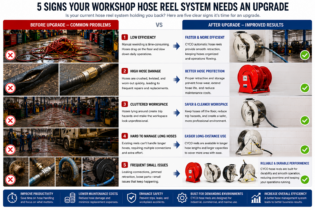
When spring fatigue develops in a retractable hose reel, the impact goes beyond the equipment itself.

Work efficiency decreases as the hose may not retract smoothly, requiring manual assistance. In high-frequency environments, this slows down operations and increases operator effort.

There are also safety concerns. A weakened retraction system can leave hoses lying loosely on the floor, increasing tripping hazards and interfering with equipment operation.

5. How to Prevent Spring Fatigue

Preventing spring fatigue in a spring-driven hose reel depends more on proper selection and usage than on repair.

5.1 Proper Load Matching

Selecting the correct reel size is essential. Hose length, diameter, and working pressure should match the specifications of the retractable hose reel to ensure the spring operates within its designed load range.

5.2 Controlled Usage

Avoid overextending the hose beyond its designed limit. Excessive extension increases stress on the spring and shortens service life. Smooth and controlled operation also helps reduce shock loads.

5.3 Regular Inspection and Maintenance

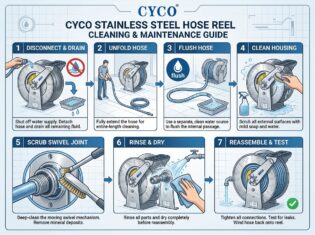
Routine cleaning and lubrication help maintain stable performance. Keeping the internal components of a spring-driven hose reel free from dust and debris reduces friction and mechanical stress.

5.4 Environmental Protection

In humid or corrosive environments, choosing a retractable hose reel with protective coatings or stainless-steel housing can significantly extend service life. In temperature-sensitive applications, heat- and cold-resistant materials are recommended.

6. When Replacement Becomes Necessary

Even with proper maintenance, every spring has a finite lifespan. When retraction force becomes consistently weak and cannot be restored through maintenance, replacement is usually more cost-effective than repair.

In industrial use, replacing the spring or the entire retractable hose reel system is often necessary when performance issues begin to affect productivity or safety.

7. Conclusion

Spring fatigue in a spring-driven hose reel is the result of long-term mechanical stress combined with environmental and operational factors. While it cannot be completely avoided, it can be significantly delayed through proper selection, controlled usage, and regular maintenance.

A well-designed retractable hose reel system remains one of the most reliable and efficient solutions for hose management in industrial workshop environments.