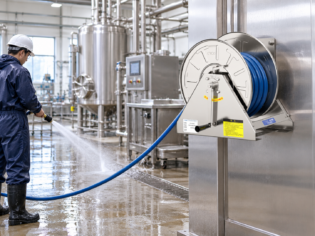
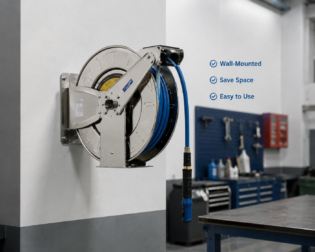
Wall-Mounted vs. Portable Hose Reel: TCO Comparison
October 12, 2026 | Industrial Hose Reels
Choosing between a wall-mounted hose reel and a portable hose reel involves more than comparing purchase prices. Installation, maintenance, hose replacement, labor, and downtime can all affect the total cost of ownership (TCO). For businesses evaluating industrial hose reels, understanding these long-term costs helps identify the most suitable option for their workspace and operating requirements.
For farms, property maintenance teams, industrial facilities, and cleaning workplaces, which hose reel offers a greater cost advantage depends on the hose’s location of use, moving frequency, and actual working environment. Understanding these factors helps purchasing personnel evaluate long-term expenditures rather than focusing only on the upfront investment.
Wall-Mounted Hose Reel vs. Portable Hose Reel: Key Differences
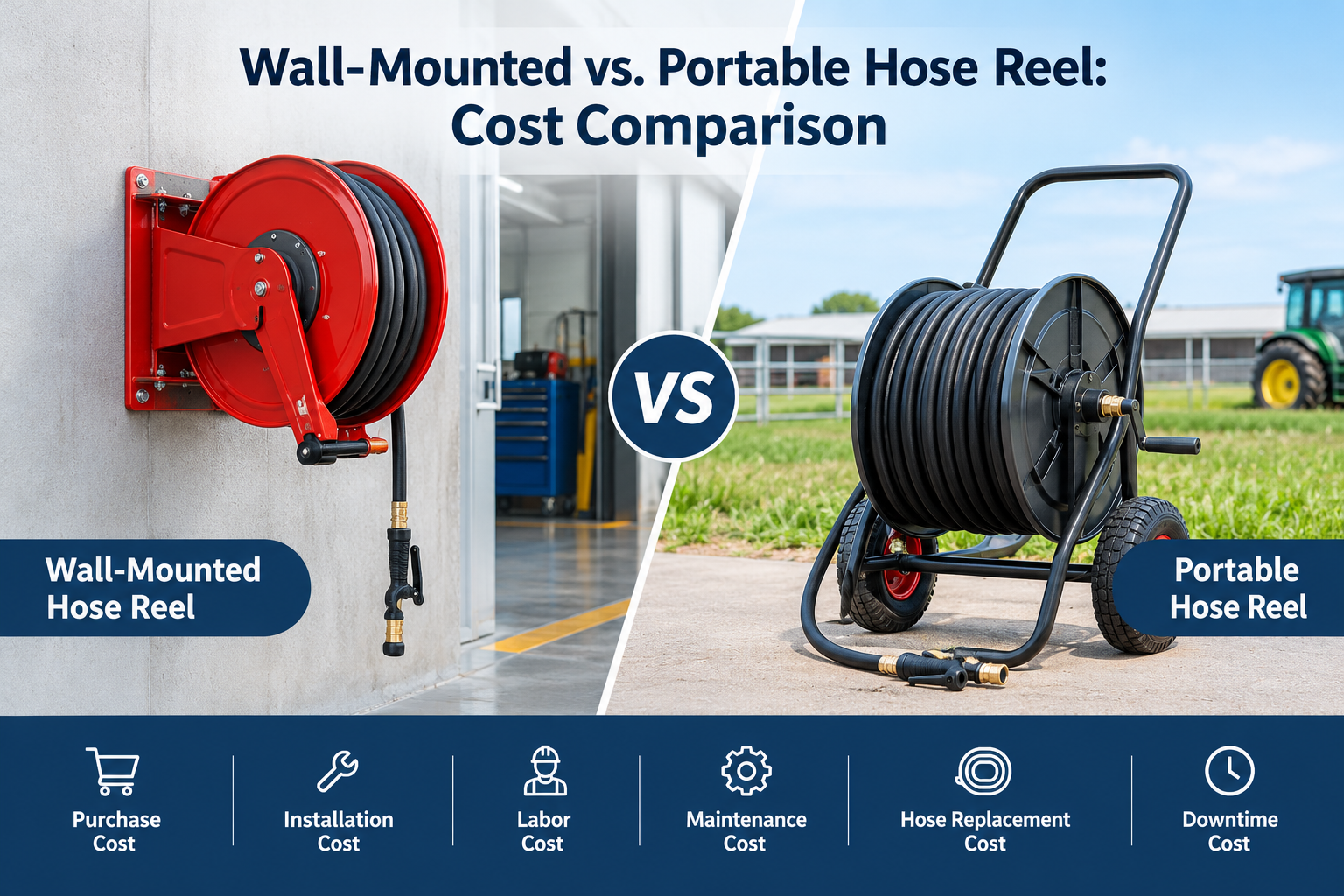
A wall-mounted hose reel is fixed to a wall, column, or other suitable supporting structure. It can store hoses in designated locations and provide fixed points for hose deployment and retraction. This configuration is common in maintenance workshops, equipment cleaning stations, production facilities, and other places where tasks are repeatedly performed within a defined work area.
Portable hose reels can be moved between different locations according to work requirements. Depending on the specific structure, they may be equipped with wheels, handles, carrying frames, or compact bases. When the same hose needs to serve multiple areas, such as different working areas on farms, large outdoor properties, or maintenance sites without suitable installation locations, portable hose reels can be more practical.
The main difference between the two is how they fit into the workflow. Wall-mounted hose reels provide a fixed hose access point, while portable hose reels allow workers to adjust the equipment’s position according to work progress. This difference also creates different cost patterns over the service life of each hose reel.
1. Initial Procurement and Installation Costs
The purchase price is the most visible expense, but it does not directly determine which hose reel offers better long-term value.
Wall-mounted hose reels may require mounting brackets, suitable fasteners, reliable supporting structures, and installation labor. These costs may be relatively low if suitable installation locations are already available on site. However, if hose reels need to be installed in multiple work areas, the total investment may increase, especially if each location requires separate installation accessories or construction work.
Portable hose reels usually do not need permanent installation, making them suitable for temporary work or locations where the layout changes frequently. However, moving components such as wheels, frames, handles, and reinforced support structures also affect the purchase price. Buyers need to consider where the equipment will be stored when not in use.
Which option is more suitable depends on site conditions. For a fixed cleaning station, the installation cost of a wall-mounted hose reel may be justified through long-term repeated use. For farms with multiple scattered work areas, portable hose reels may reduce the need to install equipment separately in each area.
2. Maintenance and Component Replacement Costs
Maintenance costs depend on the hose reel’s structure, working environment, frequency of use, and exposure to environmental factors. Neither installation method eliminates the need for maintenance.
The position of a wall-mounted hose reel is relatively fixed, but its mounting brackets and fasteners still need regular inspection. Vibration, repeated pulling, an unsuitable mounting surface, or overloading may affect the stability of the installation. The hose reel’s rotating components, swivel joints, retraction mechanism, and hose also need to be inspected according to the manufacturer’s instructions.
Portable hose reels experience additional wear associated with movement. When repeatedly moved across uneven ground, thresholds, or other obstacles, their wheels, axles, handles, and frames may become worn or damaged. Outdoor use may also increase the equipment’s exposure to dirt, moisture, dust, and corrosive substances.
These differences should be considered when developing a maintenance plan. For example, a portable hose reel used on smooth indoor floors may not experience significant additional wear, while one frequently moved across rough farm terrain may require more frequent inspections. Similarly, a wall-mounted hose reel installed in a corrosive environment may require more maintenance than one used in a clean indoor workshop.
When comparing long-term costs, consider the expected inspection frequency, spare parts expenses, maintenance labor, and the time required to repair equipment when it is out of service.
3. Hose Wear and Replacement Costs
Hose replacement can become a significant operating expense, especially when the hose is long, expensive, or frequently used. The hose reel’s position and the hose’s movement path within the work area affect how quickly the hose wears.
A wall-mounted hose reel provides a fixed outlet position for the hose. If installed at an appropriate height and orientation, it can help keep the hose organized and reduce unnecessary contact with the ground. However, if the work area extends beyond the hose reel’s actual coverage, the hose may need to pass around corners, drag across rough surfaces, or be pulled into unsuitable positions. These conditions can lead to abrasion, kinking, or premature damage.
A portable hose reel can be repositioned according to the work location, potentially shortening the distance the hose needs to extend across the ground. This can be useful for outdoor cleaning and agricultural operations. However, mobility does not completely eliminate hose wear. During use, the hose may still rub against equipment, contact sharp edges, or be dragged across rough ground when the hose reel is moved or repositioned.
When evaluating hose replacement costs, consider the hose material, length, inner diameter, working pressure, exposure to chemicals or weather, and the hose’s movement path during actual operation. Regardless of the reel type, proper hose routing, adherence to the appropriate bend radius, and regular inspections are important.
Generally, the more economical configuration is one that suits the actual work area and allows the hose to be deployed and retracted without unnecessary friction, twisting, or pulling.
4. Labor Costs and Daily Operating Time
The time workers spend positioning, using, and storing hose reels also affects their life cycle costs. Even a small daily time difference can accumulate into significant expenses when the equipment is used frequently throughout the year.
When workers repeatedly perform tasks near the same station, a wall-mounted hose reel can be more convenient. The reel remains fixed in place, eliminating the need to move equipment between different tasks. This helps simplify daily cleaning, equipment maintenance, and other repetitive operations. However, if workers frequently need to return to the reel or move equipment to cover other areas, fixed installation may increase operating time.
A portable hose reel is suitable for work spread across a large area or across different locations. Workers can move the hose reel closer to the work point, potentially reducing hose handling and unnecessary trips. This advantage depends on the moving distance, ground conditions, reel weight, and how easily the equipment can be pushed when loaded with a hose.
For example, a property maintenance team responsible for cleaning multiple separated outdoor areas may benefit from a portable hose reel. In contrast, a workshop that cleans equipment at designated stations may find a wall-mounted hose reel easier to use for daily operations.
When comparing costs, estimate the time required for preparation, relocation, hose deployment, hose retraction, and equipment storage during each operation. Then use the expected frequency of use and the applicable labor rate to calculate the potential financial impact of these time differences.
5. Storage Space and Operational Downtime Costs
Space requirements also affect long-term costs. A wall-mounted hose reel uses vertical space, such as walls, and keeps the equipment in a designated position. This helps free up floor space and reduces the need to move the equipment when it is not in use. However, the installation location must provide enough clearance for hose movement, equipment maintenance, and safe operation.
Portable hose reels require suitable parking or storage areas. After each operation, the hose reel may need to be moved to a designated location to keep pathways clear, protect the equipment, or prevent unauthorized use. In busy facilities, poor storage arrangements can create obstacles and increase handling time. Outdoor operations may also require protected storage to reduce exposure to weather and contaminants.
Downtime costs should be assessed in a similar way. If a wall-mounted hose reel is damaged or its mounting structure needs repair, the relevant work area may be affected while the problem is addressed. If the wheels, frame, or retraction components of a portable hose reel fail, the equipment may become difficult to move or unusable until repairs are completed. The actual impact depends on whether a spare hose reel is available on site and how essential the equipment is to the operation.
If downtime affects production or service delivery, buyers should consider not only repair expenses but also the potential financial losses caused by work delays.
6. How to Calculate the TCO of a Hose Reel
An effective total cost of ownership (TCO) comparison should include major expenses over the same evaluation period, such as three or five years. Comparing only the purchase price of one hose reel with the installed price of another does not fully reflect the actual cost.
A simple formula is:
Total Cost of Ownership = Purchase Cost + Installation Cost + Labor Cost + Maintenance Cost + Hose and Component Replacement Cost + Quantifiable Downtime Cost
For a wall-mounted hose reel, the calculation should include mounting accessories and installation labor, along with estimated expenses for ongoing maintenance, hose replacement, and potential time losses when the fixed location does not suit the actual workflow.
For a portable hose reel, the calculation should include the purchase price, maintenance costs for mobility-related components, storage requirements, labor time required to move the equipment, and the replacement costs of hoses or other components. If the portable configuration reduces travel time between different work areas, the resulting labor savings can also be included.
Both options should use the same calculation assumptions, including working days per year, operating hours, labor rates, expected service life, and component replacement cycles. One-time expenses should be distinguished from recurring expenses to avoid double-counting.
If reliable cost data is unavailable, use reasonable estimates and clearly identify them as assumptions. Comparing quotations from different hose reel manufacturers alongside actual maintenance records and labor observations can help buyers develop a more realistic estimate of total cost of ownership.
7. Wall-Mounted vs. Portable Hose Reel: Which One Offers Better Long-Term Value?
Which hose reel is more economical depends on how the hose is used and where the work takes place.
For fixed workstations, production areas, equipment cleaning stations, and maintenance workshops where hoses are frequently used within a predictable coverage area, a wall-mounted hose reel is often a practical choice. Its main economic advantages may include convenient access, reduced equipment handling, and more effective use of floor space.
Portable hose reels may offer better value for farms, property maintenance, outdoor cleaning, and locations where work takes place across multiple areas. Their mobility can reduce the need to install fixed hose access points in multiple locations and help workers position hoses closer to the work area. However, these advantages need to be balanced against equipment movement, storage, and maintenance costs.
Neither hose reel type guarantees lower maintenance or hose replacement costs. A wall-mounted hose reel installed in an unsuitable position may increase hose wear, while a portable hose reel used on rough ground may experience faster component wear. Regardless of the type selected, appropriate equipment specifications, correct installation or positioning, and regular maintenance remain important.
Before making a decision, evaluate the work area, hose coverage, movement frequency, installation conditions, expected maintenance, and labor requirements. When comparing different industrial hose reels, buyers should consider how each configuration fits the actual workflow and affects long-term operating costs.
Conclusion
When comparing a wall-mounted hose reel with a portable hose reel, the initial purchase price is only one factor to consider. Installation, labor, component wear, hose replacement, storage, and downtime all affect total life cycle costs.
Wall-mounted hose reels are generally more suitable for tasks performed repeatedly in a fixed location, while portable hose reels are better suited to operations that need to cover multiple areas. By estimating these costs over a consistent evaluation period and selecting the appropriate hose reel configuration for the actual working environment, buyers can assess long-term value more accurately rather than making decisions based on price alone.
Related Posts
High Pressure Hose Reel vs Low Pressure Hose Reel: The…
June 18, 2026
Chemical Hose Reels: Safety & Material Guide
July 20, 2026