What Is a Side-Mounted Hose Reel? Benefits & Uses
October 28, 2026 | Industrial Hose Reels
Introduction
In industrial facilities, maintenance workshops and mobile equipment systems, the installation position of hose reel will affect the convenience of hose access, the moving path during use and the space occupied by equipment. When the floor space is limited, or the hose needs to be arranged along the side of the machine or vehicle, the side-mounted hose reel can be a practical choice.
However, side mounting is not suitable for all installation scenarios. Available installation structure, hose outlet direction, operating space and reel specifications will all affect the suitability of this installation method. Understanding these factors will help users to choose the appropriate side-mounted hose reel, and avoid affecting hose operation and equipment reliability due to improper installation.
What Is a Side-Mounted Hose Reel?
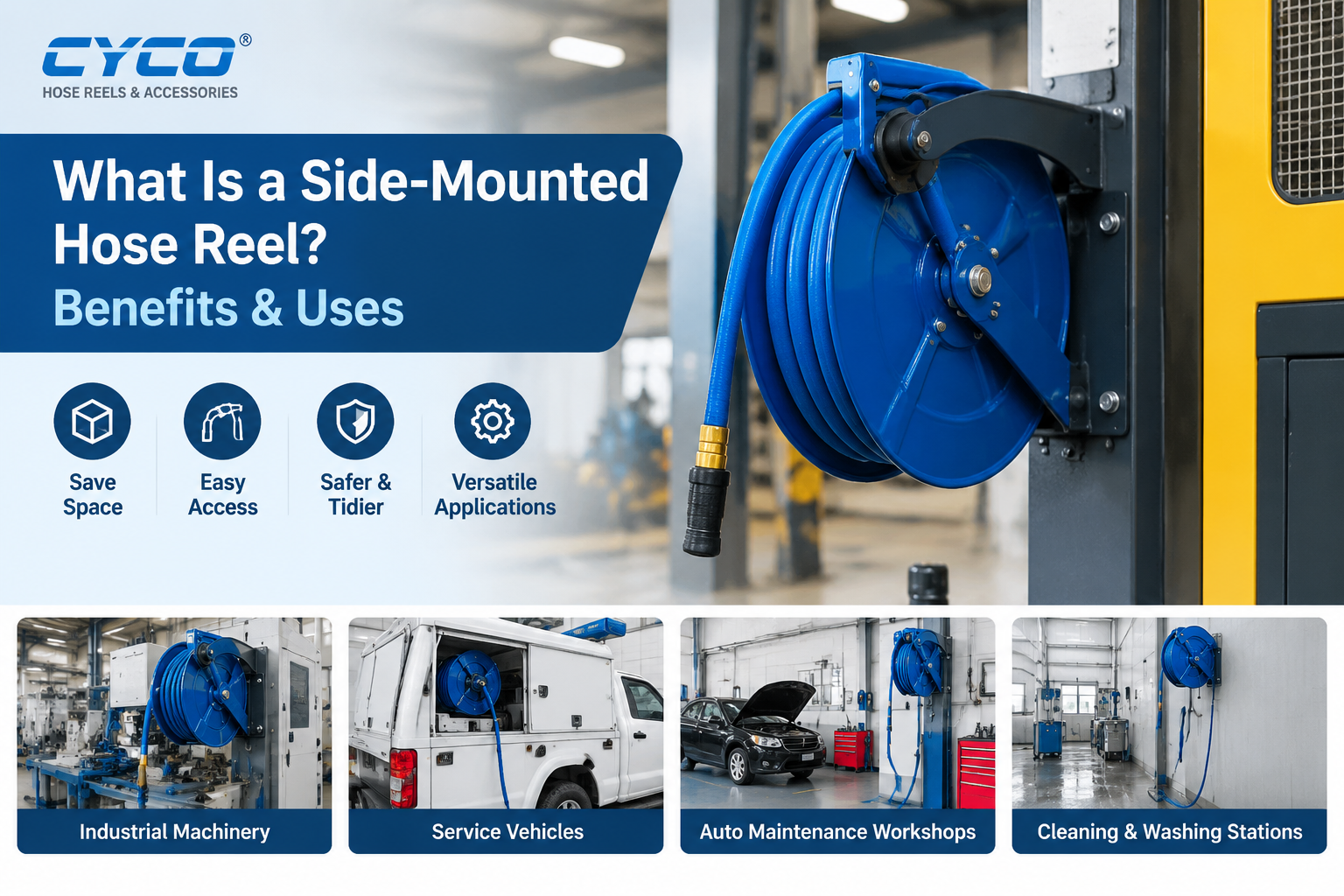
Side-Mount Hose Reel refers to the hose reel installed on the side of machines, vehicles, equipment frames, cabinets or other supporting structures. This term describes the installation position of the reel, not the specific hose material, driving mechanism or application type. The main purpose of side mounting is to put the reel in a position where it is convenient to take and arrange the hose, and at the same time avoid disturbing the surrounding equipment or operation activities.
According to the specific model, the side-mounted industrial hose reel can use spring-driven, manual or motor-driven mechanism to retract the hose. It can be used in air, water, oil, hydraulic oil and other compatible media, but only if the reel, hose, rotary joint and connecting parts meet the practical application requirements.
Key Advantages of Side-Mounted Hose Reels
1. Make Full Use of Existing Space
In compact maintenance workshops, production lines and mobile equipment cabins, ground space usually needs to be reserved for mechanical equipment, materials and personnel. Installing the hose reel on the side of a suitable structure can free up floor space and reduce the need for independent storage brackets.
This installation method is especially useful when the machine itself has a suitable installation frame, or the vehicle equipment compartment needs a more reasonable layout. However, reels must not obstruct the use of access doors, controls, channels or other key components.
2. Make the Hose More Convenient to Take
Reasonable arrangement of side-mounted hose reels can make it easier for operators to contact and use hoses. This is especially useful for scenes where maintenance work needs to be carried out from a specific side of the equipment, or scenes where the operation area has a fixed operation position.
The installation height and direction should match the actual use mode. If the operator still needs to drag the hose around the corner of the machine or reach over other equipment to get the hose, then this installation method may not only not solve the problem, but will increase the difficulty of operation.
3. Optimize the Hose Routing Path
The position of the reel determines the path through which the hose extends from the storage position to the working area. When the hose needs to extend along the side of the vehicle, machine or workbench, the side mounting can provide a more direct wiring path.
Reasonable layout is helpful to reduce the unnecessary contact between the hose and sharp edges, moving parts and other obstacles, and can also prevent the hose from crossing areas where people often pass. In the whole process of pipe laying and recycling, it is still necessary to ensure that the hose meets the specified minimum bending radius and avoid excessive tension.
4. Make the Equipment Layout More Tidy
Side-mounted hose reel can integrate hose storage into existing equipment layout. Operators don’t need to put the hose on the ground at will or store it separately, but they can fix it in a designated area near the use position.
This arrangement helps to reduce the risk of hose entanglement, wear and tripping if it is matched with a suitable recovery mechanism. The actual effect depends on the correct installation method, suitable hose capacity and standardized storage habits.
5. Easy to Integrate with Different Devices
Side-mounted mode can be used for fixed machinery, service vehicles, mobile maintenance equipment and special industrial equipment. Users can determine the appropriate reel position according to the existing structure and the extension direction of the hose.
But this does not mean that all reels can be installed on any side or at any angle. The installation method must meet the requirements of specific models, and the supporting structure must be able to bear the load generated during the operation of the equipment.
Typical Practical Application Scenarios
Industrial Machinery and Production Lines
Manufacturing equipment may need to use air, water or other service hoses for cleaning, maintenance or process assistance. Installing the hose reel on the side of the machine or on the adjacent support frame can make the hose close to the service point and reserve the surrounding ground space for production activities. Before installation, it should be confirmed that the reel will not interfere with the machine protection device, access door, moving parts or routine maintenance operation.
Service Vehicles and Mobile Maintenance Equipment
Service vehicles usually need to load tools, fluid conveying equipment and multiple hose systems in a limited space. The side-mounted hose reel allows the hose to be let out from the side of the vehicle, which is convenient for workers to take when maintaining the equipment on site.
During installation, vehicle vibration, strength of fixed structure, road clearance and external collision protection should be considered. The reel must be kept firmly during transportation, and the hose must not interfere with the normal use of doors, pedals or other vehicle parts.
Automobile Maintenance Workshops and Equipment Maintenance Areas
Compressed air, water, lubricating oil and other service hoses are usually used in automobile maintenance workshops and equipment maintenance places. When the workbench, maintenance workshop or equipment frame provides a suitable installation surface, the side-mounted reel can be a practical storage scheme.
The hose outlet should face the daily operation area, so that the maintenance personnel can release the hose smoothly. The pressure grade and hose compatibility of the reel must meet the media and actual working conditions.
Industrial Cleaning and Washing Stations
Cleaning stations in factories and maintenance areas may require hoses to reach different parts of the machine or nearby work surfaces. The side-mounted water hose reel can keep the hose in a convenient state and reduce the scattered hose in the cleaning area.
For flushing applications, material compatibility, corrosion resistance, water pressure and the effects of cleaning chemicals should be evaluated. The installation location should also avoid the influence of accumulated water on electrical equipment and other sensitive components.
Side-Mounted, Wall-Mounted and Hoisting Hose Reels: A Quick Comparison
These terms describe different installation methods, and side installation may also coincide with wall installation. For example, reels installed on the side of a building wall can be described as both side layout and wall mounting. The actual difference mainly lies in the structure of the support reel and the routing path of the hose.
| Contrast Factors | Side-Mounted | Wall-Mounted | Lifting Type |
|---|---|---|---|
| Typical installation location | Machine, vehicle, frame or cabinet side | Building wall or partition | Ceiling or top supporting structure |
| Space utilization | Use the available space on the side of the equipment | Reduce the floor occupation by the wall | Arrange the equipment above the work area |
| Hose access | Suitable for working next to the installation structure | Working area against the wall | Scenes where hoses need to extend downward to multiple positions |
| Hose wiring | Usually extends along the side of the equipment | Usually extends outward from the wall | Usually hangs from above |
| Main installation precautions | Side clearance, structural strength and component interference | Wall strength, support and bearing capacity | At the top of protruding space, fixing safety and clearance below |
| Suitable for environment | Machinery and equipment, service vehicles, compact equipment layout | Maintenance workshops, production areas, maintenance stations | Maintenance workshops, assembly areas and some industrial workspaces |
The best installation method depends on the actual use position, extension path and available support structure of the hose. Side mounting is not necessarily better than wall mounting or hoisting, but its advantage lies in that the installation method matches the actual work layout.
Key Points for Selecting a Side-Mounted Hose Reel
1. Confirm the Allowable Installation Direction
Before selecting the reel, you should first check the manufacturer’s installation instructions to confirm whether the model supports the expected side mounting method and whether there are restrictions on the working direction. This is especially important for spring-driven reels, because its recovery mechanism may depend on a specific installation direction.
2. Check the Length, Diameter and Storage Capacity of the Hose
The reel must be able to accommodate hoses of the required length and diameter, while not exceeding the rated capacity. The outer diameter of the hose, the structure of the pipe wall and the flexibility will all affect the actual storage capacity of the drum.
When determining the length, the complete path between the reel and the operation point should be considered, including the distance required to bypass the equipment. If the selection is only based on the linear distance between two points, it may lead to insufficient hose length or excessive tension.
3. Match the Reel with the Working Medium
Reels, hoses, seals, rotary joints and connecting parts must be compatible with the conveying medium. Air, water, oil, grease and hydraulic oil may require different materials and pressure classes.
Check the maximum allowable working pressure and temperature of the whole hose assembly. The safe working limit of the system depends on the components with the lowest rated capacity. If the hose needs to transport chemicals, detergents or other special media, the material compatibility should also be confirmed before installation.
4. Evaluate the Installation Structure and Bearing Capacity
Side-mounted reels transfer static and operational loads to the supporting structure. These loads include not only the weight of the reel and the hose itself, but also the force generated when the operator pulls out or recovers the hose.
The mounting surface and bracket that can bear the expected load should be selected. For vehicle installation, vibration and movement during transportation should also be considered. The specified fasteners should be used, and structural reinforcement should be added when necessary, instead of relying on thin panels or unsupported sheet metal for fixation.
5. Plan the Hose Outlet Direction and Operation Space
Hoses should be extended towards the operation area to avoid rubbing sharp edges repeatedly, passing through moving parts or crossing busy passages. The specified minimum bending radius should be maintained, and sufficient space should be left for the hose to be completely released and recovered.
At the same time, it is also necessary to consider whether the operator can conveniently use the reel handle, locking device or other control components. Sufficient space should be reserved for routine inspection, hose replacement and maintenance of peripheral equipment.
6. Choose a Suitable Recovery Mechanism
Manual hose reel may be more suitable for applications that want to directly control the hose release and recovery process. The spring-driven hose reel can automatically recover the hose through the spring mechanism under the condition of meeting the operation requirements of the model. For applications with long and heavy hoses or requiring power assistance, motor-driven hose reels can be considered.
The weight, length, frequency of use and available power conditions of the hose should be considered comprehensively when selecting. The installation structure and installation direction must also be compatible with the selected drive mechanism.
Conclusion
When hoses need to be stored on the side of machines, equipment or service vehicles, side-mounted hose reels can provide practical solutions. After reasonable installation, it helps to release the floor space, facilitate the access of hoses, and make the work area more orderly.
Successful installation is not just about finding an available side position. Hose capacity, medium compatibility, installation strength, working direction, outlet position and maintenance space all need to be considered comprehensively. By evaluating these factors before purchasing, users can choose a side-mounted hose reel that is more in line with the equipment layout requirements and can support safe and reliable hose operation.
FAQ:
Related Posts
Static Discharge Reels for Fuel Transfer: Safety Basics
October 14, 2026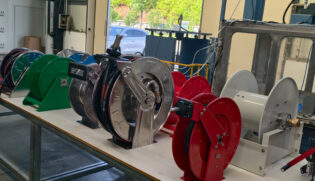
High Pressure Hose Reel vs Low Pressure Hose Reel: The…
June 18, 2026