How to Choose Right Pressure Cleaning Nozzle
May 11, 2026 | Pressure Cleaning nozzle
1. Introduction
Pressure cleaning nozzles are essential components in industrial and commercial cleaning systems. Although relatively small in size, they directly influence spray coverage, cleaning efficiency, water consumption, operating pressure, and overall equipment performance. Selecting the correct nozzle not only improves cleaning effectiveness but also helps reduce maintenance costs, minimize water waste, and extend the service life of the entire cleaning system.
Pressure cleaning nozzles are widely applied in vehicle washing, industrial equipment cleaning, surface preparation, pipeline flushing, cooling, dust suppression, and chemical spraying processes. In many industrial applications, industrial spray nozzles are used to provide precise spray control, reliable performance, and consistent coverage for demanding cleaning and processing operations.
Because different applications require different spray impact, coverage area, and droplet size, understanding nozzle structure, spray pattern, and operating performance is critical when selecting the most suitable nozzle configuration.
2. Pressure Cleaning Nozzle Overview
What Is a Pressure Cleaning Nozzle?
A pressure cleaning nozzle is a precision component that controls water flow direction, spray angle, pressure distribution, and spray pattern within a cleaning system. By adjusting the nozzle orifice size and internal structure, the nozzle can generate different spray characteristics to meet various industrial cleaning requirements. The nozzle serves as the final control point of the cleaning system, directly determining how water is delivered onto the target surface. As a result, nozzle selection has a significant impact on cleaning quality, operating efficiency, and system stability.
Main Features of Pressure Cleaning Nozzles
Modern industrial pressure cleaning nozzles are engineered to deliver high-pressure cleaning capability while maintaining stable and uniform spray distribution throughout operation. These nozzles achieve efficient water utilization by optimizing spray patterns to maximize cleaning effectiveness with minimal water consumption. Excellent wear and corrosion resistance ensure reliable performance even in harsh industrial environments, while easy installation and maintenance features reduce downtime and simplify routine replacement. Additionally, these nozzles offer broad compatibility with water, chemical, and industrial cleaning systems, making them suitable for a wide range of applications across different industries. Depending on the specific use case, pressure cleaning nozzles may also be optimized for fine atomization, concentrated impact force, or wide-area spray coverage to meet varied cleaning requirements.
3. Pressure Cleaning Nozzle Performance
Pressure Performance
Pressure is one of the most important factors affecting cleaning efficiency. Higher PSI (pounds per square inch, a pressure measurement unit used to indicate water pressure strength) generates stronger impact force, making it more effective for removing stubborn dirt, grease, and industrial residue. Lower pressure levels, however, are better suited for delicate surfaces that may be damaged by excessive force. Proper nozzle sizing is essential for maintaining stable pressure performance, as incorrect nozzle selection may lead to pressure loss, unstable spray patterns, or unnecessary strain on pumps and related equipment.
Flow Rate Performance
Flow rate determines the volume of water delivered during operation. Proper matching between GPM (gallons per minute, a flow rate measurement unit used to indicate water output volume per minute) and nozzle orifice size is critical for achieving efficient cleaning performance. A nozzle with insufficient flow capacity may reduce cleaning speed, while excessive flow may result in wasted water and inefficient system operation. Balanced pressure and flow rate help maintain optimal cleaning performance while minimizing energy and water consumption.
Spray Stability
High-quality pressure cleaning nozzles provide stable and consistent spray distribution during continuous operation. Uniform spray patterns help improve cleaning consistency, reduce streaking, and ensure reliable performance in industrial applications.
Durability and Wear Resistance
Industrial spray nozzles are commonly manufactured from stainless steel, brass, hardened alloy, or ceramic materials. These materials provide excellent resistance to corrosion, abrasion, and long-term wear under high-pressure operating conditions. In harsh industrial environments, durable nozzle materials are essential for maintaining spray accuracy and extending operational lifespan.
4. How to Choose the Right Pressure Cleaning Nozzle
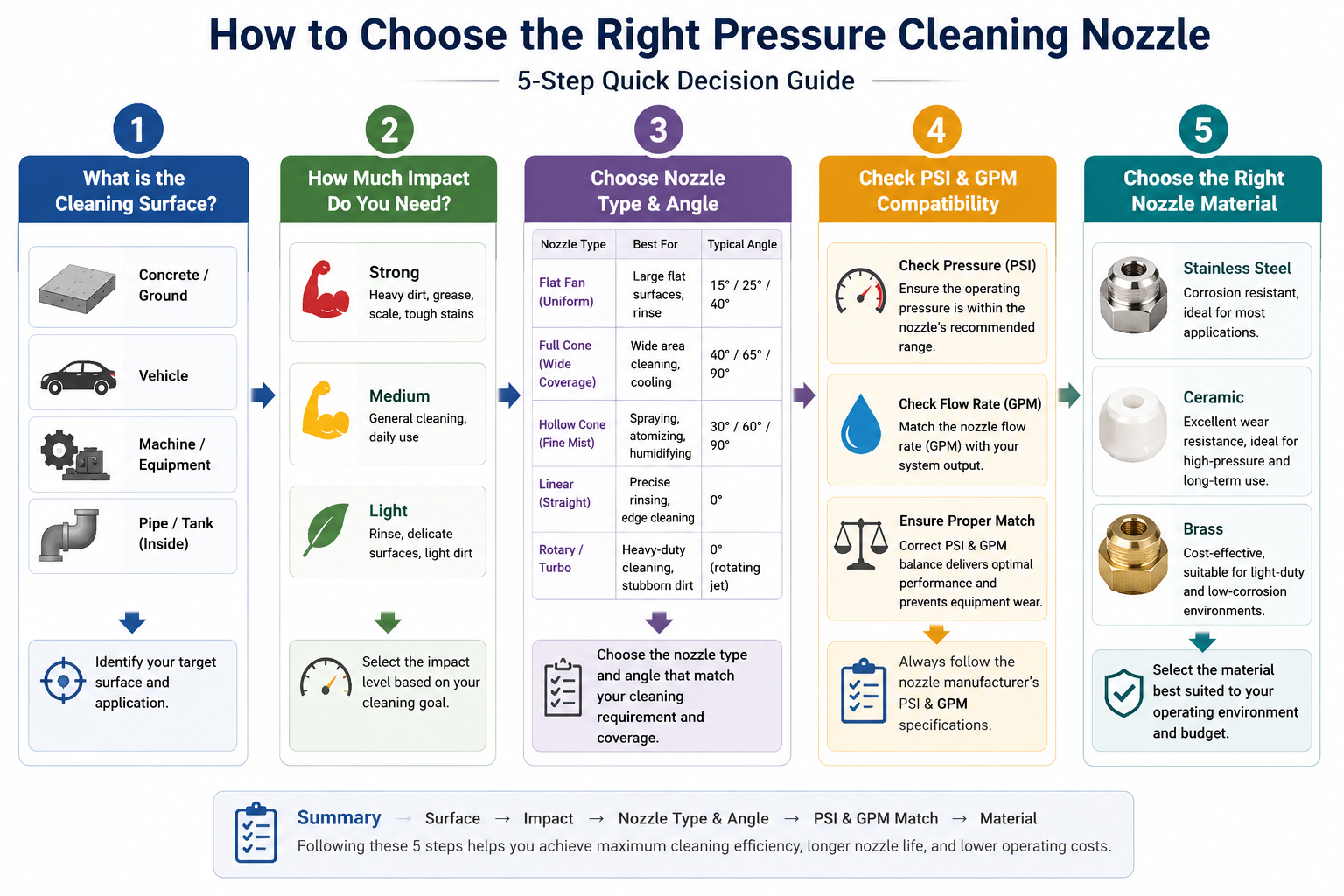
Selecting the correct pressure cleaning nozzle is one of the most important factors in achieving efficient, safe, and cost-effective cleaning performance. Because different cleaning systems operate under different pressure, flow, and environmental conditions, nozzle selection should be based on a comprehensive evaluation of the actual application requirements.
4.1 Identify the Cleaning Application
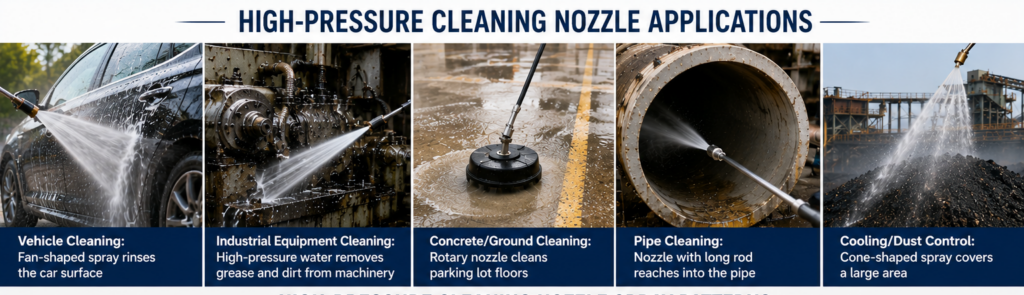
The first step in nozzle selection is understanding the specific cleaning task and operating conditions. Different applications require different spray impact levels, coverage areas, and droplet characteristics. For example, vehicle washing typically requires moderate pressure with wide and uniform coverage to avoid surface damage, while industrial equipment cleaning often requires stronger impact force to remove grease, oil, and stubborn residue. Pipe and tank cleaning may require directional spray or full internal coverage, whereas cooling and dust suppression systems generally require fine droplets and broad distribution. Chemical spraying applications require controlled atomization and consistent spray patterns. Without clearly defining the application, selecting the appropriate nozzle becomes difficult and may result in reduced cleaning efficiency or equipment damage.
4.2 Select the Correct Spray Pattern
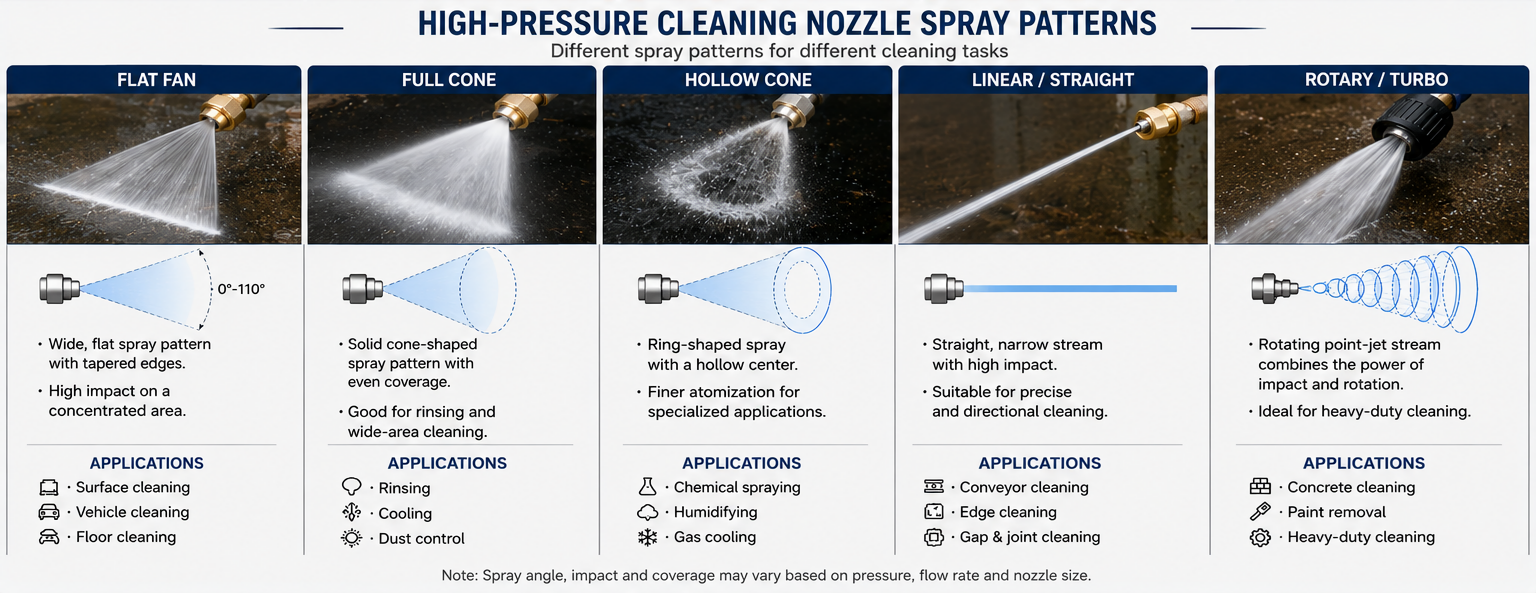
Spray pattern selection directly affects how water interacts with the target surface. Different spray patterns are optimized for different cleaning objectives. Flat fan nozzles are typically preferred for large flat surfaces because they provide even coverage and effective rinsing performance. Full cone nozzles are more suitable for applications requiring complete area coverage, such as cooling or washing processes. Hollow cone nozzles are commonly used when fine atomization is required, particularly in spraying and humidification systems. Linear spray nozzles are ideal for precise directional applications, while rotary nozzles are specifically designed for heavy-duty cleaning tasks that require concentrated impact force. Selecting an unsuitable spray pattern may lead to uneven cleaning results, excessive water consumption, or reduced operating efficiency.
4.3 Match Pressure and Flow Rate Correctly
Proper pressure and flow matching is one of the most critical aspects of nozzle selection. Pressure and flow rate must operate together in balance to achieve stable and efficient cleaning performance. Higher PSI increases cleaning force and surface impact, while higher GPM increases water volume, cleaning speed, and coverage area. However, excessive pressure or incorrect nozzle sizing can create operational problems. If the nozzle orifice is too small, excessive pressure buildup may occur, increasing equipment wear and reducing system lifespan. Conversely, if the nozzle orifice is too large, pressure may drop significantly, resulting in weak cleaning performance and unstable spray distribution. Correct matching between nozzle size, pressure, and flow rate helps achieve stable spray performance, maximum cleaning efficiency, reduced water and energy consumption, lower equipment wear, and longer operational lifespan. For industrial systems operating continuously, accurate pressure and flow matching is especially important for maintaining long-term reliability.
4.4 Choose the Proper Nozzle Material
Nozzle material selection directly affects durability, corrosion resistance, and operating cost. Stainless steel nozzles provide excellent corrosion resistance and are suitable for most industrial cleaning environments. Ceramic nozzles offer outstanding wear resistance and are ideal for high-pressure continuous operation where long service life is required. Brass nozzles are often used in economical light-duty applications where operating conditions are less severe. For applications involving chemicals, abrasive particles, or continuous high-pressure operation, stainless steel or ceramic materials are generally recommended to ensure long-term reliability.
4.5 Consider the Operating Environment
Operating conditions should always be considered when selecting a pressure cleaning nozzle. Environmental factors can significantly affect nozzle lifespan and spray performance. Outdoor applications may require enhanced corrosion resistance, while chemical processing systems require materials capable of withstanding aggressive substances. High-temperature environments demand heat-resistant materials, and continuous industrial operation requires high wear resistance and stable long-term performance. Ignoring environmental conditions may lead to premature nozzle failure, unstable spray performance, and increased maintenance costs.
5. Conclusion
Choosing the right pressure cleaning nozzle is essential for improving cleaning efficiency, maintaining stable spray performance, and extending equipment service life. Proper nozzle selection requires careful consideration of spray pattern, pressure and flow balance, material durability, and operating environment. A properly matched nozzle system not only improves cleaning effectiveness but also helps reduce water consumption, energy usage, and equipment wear. In industrial and commercial cleaning systems, selecting the correct pressure cleaning nozzle is a key factor in achieving reliable, efficient, and cost-effective operation.
Related Posts

Marine Hose Reel Selection Guide
July 10, 2026
How to Choose the Right Automotive Hose Reel for Your…
August 14, 2026
How to Choose the Right Sewer Jetter Reel for Your…
July 14, 2026