Spring-Driven Hose Reels for Construction Sites
July 2, 2026 | Hose Reel Applications, Industrial Hose Reels, Spring-Driven Hose Reel
Introduction
Construction sites rely on compressed air, water, and other fluid delivery systems to power tools, clean equipment, and support daily operations. However, long hoses can easily become tangled, damaged, or create trip hazards in busy work areas. A spring-driven hose reel for construction sites helps keep hoses organized by automatically retracting them after use, improving both job site safety and operational efficiency on construction sites. In this article, we’ll explore the common applications of spring-driven hose reels for construction sites, their key benefits, and the factors to consider when choosing the right reel for construction environments.
Common Applications of Spring-Driven Hose Reels on Construction Sites
Pneumatic Tools
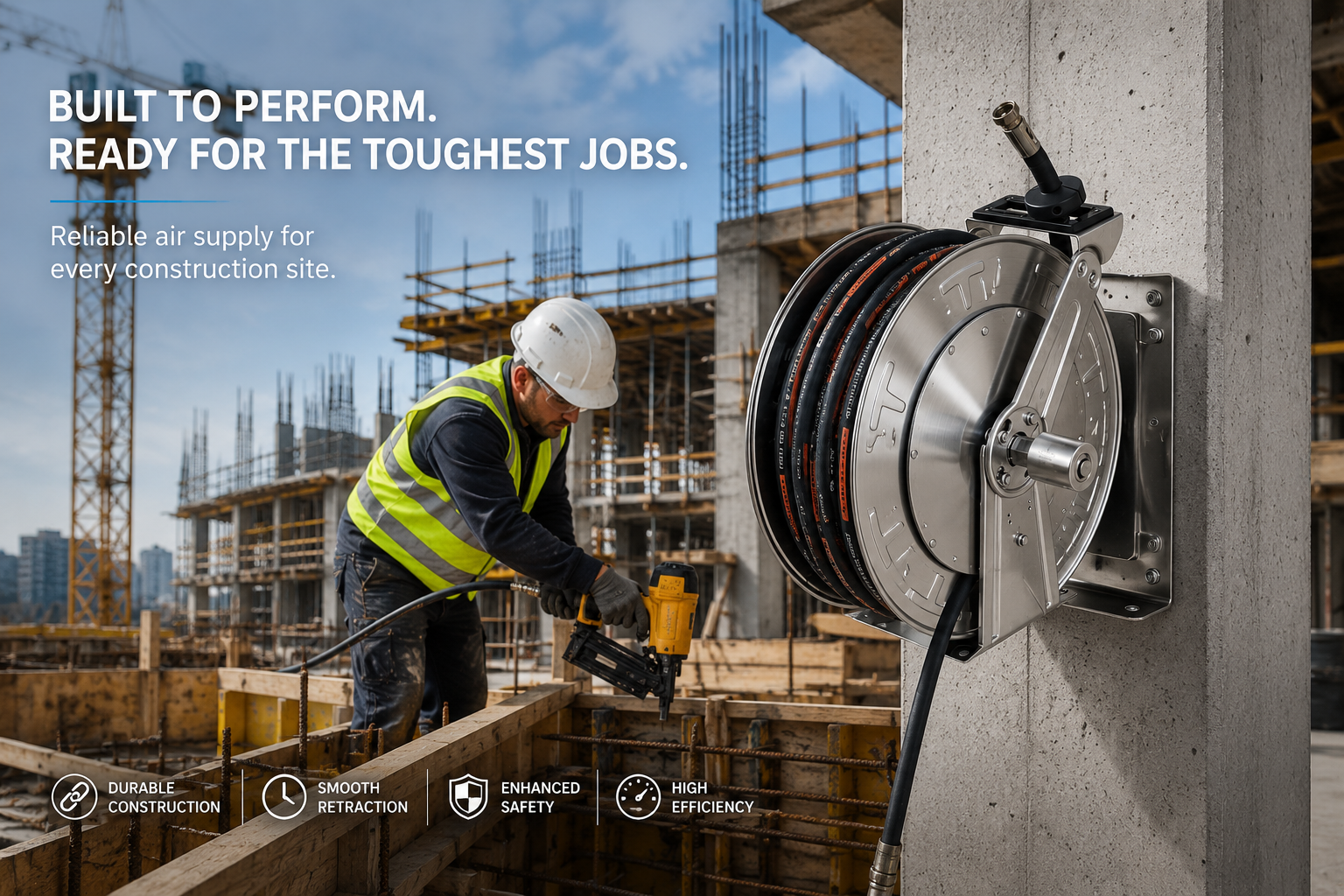
Construction sites rely heavily on pneumatic tools such as air impact wrenches, jackhammers, nail guns, and air drills for a wide range of tasks using a spring-driven air hose reel. A spring-driven hose reel provides a stable compressed air supply while automatically retracting the hose after use. This keeps hoses organized, reduces clutter, and allows workers to move efficiently between different work areas.
Concrete Cutting and Core Drilling
Concrete cutting and core drilling often require a continuous water supply to cool cutting equipment and suppress dust. A spring-driven hose reel delivers water directly to concrete saws and core drilling machines while keeping the hose neatly stored. This helps improve dust control, enhances cutting efficiency, and reduces hose wear on busy construction sites.
Pressure Washing and Site Cleaning
Pressure washing is commonly used to clean construction equipment, vehicles, floors, and work areas. A spring-driven hose reel (construction hose reel) allows operators to quickly deploy and retract hoses, making routine cleaning faster and more efficient. It also helps keep the job site organized by preventing hoses from lying across walkways or becoming tangled.
Heavy Equipment Maintenance
Construction equipment such as excavators, bulldozers, cranes, and loaders requires regular maintenance to ensure reliable operation. Spring-driven hose reels can be used to manage air, water, or lubrication hoses during servicing, providing convenient hose access while reducing setup time and improving maintenance efficiency.
Temporary Utility Stations
Temporary utility stations are frequently established as construction projects progress. Spring-driven hose reels provide a convenient solution for distributing compressed air or water to mobile workstations and temporary service areas. Their automatic retraction system allows hoses to be quickly deployed when needed and neatly stored afterward, making it easier to relocate equipment and maintain a safer, more organized job site.
Benefits of Using Spring-Driven Hose Reels on Construction Sites
Improves Job Site Safety
Construction sites are often busy environments where hoses can easily become trip hazards if left on the ground. A construction hose reel automatically retracts the hose after use, keeping walkways and work areas clear. By reducing loose hoses and workplace clutter, it helps create a safer environment for workers while lowering the risk of accidents and injuries.
Increases Productivity
A spring-driven hose reel allows workers to deploy and retract hoses quickly without manually winding them after every task. Automatic hose retraction saves time, reduces manual handling, and enables faster transitions between different work areas. This improved efficiency helps crews complete daily tasks more quickly while minimizing downtime.
Protects the Hose
Proper hose storage plays a key role in extending hose service life. By automatically rewinding the hose onto the reel, a spring-driven hose reel helps prevent kinks, reduces abrasion from rough surfaces, and minimizes damage caused by dragging the hose across the job site. Better hose protection means fewer replacements, lower maintenance costs, and more reliable operation.
Performs Well in Harsh Environments
Construction sites expose equipment to tough conditions such as dust, mud, rain, and constant outdoor use. Industrial spring-driven hose reels and heavy duty hose reels are built with durable materials and corrosion-resistant finishes that help maintain reliable performance in these challenging environments. Their rugged construction allows them to withstand daily exposure to harsh job site conditions while providing dependable hose management throughout the project.
Choosing the Right Spring-Driven Hose Reel for Construction Sites
Selecting the right spring-driven hose reel for a construction site requires balancing performance, safety, and the actual working conditions on site. Instead of focusing only on product features, it’s more practical to match each specification with how the reel will be used in daily operations.
Hose Length
Hose length should be determined by the real working radius of the job site rather than estimating loosely. If the hose is too short, it limits mobility and forces frequent repositioning. If it is too long, it can create unnecessary drag, clutter, and even safety risks.
A good practice is to evaluate the farthest working point from the fixed installation position and add a reasonable margin for movement and flexibility.
Working Pressure
The working pressure requirement depends on the type of equipment connected to the reel, such as air compressors, water supply systems, or hydraulic tools. The key is to ensure the reel’s rated pressure is equal to or higher than the maximum system output.
This helps maintain stable flow performance and reduces the risk of hose failure, leakage, or sudden pressure drops during operation.
Hose Type
The hose type should always match the media being delivered on site. For example, air systems require hoses designed for compressed airflow, while water applications need hoses that can handle continuous flow without deformation. In oil or hydraulic applications, chemical resistance and pressure stability become even more important.
Choosing the wrong hose type can quickly lead to wear, contamination, or even safety hazards, especially in high-intensity construction environments.
Reel Material
Material selection plays a major role in how well the reel performs under different environmental conditions. Powder-coated steel is widely used in industrial hose reels for construction sites because it offers strong structural protection and resistance to everyday wear. In more harsh environments—such as wet, coastal, or highly corrosive locations—stainless steel provides significantly better durability and long-term reliability.
Mounting Options
Installation flexibility is another important consideration. Wall-mounted reels are suitable for fixed workstations where space optimization and easy access are priorities. Vehicle-mounted options are ideal for mobile operations, allowing tools and hoses to move with the equipment. For more integrated setups, mounting the reel directly onto machinery can improve workflow efficiency and reduce setup time on dynamic job sites.
Conclusion
Overall, a spring-driven hose reels for construction sites are more than just simple hose management tool—it is an essential piece of equipment for improving safety and operational efficiency on construction sites. With proper selection and use, it helps create a more organized work environment and supports smoother, more efficient daily operations.
If you are unsure which configuration is best suited for your specific application, feel free to contact us at any time. We are happy to provide professional advice and tailored solutions based on your project requirements.
Related Posts
How to Operate a Fire Hose Reel System: A Best…
June 16, 2026
Electric Hose Reels for Oil & Gas Industry
July 6, 2026