How Limit Switches Improve Hose Reel Safety in Motorized Hose Reels
June 26, 2026 | Electric Hose Reels, Industrial Hose Reels
1.Introduction
Motorized hose reels have become an indispensable piece of equipment in modern industrial operations, providing a safer and more efficient method of hose management for the conveyance of fluids such as water, air, lubricating oil, fuel, hydraulic oil, and chemical media. The reliable performance of a motorized hose reel depends not only on the drive motor; its safe and stable operation also relies on the coordinated functioning of multiple key safety components. Among these, the limit switch is one of the most critical safety components.
Although limit switches are compact, they effectively prevent the reel from rewinding excessively, protect critical equipment components, and significantly enhance operational safety. This article will explain the working principle of limit switches, why they are crucial for industrial hose reel safety, and their types and common applications.
2.What Is a Limit Switch in a Motorized Hose Reel?
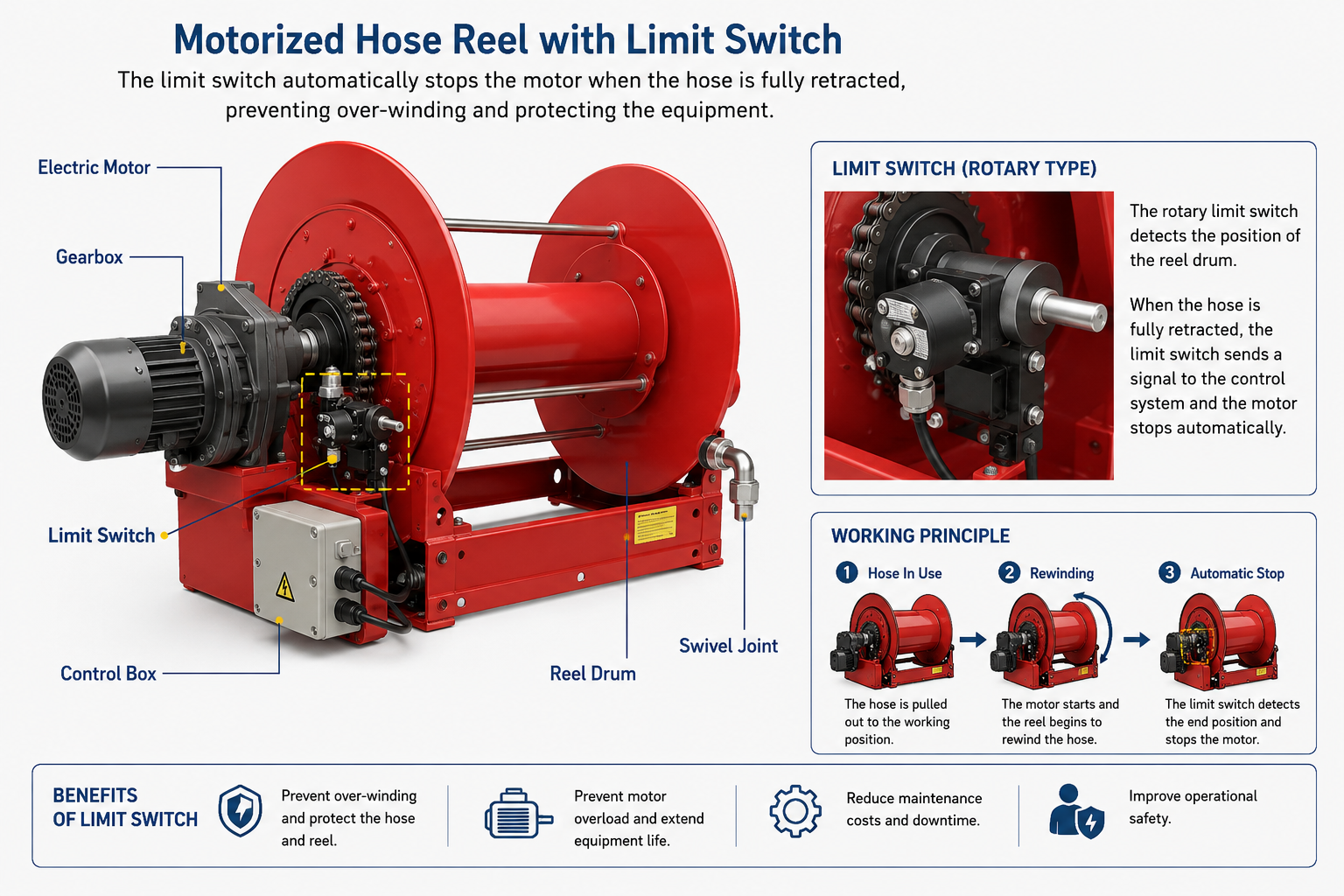
In motorized hose reels, limit switches are primarily responsible for monitoring the position of the hose or reel during the retraction process. When the hose is fully retracted or reaches a preset stop position, the limit switch sends a signal to the control system, which then shuts off the drive motor.
Without this automatic protection feature, the motor might continue to run after the hose has been retracted, causing unnecessary stress and damage to the hose and reel mechanism.
Depending on specific application requirements, industrial hose reels typically employ the following types of limit switches: mechanical limit switches, rotary limit switches, and proximity sensors. Although their structures differ, their purpose is the same—to prevent the reel from operating beyond its designed travel range.
3.How Does a Limit Switch Work in a Motorized Hose Reel?
Although different devices use different types of limit switches, their operating principles are essentially the same.
Step 1: Unroll the Hose
The operator pulls the hose out to the work area to perform the necessary tasks.
Step 2: Initiate Rewinding
Once the task is complete, the operator presses a control button or uses a remote control to start rewinding, and the motor or hydraulic drive system begins rotating the reel.
Step 3: Retract the Hose
As the reel continues to rotate, the hose is smoothly retracted. At the same time, the cable-guiding system operates synchronously to ensure the hose is evenly distributed across the reel’s surface.
Step 4: Position Detection
When the hose approaches the fully retracted position, a limit switch detects the preset stop point. Depending on the system design, detection can be achieved through mechanical contact, rotational positioning, or non-contact sensors.
Step 5: Automatic Stop
The limit switch sends a stop signal to the control system. The control system immediately cuts off power to the drive motor, bringing the reel to a smooth stop.
The entire process takes only a very short time but effectively ensures equipment safety.
4.Common Types of Limit Switches in Motorized Hose Reels
Depending on the specific application and automation control requirements, motorized hose reels can be equipped with different types of limit switches. Although they all provide an automatic stop function, there are significant differences in their detection methods, positioning accuracy, durability, and suitability for various environments. Therefore, when selecting a motorized hose reel, it is important to consider not only the reel’s drive mechanism and load capacity but also to choose an appropriate limit switch solution based on actual operating conditions. The following section introduces the three most common types of limit switches used in industrial hose reels.
4.1 Mechanical Limit Switches
Mechanical limit switches are the most common and cost-effective solution for industrial hose reels. They work by making direct contact with moving parts to trigger or break the circuit when the equipment reaches a preset position, thereby enabling automatic stoppage.
Their main advantages include:
- Low cost; economical and practical
- Simple installation and maintenance
- Reliable performance in general industrial environments
Due to their simple structure and mature technology, mechanical limit switches are widely used in standard industrial settings such as manufacturing plants, maintenance workshops, and light- to medium-duty motorized hose reels.
4.2 Rotary Limit Switch
Rotary limit switches control equipment operation by monitoring the rotational position of the reel, rather than relying on mechanical contact for detection. Compared to standard mechanical limit switches, they offer higher positioning accuracy and can more precisely control the stopping position during hose reeling.
Their main advantages include:
- High positioning accuracy
- Suitable for long-distance hose reeling and unwinding
- Ideal for high-capacity motorized hose reels
- More stable and reliable operation during continuous, high-frequency operations
Rotary limit switches are commonly used in heavy-duty industrial sectors such as mining, offshore engineering, and oil and gas. These applications often require Heavy Duty Hose Reels with large hose capacities and precise automatic control.
4.3 Proximity Sensors
Unlike mechanical limit switches, proximity sensors use a non-contact detection method. They detect the position of moving parts through technologies such as inductive, capacitive, or magnetic sensing, and send a stop signal to the control system.
Their main advantages include:
- Non-contact detection, resulting in virtually no mechanical wear
- Long service life and low maintenance requirements
- Fast response times and high operational reliability
- Excellent performance in dusty, humid, or corrosive environments
Because there is no mechanical contact, proximity sensors are particularly well-suited for harsh industrial environments. They maintain stable performance during long-term continuous operation and are an increasingly common limit switch solution in modern intelligent motorized hose reels.
5.Key Safety Benefits of Limit Switches in Motorized Hose Reels
A limit switch does much more than simply stop a motor. It plays a vital role in protecting the hose reel, extending equipment lifespan, and ensuring safe operation. By automatically stopping the reel at the correct position, a limit switch helps prevent unnecessary stress on the hose and mechanical components while reducing the risk of accidents.
5.1Prevents Over-Rewinding
One of the primary functions of a limit switch is to prevent over-rewinding. Once the hose has been fully retracted, the limit switch automatically stops the drive motor, preventing the drum from continuing to rotate.
Without this protection, excessive rewinding can place unnecessary tension on the hose and fittings, increasing the risk of premature wear or component failure. Automatic stopping ensures that the hose remains in the correct position after every operation.
5.2 Protects the Hose
Industrial hoses are valuable assets, and excessive pulling or improper rewinding can significantly shorten their service life.
By stopping the reel at the preset position, a limit switch helps prevent:
- Hose stretching
- Hose compression
- Twisting and deformation
Reducing these stresses minimizes hose damage, maintains consistent performance, and extends the overall lifespan of the hose, ultimately lowering replacement and maintenance costs.
5.3 Prevents Motor Overload
If the motor continues running after the hose has been fully retracted, it must work against increasing resistance. This can lead to excessive current draw, overheating, or prolonged motor stall conditions.
A limit switch automatically interrupts the drive system before these issues occur, helping to:
- Reduce excessive motor current
- Prevent prolonged motor stalling
- Protect the drive motor from overload
As a result, the motor operates more efficiently and enjoys a longer service life.
5.4 Protects Gearboxes and Drive Components
The drive system of a motorized hose reel includes critical mechanical components such as gearboxes, chains, shafts, bearings, and couplings. Continuous over-travel places unnecessary stress on these parts and accelerates wear.
A properly adjusted limit switch helps reduce:
- Gear wear
- Chain wear
- Coupling damage
- Unnecessary mechanical stress
Protecting these components not only improves equipment reliability but also reduces maintenance frequency and repair costs.
5.5 Improves Operator Safety
Safety is one of the most important benefits of using limit switches in motorized hose reels.
By automatically stopping the reel at the correct position, the system helps prevent unexpected hose movement or excessive tension that could endanger operators.
This reduces the risk of:
- Sudden hose pulling
- Loss of equipment control
- Operator injury
For industrial environments where heavy hoses are used frequently, automatic stopping provides an additional layer of protection, creating a safer and more controlled working environment.
6.Applications That Require Limit Switch Protection
Industries that rely on motorized hose reels often use long, heavy-duty hoses that are deployed and retracted repeatedly throughout the workday. In these harsh applications, uncontrolled rewinding can place excessive stress on the hose, drive motor, gearbox, and other mechanical components, increasing the risk of equipment damage and unexpected downtime.
For this reason, a reliable limit switch for a motorized hose reel is an essential safety feature in industries such as oil and gas, mining, marine, fire protection, manufacturing, and heavy equipment maintenance. By automatically stopping the reel at the correct position, the limit switch helps prevent over-rewinding, improves hose reel safety, reduces maintenance costs, and extends the service life of both the hose and the reel system.
7.Conclusion
Though small in size, limit switches are indispensable guardians of motorized hose reel safety systems. They prevent over-rewinding, protect hoses and drive components, avoid motor overload, and reduce maintenance costs—making them a powerful safeguard for equipment longevity and operational safety.
In high-risk applications such as oil and gas, mining, marine engineering, and firefighting, every retraction matters. Choosing a motorized reel with a high-quality limit switch is not an option—it is a necessary safety investment.
Safety comes first. When selecting or upgrading your reel system, always prioritize limit switch configuration—add protection for your equipment and peace of mind for your personnel. Ensure every retraction is precise and every meter of hose is secure.
Related Posts
How to Choose the Right Hose Reel Cart with Wheels
June 29, 2026
Fuel Hose Reel Selection Guide for Safe Fueling Systems
June 22, 2026
Why Do Workshops Need Hose Reels?
March 18, 2026