What Causes Uneven Hose Winding on a Spring Driven Hose Reel?
August 18, 2026 | Spring-Driven Hose Reel
1. Introduction
A spring-driven hose reel is designed to keep a hose neatly wound on its drum while allowing operators to pull out and retract the hose when needed. A spring retractable hose reel uses a spring mechanism to automatically return the hose to the reel after use. Under normal conditions, the hose should wind smoothly and distribute across the reel drum without excessive overlap or piling up on one side.
Uneven winding is a typical problem that may occur after tube windings. Interestingly, during normal operation the tube may be wound several times on one side of the drum, crossing or overlapping itself, or without its proper parallel winding, to eventually create a bulky wound-up tube. This type of winding, if left untouched, can contribute to the excessive wearing of the tube, to a reduced retraction, and of course to a more difficult reel operation.
Some causes are pull angle, hose guide location, installing, spring tension, hose specifications, worn parts, et cetera. Knowledge of the possible causes makes it easier to know where to repair to make the hose winding go back to normal.
2. How Should a Spring Driven Hose Reel Wind the Hose?
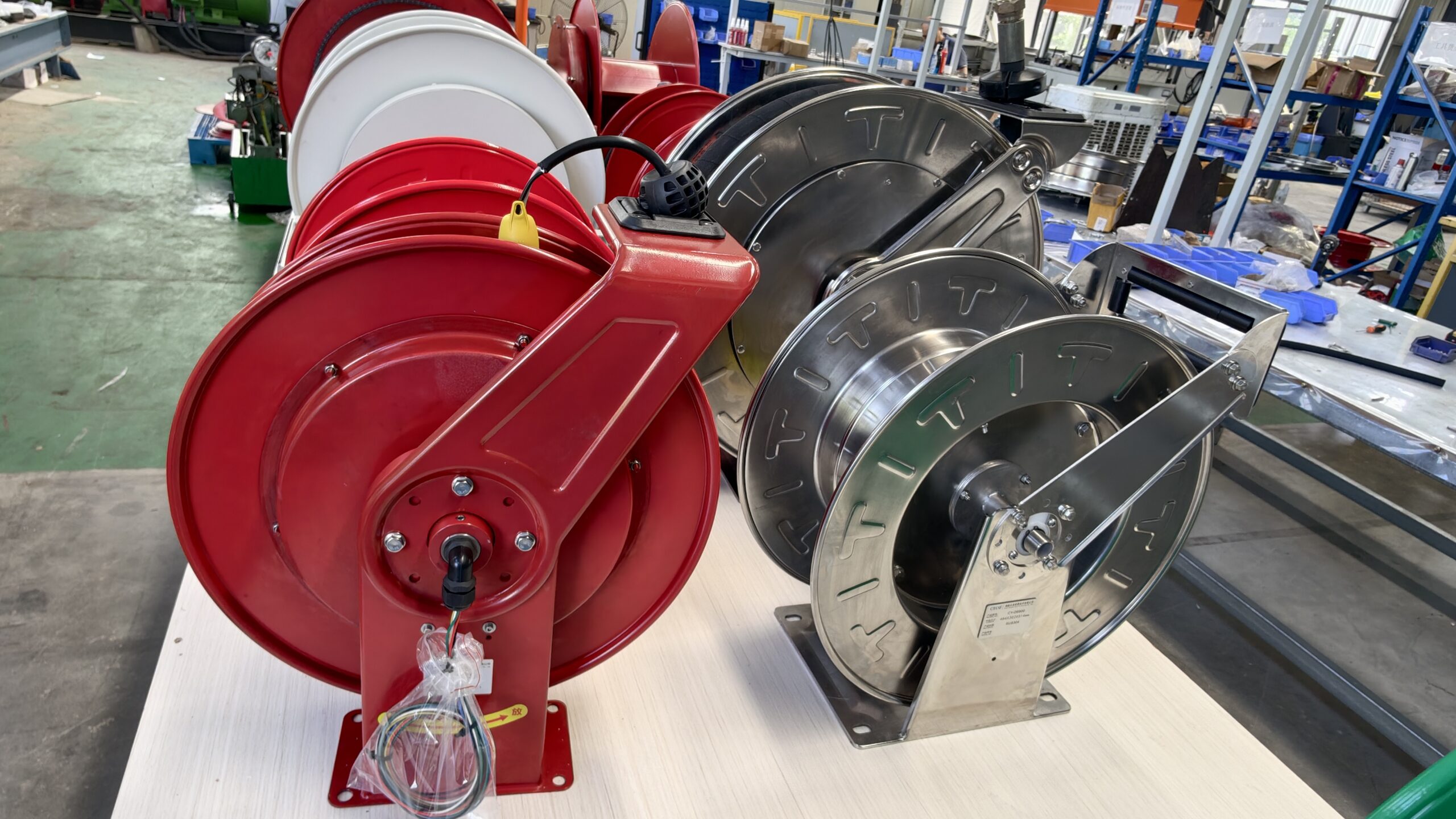
Before troubleshooting uneven winding, it is useful to understand how a spring driven hose reel normally handles the hose. In a spring retractable hose reel, the internal spring stores energy as the hose is pulled out and releases that energy to rotate the drum during retraction.
2.1 The Role of the Reel Drum
The reel drum provides the surface on which the hose is stored. As the hose retracts, it should gradually move across the drum and form relatively even layers. The available drum width, diameter, and hose capacity all influence how the hose is distributed.
If the hose length or diameter exceeds the reel’s rated capacity, there may not be enough space for proper winding. The hose can become tightly packed in some areas while remaining loose in others.
2.2 The Role of the Hose Guide
The hose guide helps control the path of the hose as it enters and leaves the reel. On many spring driven hose reels, the guide arm or guide rollers allow the hose to move across the drum instead of repeatedly entering at one fixed point.
A properly positioned hose guide helps maintain a more consistent winding path. If the guide is misaligned, damaged, or restricted, the hose may repeatedly return to the same area of the drum.
For a spring retractable hose reel, the guide mechanism is particularly important because the hose needs to move smoothly as the spring retracts it onto the drum.
2.3 The Role of Proper Hose Tension
The drive spring provides the force needed to retract the hose. Adequate tension helps keep the hose under control as it returns to the reel.
If the retraction force is inconsistent, the hose may become loose during winding. Loose sections are more likely to overlap, twist, or accumulate unevenly on the drum.
3. Common Causes of Uneven Hose Winding
3.1 Incorrect Pulling Angle
One of the most common causes of uneven winding is an incorrect pulling angle. If the hose is consistently pulled sideways rather than in a direction that matches the reel and hose guide, it may enter the drum from the same side repeatedly.
This can cause the hose to build up in one area instead of spreading across the drum. Side loading can also place additional stress on the hose guide and mounting structure.
When operating the reel, try to keep the hose path aligned with the guide mechanism. If the application requires frequent pulling from different directions, the reel installation should allow the hose to move smoothly without excessive lateral force.
3.2 Improper Hose Guide Position
A hose guide that is incorrectly positioned can prevent the hose from moving smoothly across the drum. Dirt, debris, mechanical damage, or restricted movement may also affect the guide’s operation.
If the guide arm cannot move as intended, the hose may repeatedly wind around the same section of the drum. Over time, this creates uneven layers and can increase localized hose wear.
Regularly inspect the guide mechanism and make sure it moves freely according to the reel’s design. If the reel has an adjustable guide arm, follow the manufacturer’s instructions when making adjustments.
3.3 Incorrect Installation Position
The installation position of the reel directly affects the hose’s entry path. A reel that is mounted at an unsuitable height, angle, or location may force the hose to approach the drum from an awkward direction.
For example, if a wall-mounted reel is positioned too far from the normal work area, operators may pull the hose sharply sideways. Similarly, an incorrectly positioned vehicle-mounted reel can create excessive bending or lateral movement during use.
Before installation, consider the normal direction of hose travel and make sure the reel can accommodate that movement without placing unnecessary stress on the hose.
3.4 Insufficient or Excessive Spring Tension
Spring tension plays an important role in hose retraction. If the spring does not provide enough force, the hose may retract slowly or stop before it is fully wound. This can leave loose sections on the drum and contribute to uneven winding.
On the other hand, excessive or abnormal spring tension can cause the hose to retract too aggressively. This may increase mechanical stress and make controlled winding more difficult.
Because the internal spring is under stored mechanical energy, operators should not disassemble or adjust the spring mechanism without proper knowledge and manufacturer guidance. If retraction force changes significantly, the reel should be inspected before continued use.
3.5 Hose Size or Weight Does Not Match the Reel
A hose that is excessively large, long or heavy for the reel places too much stress on the drum and drive spring. The additional weight can cause problems with retraction, as well as increasing difficulty in applying the hose evenly. When changing over a hose, verify that the hose’s length, diameter, weight and operating parameters are suitable for the reel.
3.6 Hose Kinks, Twists, or Damage
It may be difficult for a damaged or twistend hose to glide through the guide system. Sudden change in direction while re-rolling can be caused by a kink, while flattened or distorted sections may lead to uneven winding.
Check the hose frequently for cracks, cuts, abrasions, kinks, or other visible damage. Do not use a damaged hose until it has been repaired or replaced in accordance with the relevant safety regulations.
3.7 Damaged or Worn Reel Components
Inconsistent winding can be due to wear or damage to the various items of reel equipment. Moving parts such as rollers, shafts, swivel joints, bearings etc. may experience higher levels of resistance.
When these components do not move smoothly, the hose may not travel through the winding path correctly. Unusual noises, increased pulling resistance, slow retraction, or inconsistent movement can indicate that further inspection is required.
4. How to Fix Uneven Hose Winding
4.1 Check the Hose Routing
First notice the way the hose undulates as it is being used. See if it tends to wrap around the reel at the same angle over and over again and if it tends to enter the drum from the same side over and over again.
Most of the time the hose routing can be corrected to improve winding without modifying the reel.
4.2 Inspect and Adjust the Hose Guide
Check the hose guide for dirt, damage, or restricted movement. Clean the guide and confirm that its moving components operate normally.
If the reel includes an adjustable guide arm, make adjustments according to the manufacturer’s instructions. Avoid forcing the mechanism or changing its position beyond the intended adjustment range.
4.3 Check Reel Installation
Inspect the mounting bracket, bolts, and support structure to make sure the reel remains securely positioned. A loose or misaligned reel can change the hose entry angle and contribute to uneven winding.
For mobile applications, also check whether vibration or repeated vehicle movement has affected the reel’s mounting position.
4.4 Inspect Hose Condition and Capacity
Check the hose for kinks, twists, deformation, and excessive wear. Then compare the hose specifications with the reel’s rated capacity.
If the hose exceeds the reel’s recommended capacity, replacing it with a compatible hose may be necessary to restore normal operation.
4.5 Inspect the Spring and Internal Components
If the basic checks do not resolve the problem, inspect the reel’s retraction mechanism and internal components. A noticeable reduction in spring force, unusual noise, or incomplete retraction may indicate an internal problem.
This is particularly important for a spring retractable hose reel, where the drive spring directly controls the hose retraction mechanism.
Because spring mechanisms can store significant mechanical energy, internal repairs should be performed by qualified personnel or according to the manufacturer’s service instructions.
5. How to Prevent Uneven Hose Winding
5.1 Pull the Hose in the Correct Direction
Whenever possible, pull the hose in a direction that works naturally with the reel and hose guide. Avoid repeatedly pulling at extreme side angles.
Correct hose routing reduces unnecessary stress and helps the hose return to the drum more evenly.
5.2 Keep the Hose Guide Clean and Functional
Inspect the guide regularly and remove dirt, debris, or other contaminants that could restrict movement. Damaged guide components should be addressed promptly.
5.3 Avoid Overloading the Reel
Do not exceed the reel’s rated hose capacity. When installing or replacing a hose, consider its length, diameter, weight, and operating requirements.
Using a compatible hose helps maintain proper retraction force and reduces unnecessary mechanical stress.
5.4 Inspect the Reel Regularly
Routine inspection should include the hose, hose guide, mounting hardware, drum, swivel joint, and other accessible components.
Identifying small changes in retraction speed or winding behavior early can help prevent more serious mechanical problems.
6. When Should You Stop Using the Reel?
A spring driven hose reel should be taken out of service when it develops conditions that could affect safe operation. These may include severe uneven winding, failure to retract, unusual mechanical noise, sudden loss of spring tension, damaged mounting hardware, or visible damage to the hose or swivel joint.
If the reel suddenly behaves differently from its normal operating condition, do not continue forcing the mechanism. Stop operation, inspect the equipment, and follow the manufacturer’s maintenance or repair instructions.
7. Conclusion
Uneven hose winding on a spring driven hose reel can result from several factors, including incorrect pulling angles, improper hose guide positioning, unsuitable installation, abnormal spring tension, incompatible hose specifications, hose damage, or worn reel components.
The best way to prevent these problems is to maintain a correct hose path, keep the guide mechanism clean and functional, use a hose within the reel’s rated capacity, and perform regular inspections. When unusual retraction behavior or internal spring problems occur, repairs should be handled according to the manufacturer’s service requirements.
Related Posts

Spring-Driven Hose Reels for Construction Sites
July 2, 2026
Why Spring Fatigue Happens in Retractable Hose Reels
June 10, 2026