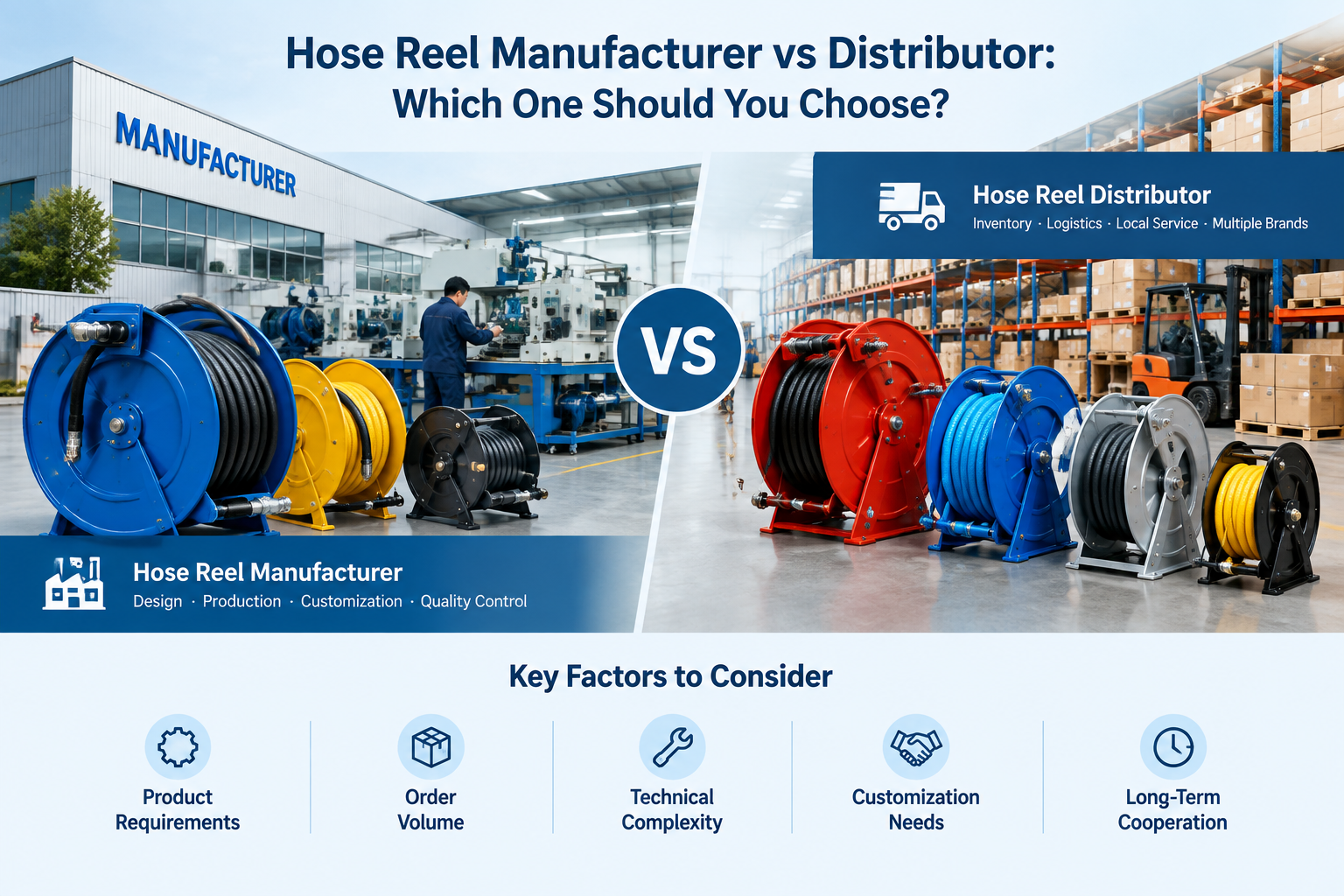
Hose Reel Manufacturer vs Distributor: Which One Should You Choose?
September 30, 2026 | Industrial Hose Reels
When purchasing industrial hose reels, many buyers face an important decision: should they work directly with a hose reel manufacturer or purchase through a distributor?
Both options can provide access to hose reel products, but they serve different roles in the supply chain. A manufacturer focuses on product design, production, customization, and quality control, while a distributor mainly connects customers with available products from different brands.
The right choice depends on factors such as product requirements, customization needs, order volume, technical support, and long-term cooperation goals.
This guide explains the key differences between hose reel manufacturers and distributors to help buyers make a more informed purchasing decision.
1. What Is a Hose Reel Manufacturer?
A hose reel manufacturer is a company that designs and produces hose reels directly through its own manufacturing facilities.
Manufacturers are responsible for the complete production process, including product design, material selection, component manufacturing, assembly, testing, and quality inspection.
An industrial hose reel manufacturer usually provides different types of hose reels for various applications, including:
- Spring-driven hose reels
- Manual hose reels
- Motor-driven hose reels
- Hydraulic hose reels
- Air and water hose reels
- Cable reels
Because manufacturers control the production process, they can offer more flexibility in product specifications, customization, and engineering support.
For industrial buyers with specific application requirements, working directly with a manufacturer provides better communication throughout the product development and production process.
2. What Is a Hose Reel Distributor?
A hose reel distributor is a company that purchases products from manufacturers and supplies them to end users, contractors, or businesses.
Unlike manufacturers, distributors generally do not produce hose reels themselves. Their main role is to manage product availability, sales, logistics, and customer service within a specific market.
Distributors often provide advantages such as:
- Local inventory
- Faster delivery
- Smaller order quantities
- Regional technical support
- Multiple product options from different brands
For customers who need standard hose reels without customization requirements, distributors can provide a convenient purchasing channel.
However, because distributors are not directly involved in manufacturing, their ability to modify product designs or provide production-level technical solutions may be limited.
3. Key Differences Between Hose Reel Manufacturers and Distributors
The main difference between a hose reel manufacturer and a distributor is their role in the supply chain.
| Hose Reel Manufacturer | Hose Reel Distributor | |
|---|---|---|
| Production | Designs and manufactures products directly | Purchases products from manufacturers |
| Customization | Provides customized solutions based on requirements | Usually offers standard products |
| Product Knowledge | Deep understanding of product structure and manufacturing | Focuses on product supply and sales |
| Pricing | Direct factory pricing for larger projects | May include additional supply chain costs |
| Technical Support | Provides engineering and production support | Provides product selection and service support |
| Order Quantity | Suitable for bulk and OEM projects | Suitable for smaller purchases |
| Product Availability | Produced according to order requirements | Usually maintains inventory |
4. When Should You Choose a Hose Reel Manufacturer?
Direct cooperation with a hose reel manufacturer is often suitable for companies that require customized products, larger quantities, or long-term supply partnerships.
4.1 Custom Hose Reel Requirements
Industrial applications often have different requirements for hose length, working pressure, materials, installation methods, and drive systems.
A manufacturer can adjust product specifications based on actual operating conditions, such as:
- Hose capacity
- Reel structure
- Mounting method
- Material selection
- Connection configuration
- Drive system
For example, applications involving hydraulic systems, harsh environments, or special installation conditions may require customized hose reel solutions rather than standard products.
4.2 Large Volume Orders
For distributors, contractors, and industrial companies requiring multiple hose reels, purchasing directly from a manufacturer can simplify the supply chain.
Manufacturers can provide:
- Stable production capacity
- Consistent product quality
- Batch production support
- Long-term supply planning
Direct communication with the production team also helps ensure product specifications remain consistent across different orders.
4.3 Technical Support and Product Development
Manufacturers have direct knowledge of product structures, materials, and production processes.
They can provide technical support related to:
- Hose reel configuration
- Pressure requirements
- Material compatibility
- Application conditions
- Installation solutions
This is especially important for industrial applications where hose reels must operate under high pressure, frequent use, or demanding environments.
5. When Should You Choose a Hose Reel Distributor?
A distributor can be a suitable option when customers prioritize convenience, local availability, or smaller purchase quantities.
5.1 Small Quantity Purchases
For customers who only need a limited number of hose reels, distributors can provide easier access without requiring large production orders.
They often keep standard models in stock, which can reduce waiting time for replacement or urgent projects.
5.2 Need for Local Service
Distributors usually operate closer to end users and may provide local support, including:
- Faster shipping
- Local communication
- Product assistance
- After-sales service
For businesses that value quick response and regional support, distributors can provide practical advantages.
5.3 Comparing Multiple Brands
Since distributors may represent multiple manufacturers, they can offer different product options in one place.
This allows buyers to compare:
- Product specifications
- Prices
- Availability
- Delivery schedules
For standard purchasing needs, this can make the sourcing process easier.
6. How to Choose Between a Hose Reel Manufacturer and Distributor?
There is no universal answer here. The right call depends on what you are buying, how much you need, how complex the application is, and how long you plan to work with the supplier. Below are the four factors that matter most.
6.1 Product Requirements
Start with the product itself. If your application can be handled by a standard hose reel with common specifications, a distributor is usually the quicker route. You get a catalog, a price, and a delivery date without much back-and-forth.
But if the reel needs to fit specific dimensions, handle a particular medium, meet a higher pressure rating, or work in an unusual environment, the conversation changes. A manufacturer can adjust the design rather than asking you to work around what is already on the shelf.
A simple way to judge: if you find yourself saying “I wish this model had…” then you probably need a manufacturer.
6.2 Purchase Volume
Order quantity affects both price and priority.
Large projects — multiple units, phased delivery, or OEM production — generally favor going direct. Manufacturers can plan production around your schedule, hold specifications steady across batches, and offer factory pricing that distributors cannot match once their margin is added.
For smaller purchases, the math flips. A distributor’s stock means you avoid minimum order quantities, long lead times, and the administrative overhead of dealing with a factory directly. If you need two reels next week, a distributor is almost always the better option.
Mid-sized orders are worth comparing on both sides. Ask each for a quote with the same specifications and delivery terms, then weigh the total cost rather than just the unit price.
6.3 Technical Complexity
Some applications are straightforward. Others are not.
Hydraulic systems, chemical transfer, heavy-duty equipment, and continuous-operation setups all involve variables that are easy to get wrong — pressure spikes, seal compatibility, duty cycles, mounting stress. In these cases, the ability to talk directly to someone who understands the internal structure of the reel is worth a lot.
A manufacturer can walk through the technical requirements with you and confirm the configuration actually matches the application. A distributor can help with selection, but when the questions get deep, they usually have to relay them upstream — which slows things down and can introduce misunderstandings.
The rule of thumb: the more technically demanding the application, the more you benefit from going direct.
6.4 Long-Term Cooperation
Think beyond the current order. If you expect to need ongoing supply, product modifications, or new variants down the road, a direct relationship with a manufacturer tends to pay off. Communication improves over time, specifications stay consistent, and future projects get easier to support.
That said, a long-term relationship is not free. It takes effort to maintain, and it only makes sense if your volume and needs justify it. For occasional or one-off purchases, a distributor relationship is lighter and more practical.
Some buyers end up using both: standard replacements through a distributor, custom or high-volume items through the manufacturer. That is a perfectly reasonable setup.
In Summary
Both hose reel manufacturers and distributors play important roles in the industrial supply chain.
Distributors provide convenient access, local inventory, and flexible purchasing options for standard products. Manufacturers provide direct production capability, customization options, and deeper technical support for complex applications.
When choosing a supply partner, buyers should consider product requirements, order volume, customization needs, technical complexity, and long-term cooperation goals.
Selecting the right purchasing channel helps ensure that the hose reel solution matches the application requirements and provides reliable performance throughout its service life.
FAQs
Related Posts
How to Choose a Large Capacity Hose Reel for Heavy-Duty…
July 13, 2026
Chemical Hose Reels: Safety & Material Guide
July 20, 2026