DEF Compatible Hose Reels: What Specifications Can’t Be Ignored?
October 10, 2026 | Industrial Hose Reels
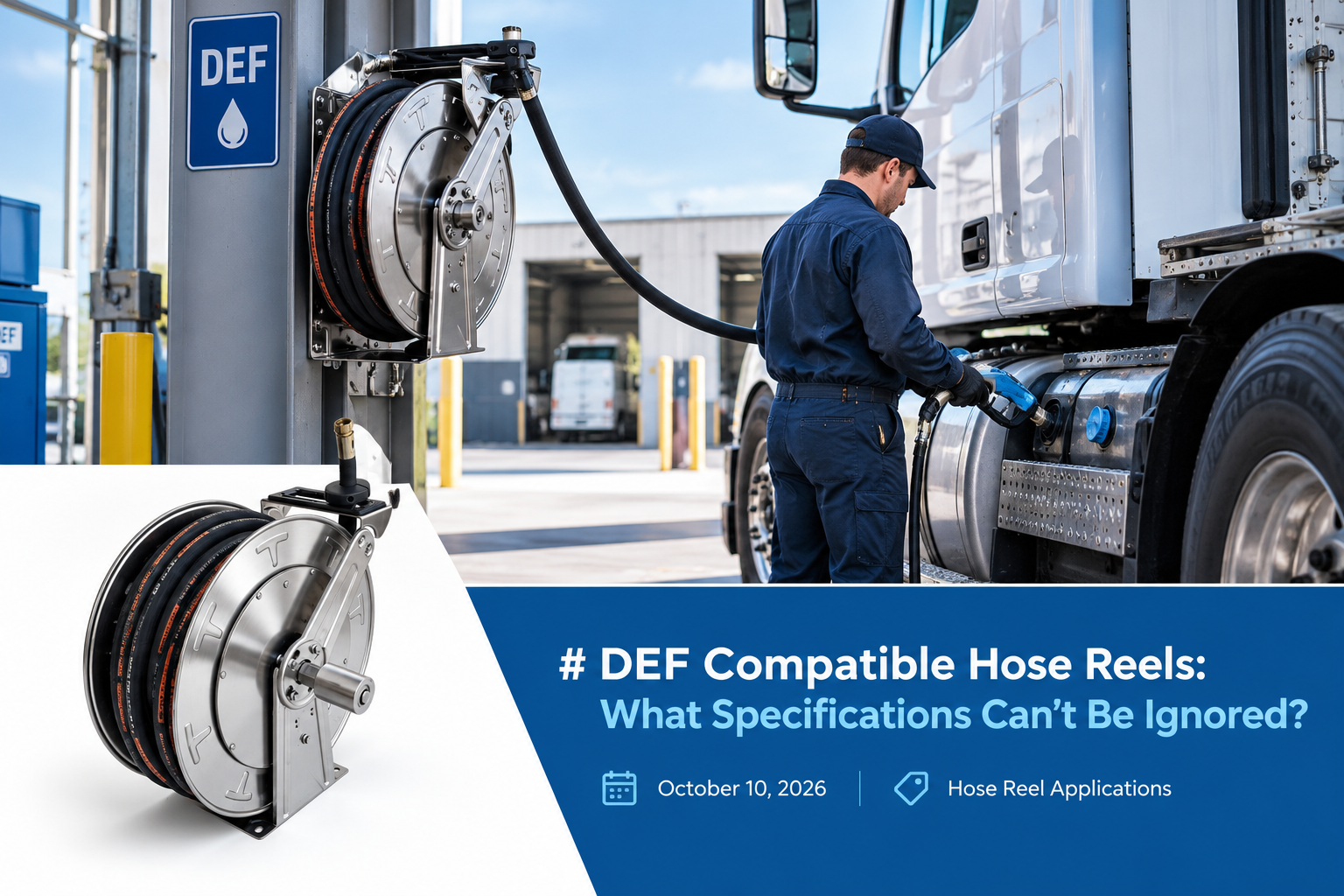
DEF compatible hose reels are widely used in truck maintenance facilities, fleet service centers, commercial vehicle workshops, and fluid dispensing stations to transfer Diesel Exhaust Fluid (DEF).
DEF is an aqueous solution consisting of 32.5% high-purity urea and 67.5% deionized water. It is used in the selective catalytic reduction (SCR) systems of diesel engines to reduce nitrogen oxide emissions. Since DEF must maintain its specified quality during storage, transportation, and dispensing, all components that come into contact with the fluid need to be carefully evaluated.
When selecting an industrial hose reel for DEF dispensing, buyers should focus on material compatibility, hose specifications, working pressure, flow requirements, swivel joints, fittings, and cleanliness. Understanding these specifications helps prevent compatibility issues and ensures that the complete dispensing system meets its operating requirements.
Why Is DEF Compatibility Important in Hose Reel Systems?
Hose reels designed for engine oil, fuel, or general industrial fluids may not be suitable for DEF. Different fluids interact differently with hose liners, seals, metals, and other components. A material that performs well in one application is not necessarily suitable for another.
Contamination is another important concern. DEF must maintain its specified quality to function properly in SCR systems. Unsuitable materials or residues from previously handled fluids may affect its purity. Therefore, DEF dispensing equipment should use components confirmed to be suitable for this application.
ISO 22241-3 addresses the handling, transportation, and storage of DEF, including material compatibility and cleanliness requirements for surfaces in contact with the fluid. These considerations are particularly relevant when evaluating the wetted components of DEF hose reels.
6 Key Specifications to Check Before Buying a DEF Hose Reel
1. Material Compatibility of Fluid-Contact Components
Material compatibility is the first specification to verify. Components that come into contact with DEF include the hose liner, the internal passages of the swivel joint, seals, gaskets, valves, and fittings.
Specially formulated EPDM (ethylene propylene diene monomer) is commonly used in DEF dispensing hoses. Suitable formulations can provide compatibility with DEF while minimizing unwanted substance release. Certain plastics and stainless steels are also used in DEF systems, but their suitability depends on the specific material grade, formulation, operating conditions, and component design.
Before purchasing, confirm that all wetted components are suitable for DEF to minimize the risk of material degradation and fluid contamination. If the hose reel will be integrated into an existing dispensing system, check the compatibility of the entire fluid path, including adapters and downstream equipment.
2. Hose Inner Diameter and Length
Hose inner diameter: The hose diameter affects flow capacity and pressure loss. An undersized hose may restrict fluid delivery, especially when the hose is long or the required flow rate is high. The appropriate diameter should be determined by the pump performance, system layout, and target flow rate.
Hose length: The hose should reach the intended dispensing point without excessive tension or unnecessary excess length. A hose that is too short limits the operating range, while an unnecessarily long hose may increase pressure loss and require a reel with greater capacity.
The reel drum must also accommodate the selected hose without exceeding its rated capacity. Check the minimum bending radius specified by the hose manufacturer, particularly when the hose is fully wound or passes through the reel guide.
3. Working Pressure and Flow Rate
Pressure and flow requirements must be evaluated together. Pumps, hoses, reels, swivel joints, fittings, and dispensing equipment all have operating limits that determine the capabilities of the complete system.
First, identify the maximum operating pressure and required dispensing flow rate. Then confirm that every pressure-bearing component can withstand the expected operating conditions. The system’s allowable working pressure cannot exceed the limit of its lowest-rated component.
Also, distinguish between the hose’s working pressure and burst pressure. Burst pressure must not be treated as a normal operating target. Pressure fluctuations and transient loads that may occur when valves close or dispensing equipment operates should also be considered.
Flow rate depends on more than the nominal connection size of the hose reel. Hose diameter, hose length, pump performance, and flow resistance in valves and fittings all affect actual delivery.
If the application requires rapid DEF dispensing for commercial vehicles, evaluate the complete system against the target flow rate. Selecting a DEF-compatible hose reel based only on its maximum working pressure may result in a system that meets pressure requirements but cannot achieve the expected dispensing speed.
4. Fittings and Dispensing Connections
The inlet, outlet, hose-end connectors, valves, and dispensing nozzle must match the existing DEF dispensing system. Before purchasing, confirm the connection type, thread standard, nominal size, and sealing method. For example, NPT and BSPP use different thread designs and sealing arrangements and should not be treated as interchangeable.
All fittings and sealing materials must also be suitable for DEF to minimize leakage and contamination risks. If a standardized vehicle dispensing interface is required, consult the relevant requirements, including applicable provisions of ISO 22241-4.
Checking the existing equipment’s connection specifications before ordering helps prevent installation problems and unnecessary adapter costs.
5. Cleanliness, Corrosion Resistance, and Operating Environment
DEF compatibility involves both material selection and contamination control. Appropriate measures should be taken during the assembly, handling, and storage of DEF-compatible hose reels to prevent unsuitable residues or foreign materials from contaminating the fluid path.
Ask the supplier how cleanliness is maintained during manufacturing and assembly, and confirm whether the reel has previously handled other fluids. If it has, determine whether it can be appropriately prepared for DEF service using a suitable cleaning procedure.
Environmental conditions should also be evaluated. For outdoor installations, the reel’s external frame and mounting hardware may require adequate corrosion resistance.
Temperature is another important factor. DEF freezes at approximately -11°C (12°F), so installations exposed to freezing conditions require appropriate storage and operating plans. Hose materials, seals, and reel components must also remain within their specified temperature ranges.
Before finalizing the configuration, evaluate the expected ambient temperature, moisture exposure, installation location, and equipment usage frequency.
Matching DEF Hose Reel Specifications to Different Applications
The appropriate configuration depends on how and where DEF is dispensed. The following table highlights the main specifications to consider in common applications.
| Application | Key Specifications |
|---|---|
| Truck and fleet maintenance | Hose reach, reel mounting, connection compatibility, and ease of operation |
| Commercial vehicle workshops | Hose diameter, dispensing flow rate, working pressure, and swivel joint performance |
| Fixed DEF dispensing stations | System pressure, inlet and outlet connections, installation layout, and cleanliness control |
| Outdoor fleet service areas | Ambient temperature, external corrosion resistance, hose protection, and mounting stability |
Regardless of the application, material compatibility must be verified, and pressure ratings must meet system requirements. These priorities help buyers identify the specifications that require particular attention during system planning.
Common Mistakes When Selecting a DEF Hose Reel
Several purchasing mistakes can result in an unsuitable installation.
Judging compatibility by appearance: A stainless steel housing does not prove that the internal hose, seals, swivel joint, and fittings are suitable for DEF. The entire fluid-contact path must be verified.
Checking component ratings separately: A hose and reel may each meet their individual requirements, but the assembled system must still operate within the limits of every component. Confirm the pressure and flow requirements of the complete installation.
Ignoring contamination control: Material compatibility alone does not guarantee fluid cleanliness. Consider previous fluid exposure, assembly methods, storage conditions, and preparation procedures before the equipment is put into service.
Avoiding these mistakes during procurement is generally easier than identifying and resolving compatibility issues after installation.
What Should You Confirm with a DEF Hose Reel Manufacturer?
Before requesting a quotation, define the basic operating requirements and ask the supplier to confirm that the proposed configuration meets them.
- Are all materials in contact with DEF, including the hose liner, swivel joint, seals, and fittings, confirmed to be suitable?
- What are the hose’s inner diameter, length, working pressure, temperature range, and minimum bending radius?
- What are the pressure rating and flow limitations of the complete hose reel assembly?
- Are the inlet and outlet connections compatible with the existing dispensing equipment?
- How are cleanliness and contamination risks controlled during assembly, storage, and delivery?
- Can the reel be configured to suit the required mounting position, hose reach, and operating environment?
Where available, request technical datasheets or written confirmation of material compatibility. If the application requires compliance with specific standards or certifications, verify the exact scope of the relevant documentation.
When sourcing a customized DEF dispensing solution, experienced hose reel manufacturers can help evaluate hose capacity, connection requirements, drive methods, and mounting configurations based on the intended application. Buyers should still request specific documentation confirming material compatibility and operating limits before placing an order.
Conclusion
Choosing a DEF-compatible hose reel requires more than checking hose length and pressure ratings. Material compatibility, hose construction, swivel joints, fittings, and cleanliness all affect the suitability of the complete dispensing system.
Verifying these specifications before purchasing helps reduce compatibility risks and ensures that the selected hose reel meets the actual requirements of the DEF dispensing application.
Related Posts
Why Spring Fatigue Happens in Retractable Hose Reels
June 10, 2026