Large Frame Hose Reel: Structure and Main Characteristics
November 5, 2026 | Industrial Hose Reels
Introduction
Industrial hose reels usually need to handle hoses with long length, heavy weight or large diameter. These hoses are widely used for conveying water, oil, chemicals, compressed air and other fluids in manufacturing plants, construction sites, service vehicles and processing facilities. With the increase of hose size and weight, the reel not only needs a larger reel, but also its supporting structure must have sufficient strength and stability to meet the daily use requirements.
The large frame hose reel adopts reinforced frame to support the drum, central shaft, drive system and other components. The frame helps to disperse the overall weight of hoses and reels, maintain the correct alignment of rotating components, and provide stable support for equipment installation. Frame design will affect the bearing capacity, operation stability, installation mode and maintenance convenience of the reel.
Understanding the main structure and function of large frame hose reel is helpful for buyers to choose the right products according to hose specifications and actual working environment.
1. What Is a Large Frame Hose Reel?
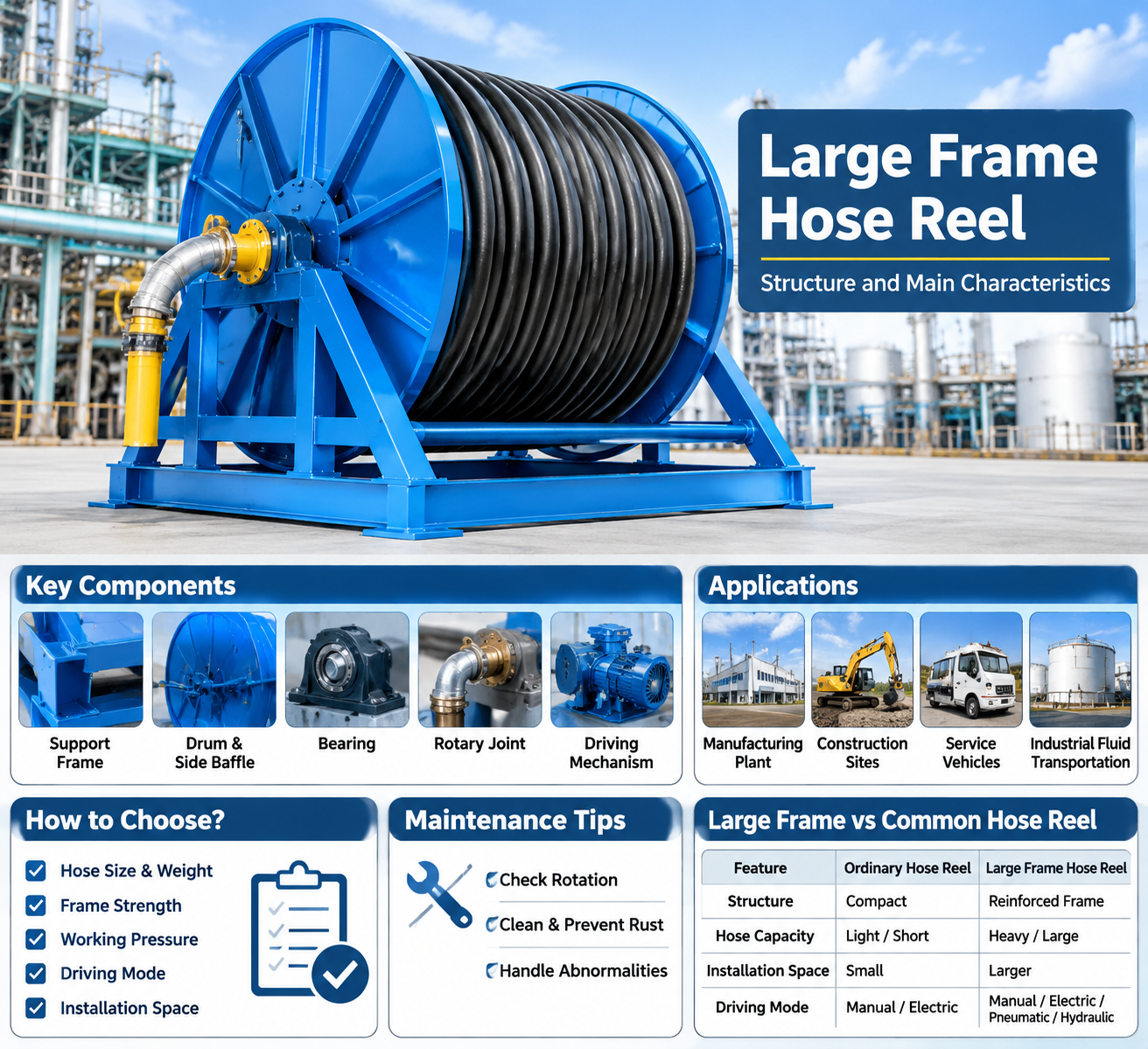
Large frame hose reel is an industrial hose reel with large or reinforced support structure, which is mainly used to accommodate larger reels and heavier hoses, or to meet more complicated industrial operation requirements.
Compared with ordinary hose reels, this kind of products usually have a wider or stronger support structure, and are equipped with corresponding reels, central shafts and installation components according to actual loads. Its specific structure will be different due to hose specifications, driving methods and installation requirements.
The large frame hose reel can be wound in many ways, including manual, spring-driven, electric, pneumatic and hydraulic drive. The specific configuration depends on the weight, length, frequency of use, available power and installation space of the hose.
It should be noted that a large frame size does not mean that the hose capacity must be larger. The actual capacity of the reel also depends on the size of the reel, the outer diameter of the hose, the winding method, and whether there is enough space to avoid the hose from being squeezed or damaged during the winding process.
2. Main Structural Components of Large Frame Hose Reel
The running performance of large frame hose reel depends on the cooperation between the main components. Each component has a different function, supporting the hose together and ensuring the stable operation of the reel.
2.1 Support Frame and Base
The frame mainly bears the weight of the drum, hose, central shaft and driving parts. During the operation of the reel, it also needs to bear the force generated when the hose is pulled out and retracted.
Reinforced steel frames are usually used in industrial applications because steel has good structural strength and can support heavy equipment components. The base is responsible for fixing the reel on the ground, vehicles, equipment or installation platform, and its size and installation hole position need to match the actual installation position.
2.2 Drum and Side Baffle
The reel is used for winding and storing hoses, and its size directly determines how many hoses the reel can hold. The width, diameter and effective winding space of the drum must match the outer diameter and required length of the hose.
Side baffles are located on both sides of the drum, which are mainly used to limit the winding range of the hose and prevent the hose from slipping off the drum. At the same time, the side baffle is also helpful to improve the overall structural strength of the rotating assembly.
2.3 Central Shaft and Bearing
The central shaft is used to support the rotating drum and bear the force generated in the process of hose retraction. It must have enough strength to bear the overall weight of the drum and the filled hose.
The bearing is installed in the rotating assembly, so that the drum can rotate smoothly around the central axis. If the size of the central shaft is insufficient, or the bearing is not suitable for the actual load and working environment, the reel may have problems such as excessive vibration, uneven rotation or premature wear of components.
2.4 Rotary Joint and Fluid Connection
The rotary joint is responsible for connecting the fixed supply pipeline with the rotary drum, which can keep the normal transmission of fluid while the drum rotates.
The rotary joint must match the conveying medium, working pressure, flow demand and connection size. For the application of conveying chemicals, corrosive liquids or other special media, special attention should be paid to the compatibility of materials.
Proper rotary joint is helpful to reduce the torsion of hose during reel operation. However, its pressure and flow parameters always need to meet the actual work requirements.
2.5 Driving and Winding Mechanism
The winding mechanism determines how the hose is pulled out and retracted. Large frame hose reels can be driven in different ways, and the working principles of various mechanisms are different:
-
Manual drive: the drum is driven to rotate by hand handle, which is relatively simple in structure and does not need extra power.
-
Spring drive: the mechanical energy stored and released by the spring is used to drive the drum to rotate and realize the automatic recovery of the hose.
-
Electric drive: the rotating power is provided by a motor, usually with corresponding control devices.
-
Pneumatic drive: compressed air is used to drive the reel to run, which is suitable for the working environment with gas source on site.
-
Hydraulic drive: Power is provided by hydraulic system, which is usually used in conjunction with heavy equipment or vehicle-mounted systems.
The power source, control mode and structural configuration of different driving mechanisms are different, and the specific selection needs to be combined with hose specifications and actual operation requirements.
3. Application Scenarios of Large Frame Hose Reel
The large frame hose reel is mainly used in the working environment with long hose length, heavy weight or large volume. According to the different conveying medium, driving mode and installation form, its application scope is also different.
3.1 Manufacturing Plant
Manufacturing plants need to use hoses for compressed air transportation, water supply, equipment lubrication, equipment cleaning and fluid transportation. Large frame hose reels can help manage long hoses in production lines and equipment maintenance areas.
For the working environment where the hose is used frequently or needs to be retracted frequently, the stable frame structure can provide reliable support for the reel and reduce the problems caused by insufficient support when the equipment is running.
3.2 Construction Sites and Mines
Construction and mining operations may require the use of large-diameter hoses for water supply, dust suppression, drainage and other fluid transportation. These hoses are usually heavy, and it is difficult to carry and arrange them manually.
Large frame hose reel can provide centralized storage and collection methods for such hoses, and reduce the situation that hoses are scattered in the working area. For applications where mobile equipment or job sites often change, reels also need to adapt to complex working conditions on site.
3.3 Service Vehicles and Mobile Equipment
Service vehicles and special engineering vehicles are usually equipped with hoses for lubrication, hydraulic maintenance, cleaning or fluid transportation. The reel can be installed in the equipment cabin inside the vehicle, on the platform of the vehicle, or near other equipment.
In these applications, the large frame reel can centrally manage the vehicle hose, which is convenient for the operator to pull out and withdraw the hose according to the operation needs. For the equipment that needs to move with the vehicle, the structure suitable for vehicle installation should also be selected.
3.4 Industrial Fluid Transportation Area
Oil terminals, processing facilities and other fluid handling places may need to use large hose reels to manage fluid delivery hoses. Reel can be used to arrange hoses in different conveying links, which is convenient for equipment operation and field management.
Due to the differences in media and working conditions transported in different places, reels need to be configured according to specific fluid transportation systems to meet the corresponding use requirements.
4. How to Choose the Appropriate Large Frame Hose Reel?
When selecting a large frame hose reel, we should not only look at the external dimensions of the frame or the overall appearance of the reel. Large frame is mainly used to support the load of drum, central shaft and hose, but the larger frame size does not mean that the hose capacity must be larger. The actual selection also needs to be judged in combination with hose specifications, bearing structure and installation conditions.
4.1 Hose Diameter, Length and Total Weight
Firstly, the type of hose to be stored should be determined, including the inner diameter, outer diameter, length and weight per unit length of hose. For large industrial hoses, it is also necessary to calculate the weight of fittings such as joints and connecting fittings.
The outer diameter of the hose determines how much winding space the drum needs to reserve, and the length of the hose directly affects the overall weight and occupied space after winding. If it is necessary to accommodate long, thick or heavy hoses, it should be confirmed whether the drum width, the diameter of the side baffle and the internal winding space are sufficient.
In addition, the weight generated by hoses and accessories will be transferred to the drum, central shaft, bearing and frame structure. Therefore, it is not only necessary to confirm whether the reel can hold the hose, but also to verify whether the whole structure can bear the corresponding load.
4.2 Frame Structure and Bearing Capacity
The main feature of large frame hose reel is that it adopts a large supporting frame to provide stable support for the reel and its internal components. When selecting the type, we should focus on checking the frame material, the structure of columns and beams, the design of the base and the strength of the connection parts.
For the equipment that needs to accommodate heavy hose, special attention should be paid to the support mode at both ends of the central shaft and whether the connection between the bearing and the frame can bear the weight generated by winding the hose. The frame should also have sufficient structural stability to avoid obvious shaking or deformation in the process of hose retraction.
If the reel is installed on a truck, trailer or other mobile equipment, it is also necessary to consider the vibration and impact generated when the vehicle is running. At this time, the size of the base, the position of the mounting hole and the fixing method all need to match the installation structure of the equipment.
4.3 Compatibility Between Working Pressure and Conveying Medium
Large frame hose reels can be used to store different types of industrial hoses, but the specific scope of application depends on the configuration of hoses, rotary joints, connecting fittings and other fluid components. The corresponding hoses and rotary joints shall be selected according to the actual working pressure, and the pressure grade of each connecting part shall be confirmed to meet the system requirements.
For corrosive medium, high-temperature fluid or outdoor use environment, it is also necessary to consider the material selection of liquid-contacting parts and external structures. For example, the materials used for frames and drums should be able to adapt to the humidity, corrosion and temperature conditions on site, so as to avoid the service life of equipment being affected by material mismatch.
4.4 Driving Mode and Hose Retraction Requirements
The driving mode of large frame hose reel should be determined according to the hose weight, winding frequency and field dynamic conditions.
For shorter, lighter and less frequently used hoses, manually driving the hose reel can usually meet the demand; For long, heavy hoses or hoses that need to be retracted frequently, electric, pneumatic or hydraulic drive hose reels can be considered.
If the spring is used to drive the hose reel, it is necessary to confirm whether the recovery capacity of the spring mechanism matches the length and weight of the hose. The power source, control mode and installation conditions of driving mechanism should also be considered when selecting the type.
4.5 Installation Space and Hose Inlet and Outlet Direction
Large frame hose reel usually has a large overall size, so the available space around the equipment should be measured before installation, including the width, height and depth of the frame, as well as the space needed for reel rotation and hose collection.
You also need to consider the position and direction of the hose outlet. For reels installed beside vehicles, equipment platforms or production lines, ensure that the hoses can be smoothly pulled out from the reels, and arranged evenly when they are retracted, so as to avoid friction with the frame edge, surrounding equipment or other pipelines.
If the reel needs to be installed in a high position or a narrow area on site, it should also be confirmed in advance whether it is convenient for operation, inspection and maintenance. Although the large-scale frame structure can provide stable support, the unreasonable installation position may still affect the normal retraction of hoses and equipment maintenance.
5. Daily Maintenance of Large Frame Hose Reel
Large frame hose reel bears hose load for a long time and may be affected by frequent operation, dust, moisture and outdoor environment. Regular maintenance helps to keep the equipment running normally.
5.1 Check the Running Status of Drum
Regularly check whether the drum rotates smoothly, and whether there is jamming, deviation or abnormal noise. At the same time, pay attention to whether the hose is evenly wound to avoid long-term concentration on one side of the drum, resulting in uneven load distribution.
5.2 Clean Reels and Handle Rust
Remove the dust, silt and oil stain on the surface of frame and drum in time. For outdoor reels, it is also necessary to check whether the surface coating falls off, and deal with the corrosion in time to reduce the impact of corrosion on the structure.
5.3 Timely Handle Abnormal Operation
If there are problems such as drum rotation difficulty, equipment vibration or uneven winding of hose, stop operation and check the reasons. For problems such as mechanical parts wear, structural deformation or welding position cracking, professional maintenance should be arranged in time to prevent the equipment from continuing to operate under abnormal conditions.
6. What Is the Difference Between a Large Frame Hose Reel and a Common Hose Reel?
The main difference between large frame hose reel and ordinary hose reel lies in the size and strength of supporting structure, as well as the matching hose capacity and equipment configuration.
Ordinary hose reels can usually meet the needs of shorter and lighter hoses and general use frequency. The large frame hose reel is more suitable for hose applications that require stronger structural support or larger reel configuration.
| Comparison Project | Ordinary Hose Reel | Large Frame Hose Reel |
|---|---|---|
| Support Structures | are usually more compact | using reinforced or larger support frames. |
| Hose Requirements | are usually applicable to lighter or shorter hoses. | According to the actual capacity, heavier or larger hose components can be accommodated. |
| Installation Requirements | apply to smaller installation spaces, | which usually require larger installation spaces and sufficient support capacity. |
| The Driving Mode | is manual, spring-driven or electric. | According to the model, manual, spring-driven, electric, pneumatic or hydraulic driving can be adopted. |
| Typical Application | Common workshop and equipment supporting application | management scenarios of industry, mobile equipment and heavy hoses. |
The large frame does not mean that the reel is necessarily suitable for all heavy-duty operations. The drum capacity, central shaft, bearing, rotary joint, drive system and installation structure must match the actual work requirements.
Conclusion
Large frame hose reel is not only a kind of hose storage equipment, but also its structural configuration is related to the stability of hose retraction, equipment bearing and daily use.
Choosing a suitable model requires a full understanding of hose size, overall load, working environment, driving requirements and installation space. By comprehensively evaluating the structure of the whole reel, rather than just focusing on the frame size, the purchaser can choose products that are more in line with the equipment configuration and actual operation requirements.
For special industrial applications, it is recommended to confirm the product specifications, rated load and installation requirements with the manufacturer before ordering, so as to reduce problems such as capacity mismatch or improper installation.
Related Posts
How to Choose a Vacuum Hose Reel for Industrial Application
October 13, 2026
High Pressure Hose Reel vs Low Pressure Hose Reel: The…
June 18, 2026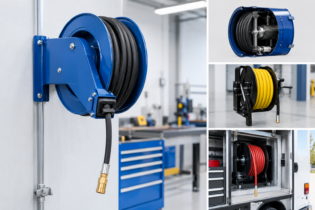
Compact Hose Reel: How to Balance Size and Hose Capacity
October 19, 2026