How to Operate a Fire Hose Reel System: A Best Practice Guide for Safe and Efficient Fire Protection
June 16, 2026 | Industrial Hose Reels
Introduction
A Fire Hose Reel System is an essential fire protection infrastructure widely installed in commercial buildings, industrial facilities, and public spaces. Its primary function is to provide a continuous and stable water supply during the early stage of a fire, helping to control fires caused by common combustible materials such as paper, wood, and textiles, and preventing further fire spread.
Unlike portable fire extinguishers, a Fire Hose Reel System is directly connected to the building’s internal water supply network. As long as the system pressure is stable, it can deliver continuous water without interruption. Therefore, it is considered one of the most reliable first-response devices within a building’s fire protection layout.
Proper Fire Hose Reel Operation is not only about following step-by-step procedures but also involves understanding equipment condition, system performance, and real-life fire scenarios. For building managers, safety officers, and general users, mastering correct Fire Hose Reel Operation is essential for improving overall fire safety.
Working Principle of a Fire Hose Reel System
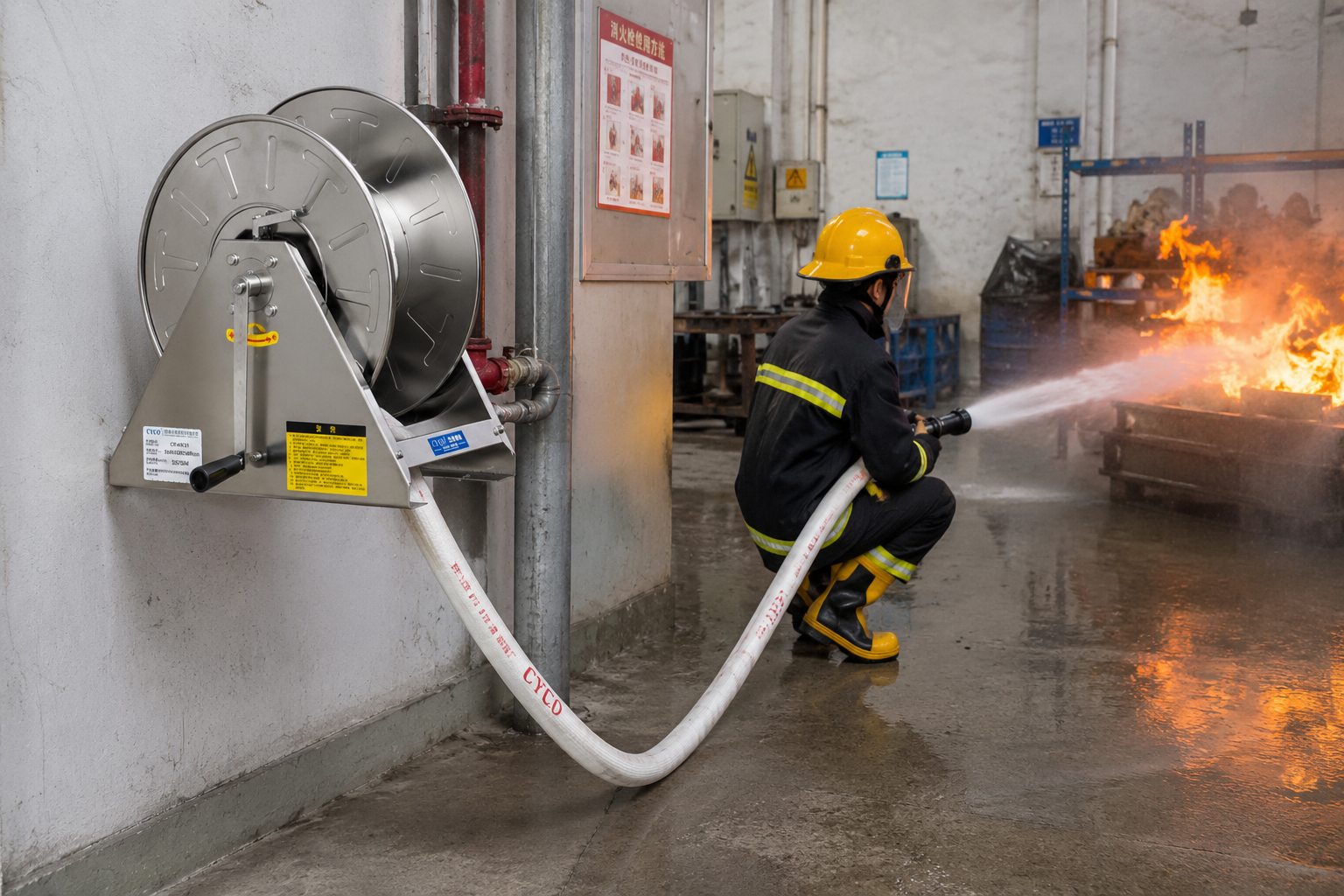
To properly perform Fire Hose Reel Operation, it is important to understand how the Fire Hose Reel System works. A typical Fire Hose Reel System consists of a reel drum, fire hose, nozzle, inlet valve, and connecting pipework. Its core principle is “constant pressure water supply + manual flow control.”
In normal conditions, the hose is neatly wound around the reel and connected to the building’s fire water supply through a valve. When a fire occurs, the operator initiates Fire Hose Reel Operation by pulling out the hose, opening the valve, and allowing water to flow from the supply system through the hose and out of the nozzle in a controlled stream.
The advantages of a Fire Hose Reel System include:
First, it provides a continuous water supply, allowing longer operation time compared to fire extinguishers. Second, the hose length is usually between 20 and 30 meters, enabling coverage of a relatively large fire area. Third, the nozzle typically allows adjustable spray patterns, switching between jet and spray modes to suit different fire conditions.
Modern Fire Hose Reel Systems use semi-rigid or high-strength rubber hoses that offer pressure resistance, heat resistance, and aging resistance, ensuring reliable performance during emergency Fire Hose Reel Operation.
A representative product in this category is the Manual Stainless Steel Fire Hose Reel CY-HS18, a stainless steel model designed for fire trucks, industrial fire protection systems, and marine applications where durability and corrosion resistance are critical. Similar considerations also apply to Marine Hose Reel applications.
How to Perform Fire Hose Reel Operation
Knowing how to perform correct Fire Hose Reel Operation is critical for effective early-stage fire suppression. Although designs may vary slightly depending on the building, the standard operating procedure for any Fire Hose Reel System remains largely the same.
1. Identify the Fire Source and Ensure Safety Distance
In the early stage of a fire, first assess whether the fire is small and controllable. If so, the Fire Hose Reel System may be used for initial suppression. The operator should stand upwind and maintain a safe distance from the fire to avoid smoke and heat exposure.
Important Safety Notice: Before starting Fire Hose Reel Operation, always identify the type of fire involved. Fire Hose Reel Systems are primarily designed for Class A fires involving ordinary combustible materials such as paper, wood, and textiles. They should not be used on energized electrical equipment or flammable liquid fires, such as oil, fuel, or solvent fires, unless the system has been specifically certified for such applications and is equipped with appropriate electrical protection devices. Using water on unsuitable fire types may increase the risk of electric shock, fire spread, or personal injury.
2. Open the Fire Hose Reel Cabinet
The Fire Hose Reel System is usually installed inside a wall-mounted cabinet. Open the cabinet door fully and ensure it stays open without obstruction. Quickly check whether the hose and nozzle are in good condition—look for visible cracks, severe kinks, or signs of leakage. If any damage is found, do not use the reel and proceed with evacuation or alternative fire-fighting measures. Familiarizing yourself with the cabinet location during routine safety drills can save valuable time when performing Fire Hose Reel Operation in an actual emergency.
3. Pull Out the Hose Toward the Fire
To begin proper Fire Hose Reel Operation, grasp the nozzle assembly firmly and pull the hose out smoothly while walking backward toward the fire source. Allow the reel to rotate freely and avoid sharp bends or twisting that may cause kinks. Pull out sufficient length to reach the fire, but leave at least one loop of hose on the drum to prevent tension on the fixed pipe connection. Once extended, lay the hose flat on the ground and check for any kinks or loops. Straighten them out immediately, as kinks significantly reduce water flow and pressure and can compromise the entire Fire Hose Reel System’s performance.
Attention: Do not open the water valve until the hose is fully extended—opening it prematurely will fill the hose with water while it is still coiled, making it too heavy to pull and potentially causing dangerous hose whiplash. This is one of the most critical rules in Fire Hose Reel Operation.
4. Open the Water Supply Valve
Once the hose is fully extended, kink-free, and positioned correctly, locate the valve handle near the reel drum. Turn the handle fully counterclockwise (or as directed by the valve design) to open it completely—partial opening reduces water pressure and jet performance, undermining the effectiveness of the Fire Hose Reel System. As the valve opens, you will feel the hose stiffen due to water pressure; maintain a firm hold on the nozzle to manage this sudden surge. After opening, quickly check for any leaks around the hose connections. If significant leakage occurs, close the valve immediately and evacuate, as the Fire Hose Reel System is not functioning properly.
5. Operate the Nozzle for Firefighting
Hold the nozzle handle with one hand and support the hose behind the nozzle with the other hand to counteract the recoil force of water discharge during Fire Hose Reel Operation. While maintaining control, adjust the nozzle’s spray mode using the adjustment ring or head. For solid combustible materials, a straight jet stream is more effective. For spreading flames, a spray or mist mode helps reduce temperature and control fire spread.
Technique tip: Aim the jet at the base of the flames—where the fuel is burning—rather than at the flames themselves. Use a sweeping motion from side to side to cover the burning area efficiently.
6. Monitor and Adjust During Operation
Continuously adjust position and spray direction based on fire conditions to ensure the water stream targets the base of flame effectively.
If the fire shows signs of diminishing, continue applying water to hot spots to prevent re-ignition. If the fire does not show clear improvement within approximately 15 seconds of continuous discharge, close the valve, evacuate immediately, and call emergency services. Do not attempt to fight a growing fire alone.
It is important to note that a Fire Hose Reel System is designed for early-stage fire control only. If the fire grows rapidly, immediate evacuation and professional firefighting response are required.
How to Maintain a Fire Hose Reel System
To ensure a Fire Hose Reel System operates reliably when needed, regular maintenance and inspection are essential. Proper maintenance is as important as correct Fire Hose Reel Operation.
1. Regularly Check Water Pressure and Supply System: Since the Fire Hose Reel System depends on the building’s water supply, water pressure must be checked regularly to ensure stable performance during Fire Hose Reel Operation.
2. Inspect Hose Condition for Aging or Damage: For damaged or aging hoses, following proper replacement procedures is essential. Learn more about How to Replace the Hose on a Hose Reel to ensure safe installation and reliable operation.
3. Ensure Nozzle Flexibility: The nozzle must be tested regularly to ensure smooth switching between jet and spray modes for different fire scenarios, as this directly impacts Fire Hose Reel Operation effectiveness.
4. Check Reel Rotation: The reel should rotate smoothly without sticking or rusting. If resistance is detected, lubrication or repair is required to ensure smooth Fire Hose Reel Operation.
5. Conduct Functional Testing: Regular simulated operation is recommended to test the full Fire Hose Reel System, including valve opening, water pressure, and hose retraction performance, ensuring readiness at all times.
Conclusion
Fire Hose Reel Systems play a vital role in modern fire protection systems, particularly in containing fires during their initial stages. Mastering proper Fire Hose Reel Operation can significantly improve emergency response efficiency and minimize casualties and property damage.
From operating principles to procedural steps and maintenance requirements, every aspect of a Fire Hose Reel System directly impacts its reliability and effectiveness. Only through standardized Fire Hose Reel Operation, a clear understanding of usage limitations, and regular professional maintenance can this equipment be transformed from a mere “ornament” on the wall into a vital tool for saving lives in critical moments.
Related Posts

Chemical Hose Reels: Safety & Material Guide
July 20, 2026
Fuel Hose Reel Selection Guide for Safe Fueling Systems
June 22, 2026
Static Discharge Reels for Fuel Transfer: Safety Basics
October 14, 2026